Wilkie Collins’s The Woman in White is the sensation novel that made his name — a labyrinth of locked asylums, swapped identities, and legal terror disguised as courtship, first serialized in 1859 with a narrative trick that scandalized and thrilled Victorians. This guide covers the plot, the famous opening, and how the DodaBooks Annotated Edition turns its dizzying structure into something you can hold.
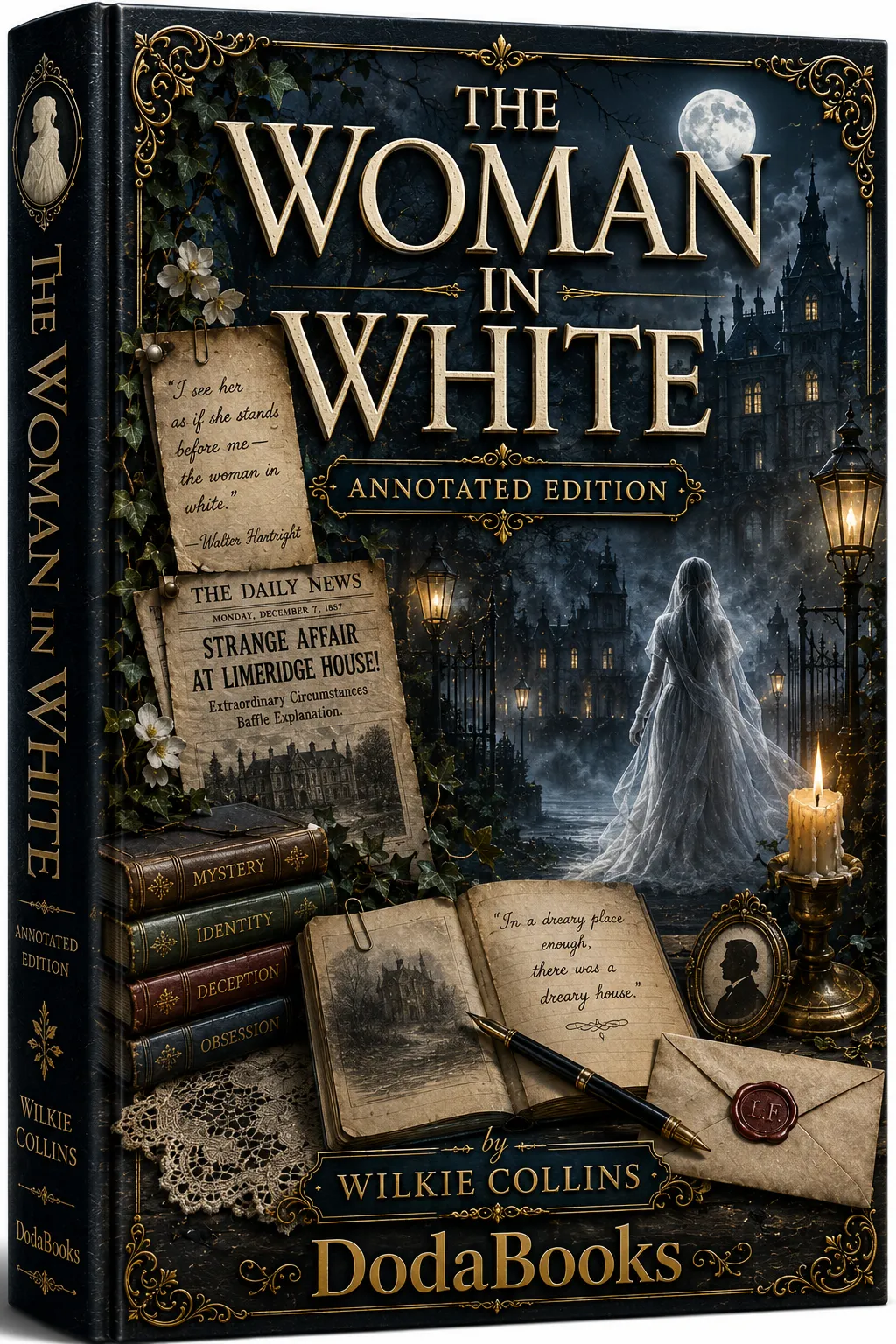
👗
The Woman in White
On a moonlit road, a young drawing master meets a woman in white who has escaped an asylum. That same night, his wealthy patron plots an inheritance fraud that will require a dead woman — and a living one to take her place.
| Author | Wilkie Collins |
| Published | 1859–60 (serialized) |
| Genre | Sensation fiction, mystery, gothic |
| Setting | Limmeridge, Blackwater Park, London |
| Best For | Mystery fans, Victorian readers, students |
| Reading Time | 10–12 hours |
👗 The Story
The novel opens on a road in Hampstead, where a young drawing master named Walter Hartright meets a woman dressed entirely in white who has just escaped from an asylum. She gives her name, Anne Catherick, and disappears. Hours later, Walter learns the woman seems to know a terrible secret about his new employer’s family — the fair, gentle Laura Fairlie, whom he has just begun to love.
Laura is engaged to Sir Percival Glyde, a baronet in debt who has married her for her fortune. And Sir Percival has a friend: Count Fosco, a corpulent, brilliant Italian mastermind. Between the two of them, they devise a scheme that takes the sensation novel’s central nightmare — the living woman imprisoned in an identity that is not hers — and turns it into a legal mechanism. Laura almost disappears into the asylum the woman in white escaped from, and the woman in white is buried under Laura’s name.
“There are, it is said, two secrets supposed to lie hidden in every man’s breast: his own, and that which the lawyer calls his client’s.”
🌀 The Narrative Experiment
Collins told the entire story through a chain of first-person narrators — the drawing master, the loyal housekeeper, the mad lawyer, the scheming count himself — each writing his or her own section. T. S. Eliot, among others, cited The Woman in White as one of the greatest novels of the English language precisely for this: the technique turned the reader into a jury, weighing twelve conflicting testimonies about the same crime.
That structure is also why it’s thrilling even after 160 years. Collins hides crucial facts inside each narrator’s competitiveness and vanity, and modern readers can be forgiven for missing them on a first pass. The note layer of the DodaBooks edition exists exactly to catch those moments. — to show how Collins plays fair while still going behind the reader’s back. The same technique powers his later detective novel, The Moonstone, whose fourteen narrators carry the mystery in their own blind spots.
🔍 The Annotated Edition
Annotation Cards
Visible, color-coded notes beside each narrative — read as you go.
Identity & the Law
Victorian marriage, property, and lunacy law behind the conspiracy.
Victorian Gender
What a woman's signature meant — and what an asylum could do.
Narrators & Truth
What each narrator knows, hides, or gets wrong — tracked in real time.
Character Psychology
Fosco, Glyde, Laura, Marian — the motives under the manners.
Reading Lenses
Chapter-end guides, a Themes essay, and a full Annotation Index.
📘 Annotated Insight — Count Fosco, the Villain You’ll Root For
Collins’s Count Fosco is one of the great villains of literature precisely because he is impossible to hate: a genius, a gourmand, an animal-lover who feeds his mice and his monkeys, a hypnotist who loves music and danger. The annotations trace how Collins engineers the reader’s divided loyalty — because the horror lands harder when the monster is charming by half.
⚖️ The Lady of the Novel
Marian Halcombe, Laura’s sharp-tongued, unfashionable, brilliant half-sister, is the novel’s real hero — and she scandalized and delighted Victorians in equal measure. She is the character who does the actual detecting, and she does it in a society that expects women to be decorous and mute. Collins’s feminism was serious, and this book is the proof: the novel is, among other things, a legal horror story about what marriage could do to an Englishwoman. The menace in that machinery is echoed in the sensation classic Lady Audley’s Secret, where bigamy and beauty hide behind a respectable Victorian marriage.
The Woman in White rewards re-reading — and the annotations make the first reading feel like the second.
⚖️ The Law Is the Real Monster
The Woman in White is famous for its gothic atmosphere, but its true horror is legal. In mid-Victorian England, a married woman’s property, her income, and much of her legal identity passed to her husband. Sir Percival Glyde’s entire scheme depends on this: because Laura cannot legally act for herself, her fortune can be seized, and because a married woman’s right to her own signature was limited, her identity can be stolen with shocking ease.
The plot’s darkest device — the madhouse — was also dangerously real under Victorian lunacy law. In the era of the broad “lunacy” statutes, it was alarmingly possible to have an inconvenient person committed with little more than the word of a relative or a doctor. Collins fashioned a nightmare out of genuine legal machinery, which is why the novel scandalized readers: they recognised the institutions it condemned. The Annotated Edition walks you through these statutes and precedents so you can see just how plausible — and therefore how terrifying — the conspiracy really is.
🧩 The Anatomy of a Twist
Modern mystery readers are so used to plot twists that it is easy to forget how groundbreaking this book was. Collins did not invent the twist, but he did systematise it, withholding and parceling out information across a dozen voices for maximum effect. Learning to spot how he does it makes a second reading almost as pleasurable as the first.
Watch three techniques. First, misdirection through sympathy: we trust Marian because she is admirable, so we assume her conclusions are right. Second, the honest but misleading statement: a narrator tells the truth yet leaves out a crucial fact, so the reader fills the gap incorrectly. Third, the planted clue: Collins drops a detail that seems colourless on page one but becomes damning on page four hundred. The annotations highlight each of these as it fires, turning the reading experience into a masterclass in narrative craft.
🕰️ How to Read a Twelve-Part Serial
The Woman in White was published in weekly instalments, and readers in 1859–60 lived with the story for months. Reading it as a serial — a few chapters at a time with gaps between — actually honours the experience Collins designed, building suspense across weeks rather than hours.
Modern readers who prefer momentum can still benefit from structure. Keep a running idea of who has told the story so far and what each narrator stands to gain from their version of events. Note the dates and locations that begin each section, because Collins uses them as legal evidence. Most of all, resist the urge to flip ahead: the pleasure of this novel is the slow accumulation of testimony, and the annotation layer is built to keep you oriented without breaking the spell.
❓ Frequently Asked Questions
Is it very long?
It’s a big Victorian serial novel, around 600 pages in most editions — but the narrative structure, the chapter pacing, and the annotation-friendly layout make reading it in sessions easy. Realistically, 10–12 hours to finish.
Is The Woman in White a ghost story?
No — the spooky opening is the point. Collins takes every gothic convention — the asylum, the veiled woman, the moonlit road — and systematically gives each one a rational explanation. The horror is that the explanations are worse than ghosts.
How does it compare to The Moonstone?
The Moonstone is the “detective novel”; The Woman in White is its darker, velvet cousin — identity theft instead of diamond theft, lawyers instead of detectives. Most readers should read both. The DodaBooks editions sit neatly side by side.
Was it really a bestseller?
Enormously. The Woman in White sold out its first printing on publication day, turned Collins into a celebrity, and established “sensation fiction” as the literary sensation of the 1860s.
Do I need Victorian knowledge to enjoy it?
No — the plot is perfectly legible on its own. But the legal and gender context makes it dramatically richer and darker, and that context is exactly what the annotations supply at the moment you need it.
Why does Count Fosco get his own narrative section?
Because Collins knows the villain is the most interesting character. Giving Fosco a section of his own lets him charm the reader directly while revealing just enough to connect the plot. It is a masterstroke — it deepens the threat by making the monster deeply, disturbingly likeable.
Does the woman in white appear throughout the book?
Anne Catherick, the escaped woman in white from the famous opening, reappears at crucial moments, and her resemblance to Laura is the pivot of the whole plot. Far from a cameo, her secret — and her fate — is the mystery at the story’s center driving everything else forward.
📚 Related Articles
👗 Read the Story That Made Victorians Scream
Experience Collins’s labyrinth with the full context built in:
- ✅ Complete 1859–60 text — all the narrators, all the pages
- 🗂️ Passage-specific annotation cards — visible, color-coded
- ⚖️ Victorian law and marriage reality — the horror in the machinery
- 🧩 Narrator trust mapped as you meet each voice
- 🔒 DRM-free — read on any device
- 📥 Instant download — EPUB format