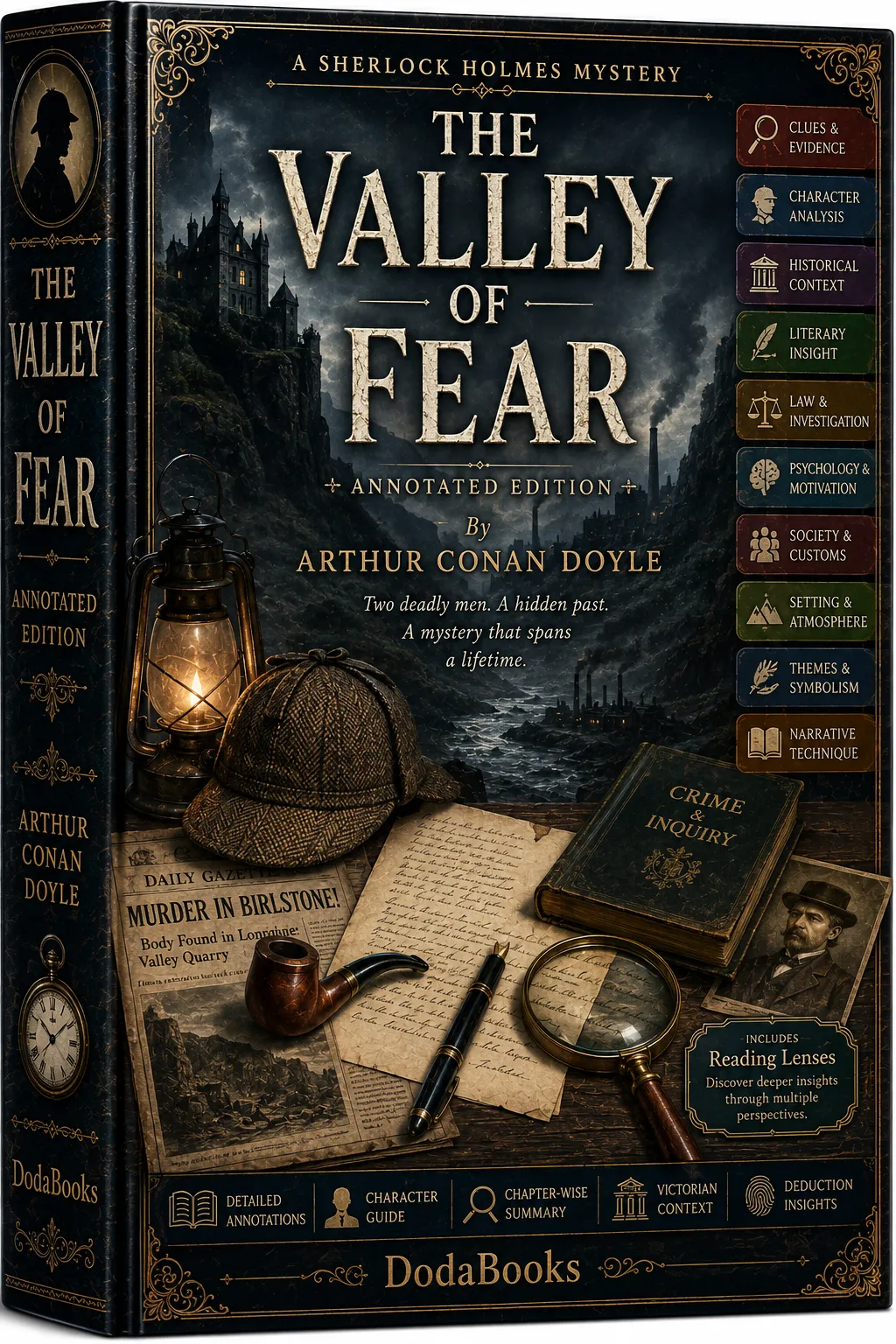
Arthur Conan Doyle’s The Valley of Fear is the fourth and final Sherlock Holmes novel — a 1915 masterpiece that pairs a quintessential English country-house murder with a brutal American backstory of coal mines, Pinkerton agents, and a shadowy secret society. This guide covers the two-act structure, the real history behind it, and why the DodaBooks Annotated Edition is the best way in.
⛏️
The Valley of Fear
A code arrives from Porlock. A country-house murder follows. And in the Pennsylvania mining valley behind it all, a secret society rules by fear. The last Sherlock Holmes novel — in full.
| Author | Arthur Conan Doyle |
| Published | 1914–15 (serialized) |
| Genre | Detective novel, crime fiction |
| Setting | Birlstone Manor, Sussex and Vermissa Valley, Pennsylvania |
| Best For | Holmes fans, crime readers, American history buffs |
| Reading Time | 5–7 hours |
⛏️ The Story
The Valley of Fear unfolds in two halves. In the first, Sherlock Holmes receives a coded message warning of danger to one John Douglas of Birlstone Manor. By the time Holmes and Watson arrive, Douglas is dead — shotgunned to the face, a dumbbell smashed, a wedding ring missing. Everyone has a theory; Holmes has a better one. The twist reveals that John Douglas is not who Birlstone has believed him to be.
The second half goes somewhere entirely unexpected. It jumps back to the Vermissa Valley of Pennsylvania, decades earlier, where a young man named Birdy Edwards infiltrates a murderous secret society known as the Scowrers — a gang that controls the mining towns through terror. This section is not Sherlock Holmes at all. It’s an American western, a labor-history drama, and a spy thriller in one, and it recontextualizes everything in the first act.
“Where there is no imagination there is no horror.”
📖 The Two Acts, In Detail
The novel advertises its split right in its title page division: Part One is “The Tragedy of Birlstone,” and Part Two is “The Scowrers.” On the surface they could not be more different — one is a compact English country-house murder, the other a sprawling American frontier saga — but by the end you understand they are the same story told from two ends of a life.
Act One opens on a coded warning. A “Mr. Porlock,” a trembling associate of the criminal mastermind Professor Moriarty, sends Holmes a half-deciphered cipher hinting that a man named John Douglas is in mortal danger. By the time Holmes and Watson reach Birlstone Manor in the Sussex countryside, the damage is done: Douglas lies dead, his face destroyed by a shotgun blast, a heavy dumbbell knocked askew, and his wedding ring missing. The local police have a tidy theory involving a hated visitor and a mysterious bicyclist; Holmes, as always, has a better one. The clues — a mark on the hand, a pool on the bridge, a towel smeared with blood — accumulate into a solution that overturns everything everyone believed, because the manor’s master is not the man he appeared to be.
Act Two then rewinds decades and crosses the Atlantic to the Vermissa Valley of Pennsylvania, an anthracite-mining district controlled by a secret society of Irish coal-miners and thugs known as the Scowrers. Here a young man called Jack McMurdo arrives, joins the brotherhood, and rises through its ranks — but he is secretly Birdy Edwards, a Pinkerton detective sent in to smash the gang from within. As the flashback unfolds, we watch him win the trust of the ruthless leader, court the daughter of a victim, and set the trap that will eventually force the gang’s leaders to flee — one of them to England, where the murder of John Douglas turns out to be a settling of old accounts. The past does not stay in the past; it reaches forward and closes its grip in Sussex.
⚔️ The Themes That Bind It Together
The Valley of Fear is the most explicitly political of the Holmes novels, and its themes echo between its two halves. The most obvious is the deep tension between vigilantism and the law: Birdy Edwards breaks the law to enforce it, and the Scowrers twist lawful community into a reign of terror. Revenge is the emotional engine — the murder in Birlstone is not random but the final act of a long vendetta — and brotherhood appears in two sinister forms, the corrupt Scowrers and the loyal detective’s lonely isolation. Most haunting of all is the idea that the past reaches into the present, that old crimes and old identities can resurface decades later to destroy the lives men have rebuilt. It is a theme that makes the novel feel darker and more adult than its reputation suggests, and it rewards readers who think about the two halves as two perspectives on the same moral question.
🇺🇸 The Real History Beneath the Fiction
Every element of the Vermissa half was real. The Scowrers are Doyle’s fictionalized Molly Maguires, an Irish secret society in the Pennsylvania coal fields of the 1870s, notorious for targeted killings and union terror — and eventually broken by a Pinkerton detective who went undercover for years. Doyle borrowed the facts shamelessly and to great effect, and readers have debated ever since whether his strike-era history is true or myth.
The annotations in the DodaBooks edition dig into exactly this: the real Molly Maguires, the Pinkerton “priest-boy” infiltration, and how Doyle compressed a decade of labor conflict into one suspenseful backstory. It’s history that doubles as a thriller.
🔍 The Annotated Layer, Built for Two Novels in One
Passage-Specific Cards
Visible, color-coded annotations running through both halves of the book.
Real History
The Molly Maguires, Pinkerton agents, and Pennsylvania mining in the 1870s.
Structure Analysis
Why Doyle breaks the novel in half — and how the two halves echo.
Disguise & Identity
The layers of false names behind John Douglas, McBirney, and Birdy Edwards.
Labor & Terror
Class conflict, union struggle, and the economics of the Valley.
Canon Context
Where this novel fits in the later Holmes continuity
📘 Annotated Insight — The Sentence That Hides a Book
The novel’s opening act turns on a single sentence about John Douglas’s sleeve. A tiny, easy-to-miss clue retroactively explains a wrist tattoo, a wedding ring, and the entire case. Doyle’s second half exists to make you re-read that first half with new eyes — which is precisely the experience the annotations preserve, catching every planted detail before you see the pattern.
📜 A Novel of Two Generations
The Valley of Fear deserves to be better known than it is. Written just before the Great War, its Vermissa chapters are a bridge between Victorian detective fiction and very American crime writing — the world of the Pinkertons and the frontier that would bloom into film noir. It’s also the only Holmes novel where the villain’s motive is class politics rather than greed or revenge, which makes its ending genuinely bleak.
📖 Why It Still Matters
The Valley of Fear deserves a place on the shelf beside better-known canon entries, and there are several reasons it has aged so well. First, it is the only Holmes novel where the great detective is genuinely a supporting character — the real story is Birdy Edwards and the Valley, which lets Doyle write with a freedom the Baker Street formula rarely allowed. Second, the American half predicts the direction of the whole crime genre: hardboiled detection, labor violence, and the undercover agent all trace their ancestry to chapters like these. Third, the novel captures a real historical reckoning with the American labor wars that remains resonant today, and the annotated edition’s history section makes clear how much of the Vermissa story is grounded in documented events.
It also matters as a structural dare. Juxtaposed against the earlier novel that pioneered the two-part conceit, The Valley of Fear shows Doyle revisiting the very device he invented with A Study in Scarlet — but with a crucial difference. Where the Utah backstory of that earlier book reads as an adventure, the Pennsylvania half here is a hard-nosed spy thriller, showing how the author’s ambitions had hardened over the years. And positioned as it is, late in the canon, it forms a bridge between the pleasures of the classic short-story collections and the darker, more cynical register the later Case-Book would take.
💡 How to Read It
Treat the two halves as they were written: as one continuous argument, not two disconnected stories. On the Birlstone half, read as a pure whodunit, collecting clues about John Douglas — the mystery of his sleeve, his ring, his history — and try to beat Holmes to the reveal. When the scene shifts to Vermissa, resist the urge to skim; the coal-town politics and the Scowrers’ rituals are not decoration but the key to understanding who Douglas really is and why he had to die. On a second read, pay special attention to the details of identity and disguise that the annotated edition flags for you — the layers of names and the small physical marks that connect the two halves. It’s short (roughly 180 pages) and reads quickly, but it rewards the reader who lets the two acts talk to each other.
Get both stories in one — Doyle’s most underrated novel, fully annotated.
❓ Frequently Asked Questions
Is The Valley of Fear connected to the other Holmes novels?
It’s one of the four canonical Sherlock Holmes novels. Written in 1914–15, it’s the only one set partly in America — and the last one Doyle ever wrote.
Do I need to have read the other Holmes books first?
No. Holmes and Watson’s setup is briefly re-established, and the story stands alone. If you’ve read any Holmes, you’re ready; if not, this works as an entry point.
What is the Scowrers / Molly Maguires about?
An Irish secret society in the Pennsylvania coal district that controlled mining towns through beatings, arson, and murder. Doyle fictionalizes them as “the Scowrers,” and the annotations trace the true history — including the Pinkerton out-of-the-mine detective story.
Is the American half boring without Holmes?
The opposite — it’s the section that fans argue about most. It reads like a western-turned-spy-thriller, and many readers consider it the best part of the book. The annotations make the history sing.
How long does it take to read?
It’s short for a novel — roughly 180 pages — so 5 to 7 hours. A single weekend gets you through both Philippa halves.
Who is Birdy Edwards?
Birdy Edwards is the real identity of the man who arrives in Vermissa Valley as Jack McMurdo. He is a Pinkerton detective sent undercover to destroy the Scowrers from within, and his story drives the entire American half of the novel.
Why is the novel set partly in America?
Doyle wanted to move beyond the usual London mystery and ground the story in the real labor wars of the Pennsylvania coal fields. The American half is a historical thriller built around the Molly Maguires, whom Doyle recreated as the Scowrers.
Is the Scowrers / Molly Maguires history real?
The Molly Maguires were a genuine Irish secret society active in Pennsylvania coal country in the 1870s, and Pinkerton agents really did infiltrate them. Doyle compressed and dramatized that history, and the annotated edition traces exactly what is fact and what is fiction.
📚 Related Articles
⛏️ Solve the Case and Mine the History
The Valley of Fear is two novels in one. This edition handles both:
- ✅ Complete 1914–15 text — both halves of the story
- 🗂️ Passage-specific annotation cards — visible, color-coded
- 📍 Molly Maguires & Pinkerton history — the truth under the fiction
- 🎭 Identity and disguise analyzed across every planted clue
- 🔒 DRM-free — read on any device
- 📥 Instant download — EPUB format