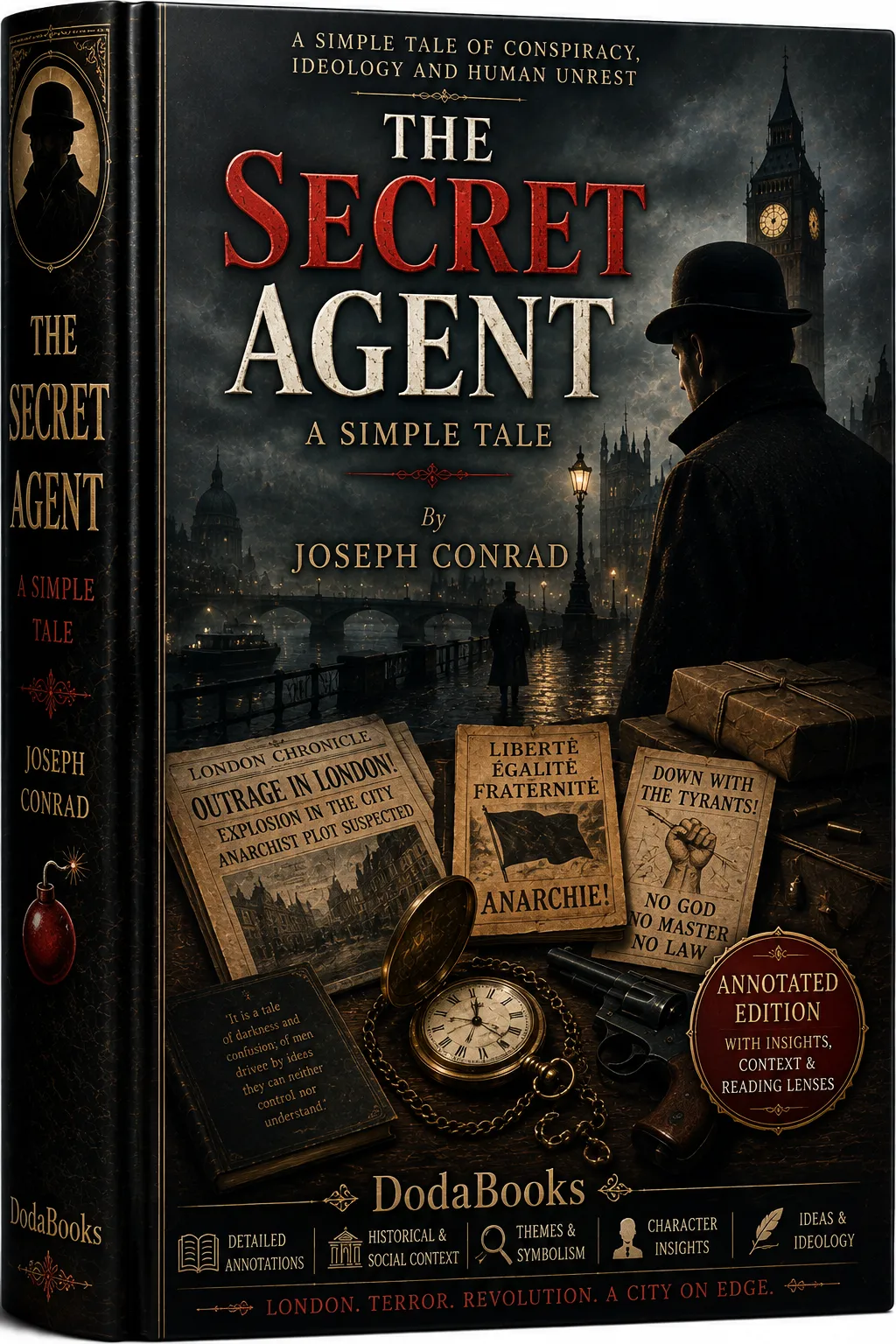
Joseph Conrad’s The Secret Agent: A Simple Tale is the 1907 novel that turned domestic life into the stuff of political catastrophe — a chilling study of an anarchist bomb plot and the quiet family at its center. This guide unpacks the plot, Conrad’s corrosive irony, and how the DodaBooks Annotated Edition makes one of the most layered novels in English accessible.
⚗️
The Secret Agent
A shabby shopkeeper on a London back street. A plot to blow up the Observatory. And a wife kept in the dark about who her husband really is. Conrad's dark masterpiece of politics, irony, and human cost.
| Author | Joseph Conrad |
| Published | 1907 |
| Genre | Political novel, espionage, psychological fiction |
| Setting | Edwardian London — Soho and Greenwich |
| Best For | Serious readers, students, Conrad fans |
| Reading Time | 8–10 hours |
⚗️ The Story
Mr. Verloc runs a small shop in Soho that sells pornography and shady goods as cover for his real trade: an agent provocateur working for a foreign embassy. He is also, quietly, an anarchist — in the same way a landlord is in the property business. His wife Winnie knows nothing of any of this. Her entire world is her simple-minded brother Stevie, whom she married Verloc to protect.
When Verloc’s embassy handler, Mr. Vladimir, demands a jolt that will wake up the British public — an attack on science itself, the Greenwich Observatory — Verloc’s plan goes disastrously, grotesquely wrong. The novel’s most famous scene is also its most terrible: the explosion that ends the night before it began, and the slow, horrified unraveling of the Verloc household that follows.
“The terrorist and the policeman both come from the same basket.”
From the Assistant Commissioner’s investigation to the unhinged Professor who carries a detonator under his coat to steer clear of the police, every thread of The Secret Agent tightens toward one of the grimmest and most celebrated endings in English fiction.
🎭 Conrad’s Ironic Vision
The Secret Agent is the rare political novel that refuses to take any side. Anarchists are bunglers and cranks; police are bureaucrats with social ambitions; embassy men play with human lives for diplomatic advantage. The real monster, Conrad suggests, is not ideology but the way respectable institutions — and respectable people — launder violence.
That ironic distance is the novel’s signature, and it’s also the reason first-time readers find Conrad difficult. He rarely tells you what he means; he shows you a detail and waits. A wife’s face becomes a diagnosis. A walk across town becomes a moral judgment. The DodaBooks edition exists precisely to make those moves visible in the moment they happen. If you enjoy this kind of layered, unreliable narration, Wilkie Collins’s The Woman in White plays a similar game with a chain of competing witnesses.
🔍 The Annotated Edition, Layer by Layer
Instead of hiding explanations behind click-to-reveal notes, the DodaBooks edition places visible, color-coded annotation cards directly in the reading flow.
Literary Insight
Why Conrad's scenes carry more meaning than their surface action suggests.
Historical Context
Edwardian London, policing, embassies, and the real anarchist movement.
Character Psychology
Verloc, Winnie, Stevie, the Professor — fear, guilt, grief, and self-deception.
Symbolism
Shops, streets, darkness, doors, and bodily imagery that recur with meaning.
Morality & Ethics
Responsibility when intentions, ideology, and consequences diverge.
Irony & Technique
Conrad's shifting perspectives, withheld information, and poisoned wit.
📘 Annotated Insight — The Bomb You Never See
Conrad never shows the explosion directly. He only shows you the aftermath — a destroyed man on a path, a scrap of paper with an address. The restraint is the strategy: by refusing spectacle, Conrad forces the reader to feel the human cost instead of the bang. The annotations take you through this scene step by step, showing how horror arrives precisely because the camera is turned away.
📜 A Novel That Predicted the Century
Written in 1907, The Secret Agent presaged the age of terrorism with uncanny accuracy — self-radicalized loners, media-savvy provocateurs, bureaucracies playing at ideology, and ordinary civilians caught in the blast. Graham Greene called it one of the great novels of the language; its influence runs through everything from spy fiction to contemporary political thrillers. In that lineage stands John Buchan’s The Thirty-Nine Steps, a very different but equally influential thriller, and G. K. Chesterton’s absurdist conspiracy novel The Man Who Was Thursday, which shares Conrad’s dark suspicion of both anarchists and the police.
For readers who want more than plot, the annotations make this one of the most rewarding novels you’ll ever read slowly.
🏛️ The Real Anarchists of Edwardian London
To read The Secret Agent properly, it helps to know how real Conrad’s background was. In the 1890s and 1900s London was a genuine refuge for political exiles and would-be revolutionaries from across Europe, and the anarchist movement was a live, feared presence in newspapers and police files alike. Conrad, a Polish-born former sailor, knew these circles through his own family’s history of political exile — his parents had been sent to Siberia for their involvement in Polish resistance.
The real 1894 Greenwich bombing that inspired the novel involved a French anarchist, Martial Bourdin, who blew himself up near the Observatory while carrying explosives. Bourdin’s motives were murky — no one ever proved he meant to attack the Observatory — but the incident gave Conrad the seed of his plot. It is telling that he turned a confused, possibly accidental death into a story of deliberate conspiracy, because his subject is not the events themselves but how respectable people build catastrophic plans and then wash their hands of the human cost.
🎭 Every Character Is a Collapsing Mask
The “secret agent” of the title is not a single spy but a condition the whole book shares. Verloc wears the mask of shopkeeper, anarchist, informant, and husband, each one propping up the others. Winnie wears the mask of a devoted wife while nursing a secret she has buried for years. Stevie is a boy who cannot hide anything, which is precisely why the plotters use him. Even the Professor wears a mask of invulnerability backed by the detonator under his coat.
Conrad’s genius is to make these masks the engine of the tragedy. Verloc does not murder deliberately; he destroys his household through one careless, self-protective decision, and the masks collapse one after another. The narrative never condemns — it simply watches each character’s constructed self crumble, which is far more unsettling than a simple moral verdict. This is the heart of what the annotations unpick: the slow, almost clinical revelation of who each person really is.
🕰️ Reading Tips for a Slow, Rewarding Read
The Secret Agent is best read twice, and in a different spirit each time. On a first pass, let the plot carry you — pay close attention to the timing of the bombing and who knows what when, because Conrad withholds information deliberately to keep you as confused as the investigators. On a second read, watch the irony: every moment a character reassures themselves, the reader knows how hollow that reassurance is.
Because Conrad jumps backward and forward in time within chapters, keep the backstory of the Verloc household clear in your head. Winnie married Verloc not for love but to secure a future for Stevie; the whole novel turns on that one fact. If that thread is ever unclear, the annotated edition restates it at the moment it matters, so you can keep riding the plot instead of double-checking your memory.
❓ Frequently Asked Questions
Is The Secret Agent very hard to read?
Conrad’s prose is dense, ironic, and sometimes non-chronological. First-time readers benefit hugely from annotation. The DodaBooks edition keeps his language untouched but explains the irony, reference, and technique at the moment you need it.
Is there an actual spy in the novel?
Yes — and that’s the black joke. Verloc is a “secret agent” who is simultaneously an anarchist, an informant, a shopkeeper, and a husband, each identity layered on the other. The novel is a study in how identities stack up and eventually collapse.
Was the Greenwich bombing real?
It’s based on a real attempt in 1894, when a would-be anarchist blew himself up near Greenwich Observatory, almost certainly intending to attack it. Conrad took the bare fact and built his entire tragic family drama around it.
What makes Winnie Verloc one of literature's great characters?
She’s a woman who makes one strategic decision to protect her brother and is destroyed by its consequences. Her arc — from silent shopkeeper to the novel’s final, terrible act — is one of the most devastating in Victorian-influenced fiction.
Is this a good first Conrad novel?
It’s widely recommended as the best entry point: it’s shorter than Lord Jim, more plot-driven than Nostromo, and its dark comedy makes the difficulty worth it — especially with annotations to hand.
Is The Secret Agent a spy story like a modern thriller?
Not in the conventional sense. There are no chase sequences or gadgets; the espionage is quiet, bureaucratic, and grimly funny. What modern thrillers took from Conrad is the atmosphere — the sense that ordinary life is shadowed by secret powers manipulating it from behind a shop counter.
Why did Conrad call it "A Simple Tale"?
It is pure irony, and one of the novel’s darkest jokes. The subtitle pokes fun at the sprawling conspiracy, the multiple interlocking plots, and the tangled psychology at the story’s center — nothing about the novel is simple, least of all its moral lesson.
📚 Related Articles
⚗️ Read Conrad’s Masterpiece with the Machinery Exposed
The Secret Agent rewards slow, attentive reading — and this edition is built for exactly that:
- ✅ Complete 1907 text — Conrad’s prose preserved in full
- 📝 Passage-specific annotation cards for every major scene
- 🏛️ Historical context — the real anarchist world of Edwardian London
- 🧠 Psychological and moral analysis of every major character
- 🔒 DRM-free — read on any device
- 📥 Instant download — EPUB format