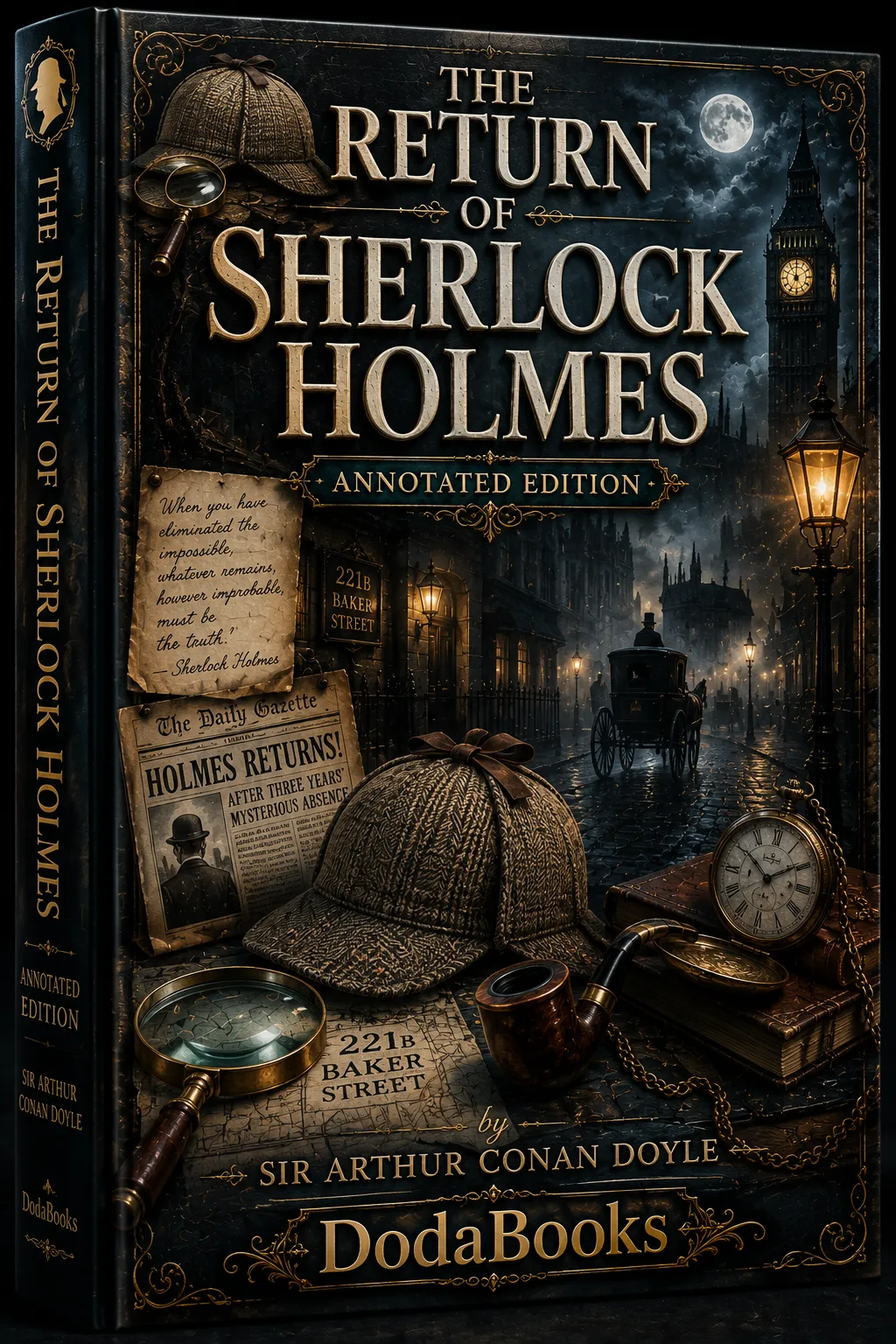
Arthur Conan Doyle’s The Return of Sherlock Holmes is the collection that brought the world’s most famous detective back from the dead — thirteen stories led by “The Empty House,” in which Holmes appears, three years after the Reichenbach Falls, to a Watson on the verge of a heart attack. This guide covers the comeback, the famous cases, and the DodaBooks Annotated Edition.
🔙
The Return of Sherlock Holmes
In 1903 a mildly eccentric old bookseller visits Watson's consulting room. A moment later he is Holmes, alive, three years and two continents beyond his own death. The resurrection collection — thirteen cases, the greatest comeback in fiction.
| Author | Arthur Conan Doyle |
| Published | 1905 (stories 1903–1904) |
| Genre | Detective short stories |
| Stories | 13, including “The Empty House” |
| Best For | Holmes fans, short-story readers, comeback-chasers |
| Reading Time | 7–9 hours |
🔙 The Resurrection
Conan Doyle had drowned Holmes at the Reichenbach Falls in 1893; the reading public never forgave him. Letters poured in for a decade. The Strand lost subscribers, and American publishers paid astronomical sums just to tempt Conan Doyle to continue. In 1903 he finally relented, and the story “The Empty House” delivered the most famous resurrection in fiction: years after the fall, Holmes watches over the back of 221B Baker Street dressed as a bookseller, then reveals himself to an ashen-faced Watson with a single whispered sentence: communication would have been fatal.
The way the survival is explained — a rock-ledge, an unused climbing rope, a hidden cave — has kept readers arguing for over a century. The annotations lay it all out: the mechanism, the timeline, the continuity, and the sheer audacity of the premise.
💼 The Thirteen Cases
Once Holmes returns, Conan Doyle delivers a string of his very best short cases: the garrotted businessman of “The Norwood Builder”; the dancing-stick-figure cipher of “The Dancing Men”; the obsessive destruction of plaster busts in “The Six Napoleons”; the kidnapped schoolboy lord in “The Priory School”; the twisted letters and lying witnesses of “The Abbey Grange”; and, behind them, a whole series of locked-room puzzles and impossible alibis. The collection reads like a greatest-hits album from a champion.
“When you have eliminated the impossible, whatever remains, however improbable, must be the truth.” — Dr. Watson, quoting Holmes
🔍 The Annotated Layer, Case by Case
Passage-Specific Cards
Visible, color-coded annotations placed beside each case's key passages.
Edwardian Context
London, class, and police procedure of the 1900s behind the plots.
The Deductions
Holmes's reasoning unpacked in every famous logical passage.
Villainy & Motive
Greed, revenge, blackmail, and obsession — the real springs of crime.
Canon Building
How the committee of the stories extends Holmes's known biography.
The Return Story
The Empty House decoded: survival, continuity, and the statute of memory.
📘 Annotated Insight — The Story That Couldn’t Happen
“The Empty House” is a miracle of reader management: Conan Doyle must convince us Holmes survived a fall that the previous book showed at close range. His solution is to tell the story through Watson’s eyes and never to show the fall again. The annotations make this trick visible — you watch the camera angles, the curtain, and the single withheld detail that makes resurrection feel inevitable in retrospect.
📜 The Engine of Sherlockian Culture
The Return is the collection that turned a detective into a permanent institution. Before the comeback, Holmes was a beloved dead character; after the Return, he was unkillable. The collection’s thirteen stories define the style — fast, humane, amusing, and staged around 221B Baker Street’s domestic realism — that has run through over a century of adaptations.
The Return is where Holmes stops being a story and becomes an industry. Read the pivot point itself, fully annotated.
📖 Thirteen Cases, One Comeback
It is worth stepping back to see the shape of the whole collection, because the Return is not just a greatest-hits album — it is a carefully ordered arc. Doyle opens with the resurrection itself (“The Empty House”), showing Holmes back in harness and justifying his survival. Then he runs through a sequence of pure puzzles designed to re-prove the detective’s genius: the impossible crime scene of “The Norwood Builder,” the creeping menace of the cipher in “The Dancing Men,” and the bouncing ball of red herrings in “The Six Napoleons.”
The middle of the book leans into larger mysteries and darker motives — the kidnapped boy of “The Priory School,” the poisonous blackmail of “Charles Augustus Milverton,” the sealed-room puzzle of “The Abbey Grange.” Toward the end, Doyle lets the tone shift: “The Second Stain” closes the collection with a state secret and an international scandal, a reminder that Holmes operates at the scale of nations, not just households. If you are working through the canon in order, you have met the detective before — in The Adventures and then in The Memoirs, where he died — and the Return deliberately answers that earlier, darker volume point by point.
🏛️ Historical & Cultural Context
The Return matters historically as much as it does literarily. The stories were published in The Strand between 1903 and 1904, and then collected in 1905 — a moment when Edwardian London was a city of startling contrasts, and Doyle uses that texture relentlessly. There are country-house murder mysteries and London crimes, titled aristocrats and foreign spies, all set against a backdrop of telegrams, hansom cabs, and the newly risen newspaper press. The cases in the Return are noticeably more international than the early Adventures: Moriarty’s network, European blackmailers, and colonial scandals drift through the plots.
There is also a quieter historical layer: these stories were written in the shadow of the turn of the century, a time when Britain was anxious about its imperial position and its place in a changing Europe. Doyle folds those anxieties into plots about national security and state secrets. The annotations bring this world alive, showing how real Edwardian institutions — Scotland Yard, the private detective trade, the upper classes’ codes of honour — shape who commits the crimes and how Holmes solves them. That context is a big part of what makes our annotated edition of the collection worth lingering over.
🔥 Themes That Define the Collection
Read as a whole, the Return is about what happens when the greatest mind of an age confronts the limits of its own power. On the surface these are detective stories, but the recurring anxieties are subtler. There is the theme of the past returning — literally Doyle’s plot device, but also present in case after case, where old sins and buried secrets resurface to destroy the present (nowhere more than in “The Abbey Grange” and “The Norwood Builder”). There is the theme of the outsider’s revenge — the wronged servant, the spurned secretary, the man dismissed by society who turns his grievance into a crime, a strand Doyle explored even more fully in the later Case-Book.
And everywhere there is the theme of performance. Holmes does not merely solve crimes; he stages conclusions, revealing the truth to a roomful of astonished witnesses. The Return is full of these set-piece reveals, and it is no accident — after a three-year absence, Doyle needed to remind readers of Holmes’s theatrical brilliance. The showmanship is part of the charm, and it is one reason the collection reads so quickly.
🤝 Why the Return Is Pivotal to the Canon
If A Study in Scarlet began the canon and The Adventures perfected the short-story form, the Return is the hinge that made the series unkillable. Before it, Holmes was a much-loved but dead character; after it, he was an institution that would run for nearly another quarter century. The collection’s success proved that the detective could carry endless re-tellings — and it set the model of the self-contained case that Doyle would sustain into his final, darker volumes.
The Return is also where the relationship between Holmes and Watson grows most comfortable. The two men are older, easier, more domestic — the stories open and close around the famous hearth at 221B Baker Street. You get the sense of two people who have been through the worst together and come out friends. That warmth, layered over the cleverness of the puzzle plots, is why the Return is so consistently enjoyable; it is Conan Doyle at the height of his storyteller’s craft, writing with nothing left to prove.
❓ Frequently Asked Questions
Do I need to read The Memoirs first?
The famous death happens in The Memoirs’ “The Final Problem,” and the Return assumes you know it. But as a collection of self-contained cases, the Return works alone — the annotations cover the continuity either way.
How does the resurrection actually work?
Holmes explains it himself in “The Empty House” — a rock-ledge above the fall, three years of concealment, and a secret watched over by his brother Mycroft. The annotations walk through every step and its continuity problems.
Which story is the best to start with?
Begin with “The Empty House” for the payoff, then “The Dancing Men” (a cipher case) or “The Six Napoleons” (a classic false-lead chase). All three are pinnacle Conan Doyle.
Is this the best Holmes collection?
Fans argue endlessly. The Adventures have charm, the Return has showmanship, the Case-Book has depth. The Return is the most uniformly strong — thirteen cases with almost no filler.
How long does it take to read?
Thirteen stories, roughly 7–9 hours of reading — each story a manageable 30–45 minute sitting.
Does Holmes stay dead this time?
No — and this is the point of the collection. The Return brings him back permanently. Unlike the earlier “death” at Reichenbach, which was meant as a farewell, the Return re-establishes Holmes for good, and he remains alive through every later collection.
Why did Conan Doyle bring Holmes back at all?
Largely money and pressure. Doyle had tried to move on to historical fiction, but readers demanded Holmes and publishers paid enormous sums to tempt him back. The cultural and financial pull of the character proved impossible to resist, and the Return was a spectacular commercial and critical success.
Which story has the most famous deduction scene?
“The Dancing Men” is built entirely around a puzzle to decode, but the showiest deductive tour-de-force is probably “The Norwood Builder,” where Holmes stakes his reputation on a single overlooked detail. Both are among the most anthologized stories in the entire canon.
📚 Related Articles
🔙 Read the Greatest Comeback in Fiction
Experience Holmes’s resurrection with full context and craft notes:
- ✅ Complete 1905 text — all thirteen cases
- 🗂️ Passage-specific annotation cards — visible, color-coded
- 🧭 Edwardian London alive — class, crime, and police procedure
- 🕵️ Every deduction unpacked in the famous logic sections
- 🔒 DRM-free — read on any device
- 📥 Instant download — EPUB format