Jacques Futrelle’s The Problem of Cell 13 is the most famous impossible-escape story in the history of detective fiction — a 1905 tale in which Professor August S. F. X. Van Dusen, “The Thinking Machine,” bets that he can escape a death-row cell with guards watching every move. This guide covers the puzzle, the legend, and the DodaBooks Annotated Edition.
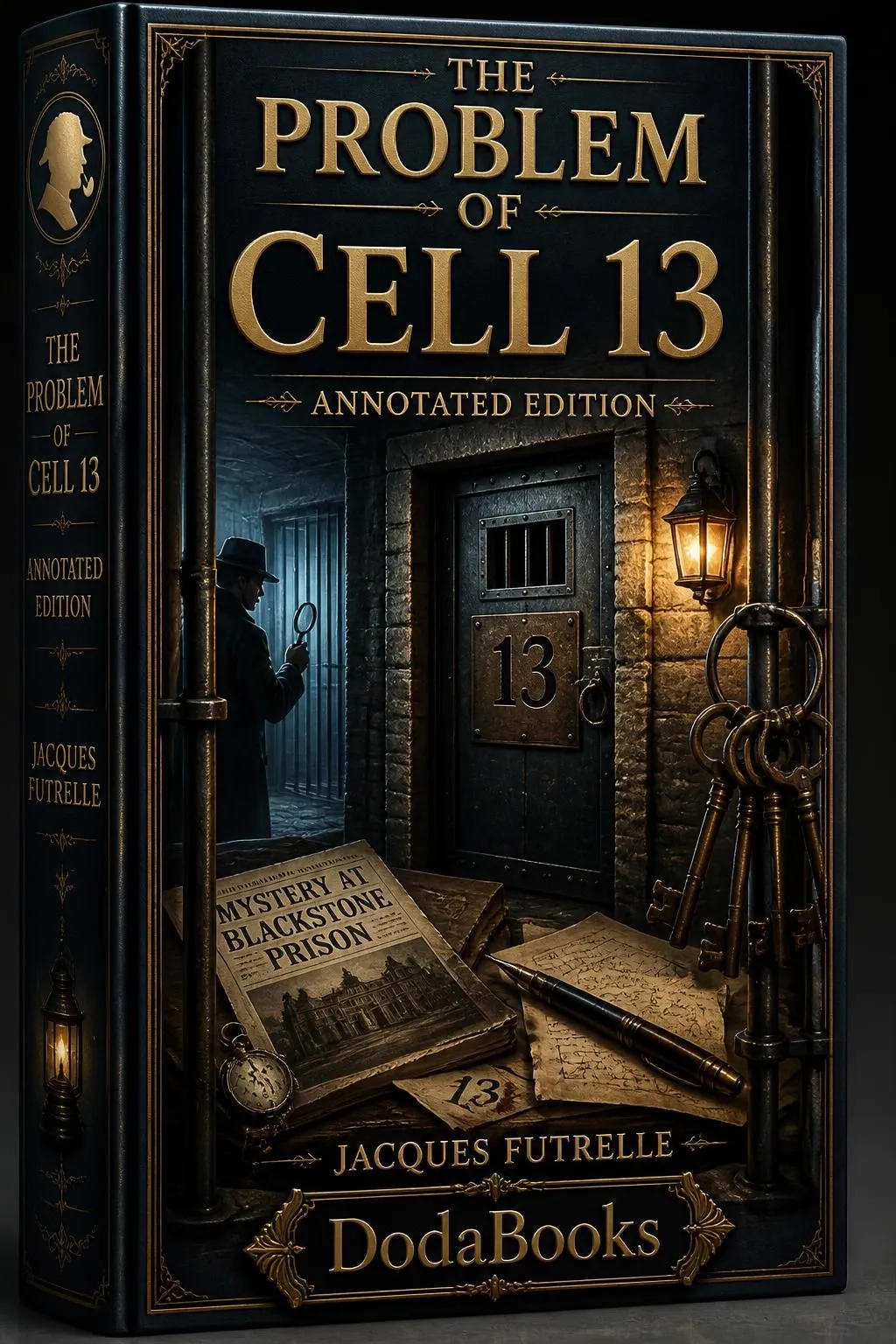
🔒
The Problem of Cell 13
Professor Van Dusen boasts that the mind can solve any problem. So he walks into a death-row cell, alone, wearing only socks and a blanket — and bets he will be out in a week. This is the story that made him immortal.
| Author | Jacques Futrelle |
| Published | 1905 |
| Genre | Detective fiction, locked-room puzzle |
| Setting | A maximum-security prison and the world outside |
| Best For | Puzzle lovers, escape fans, short-story readers |
| Reading Time | 1–2 hours |
🔒 The Challenge
Professor Van Dusen — the small, sneering man with the great head who never loses — is a mathematician who believes that “nothing is incapable of solution to the thinking mind.” In the story’s setup, he demonstrates by walking into Chisholm Prison’s Cell 13, the death cell, with nothing but the clothes he stands in, and a stated intention: to be out — walking free, let the warden test him as he likes — within a week.
The warden seals the cell, doubles the guards, and hollows himself out with vigilance. Watches are posted at every conceivable door; food is tested; the cell is searched thrice a day. Van Dusen is polite, patient, and utterly confident. And on the seventh morning, with the whole apparatus of the prison watching, he is gone.
“I am to be led from my cell between this window and the eastern prison wall… and will be free in seven days.”
🔓 The Puzzle, Step by Step
The genius of The Problem of Cell 13 is how carefully Futrelle lays the groundwork without ever letting you see it coming. Before Van Dusen is even locked up, he has already planted the seeds of his escape in plain sight. He asks, almost as an afterthought, for an electric light to be installed in his cell — a courtesy request so reasonable that no one questions it. He has friends waiting outside for him. He learns the habits of the prison doctor. Individually, each detail reads as flavor; together, they are the blueprint of what follows.
Once inside, Van Dusen is stripped to his essentials. He enters wearing nothing but the clothes on his back — the story is careful to tell you exactly what he has on him — and submits to a search. The warden examines the heavy robe and slippers, the underclothing, everything, finds nothing hidden, and seals the cell. To make his boast credible, the guards are tripled, the cell is searched three times a day, every meal is examined, and the death-cell is watched around the clock. It is the most carefully observed prison cell in fiction, and Van Dusen empties it in a week.
What makes the story endlessly re-readable is that the solution never cheats. There is no trapdoor, no bribed guard, no magic. The escape is built from ordinary objects and ordinary routines — a dropped match, a torch, a voice heard through darkness, a moment of distraction — arranged into a sequence that works because the prison’s own procedures become the very tools of the escape. Futrelle plants every one of these elements in the opening pages, so that on a second reading the punchline feels less like a trick and more like the only possible answer.
🏛️ Historical & Cultural Context — The 1905 Mind
To understand why The Problem of Cell 13 landed like a thunderclap, you have to picture the cultural moment that produced it. In 1905, American readers were newly obsessed with the power of the trained mind. The great department stores of the era sold “memory courses”; magazines ran puzzles and mental-marvel features; and a generation of popular writing celebrated the idea that pure intellect could solve any difficulty. Van Dusen — small, sneering, bald, with a face like a human skull — was the cartoon apotheosis of that faith: a man who claims that two and two make four, not sometimes, but all of the time.
Prisons themselves were also in the news. The 1890s and early 1900s saw notorious escape attempts from American penitentiaries, and the figure of the man who out-thinks the institution captured the public imagination. Equally important, this was the golden age of the mass-market magazine, and Futrelle was one of its brightest stars. Published in the Boston American in 1905, the story reached an audience for whom serialized short fiction was the television of its day — and “The Thinking Machine” became a recurring sensation precisely because each new tale promised the same impossible puzzle and the same fair solution.
🧠 Why It Drove a Century of Imitators
From this single story, Futrelle produced the template for the “impossible escape” — the subgenre that runs through every locked-room mystery, every heist thriller, and every Boston Blackie and Count of Monte Cristo pastiche to the present day. Cells with no windows, safes with no seams, rooms watched from every corner: “The Problem of Cell 13” is the beating heart of the genre.
The beautiful part is the fairness. Futrelle plays by the rules of ordinary material life — no teleportation, no supernatural aid, no hidden hatch invented two pages before the reveal. Everything is permitted; nothing is impossible; and the solution, when it comes, is audacious precisely because it has been there in front of you the whole time.
🔍 The Annotated Edition
Annotation Cards
Visible, color-coded notes placed beside the puzzle as you read.
Clue Map
Every hint flagged — the dropped match, the torch, the voice in dark.
The Method
How "thinking machine" reasoning differs from Holmesian deduction.
1905 America
Prisons, newspapers, trains, and telegraphs of the era in the plot.
Genre Roots
How the story seeded escape-thriller and impossible-crime fiction.
Reading Lenses
A Themes guide and full annotation index for study and re-reading.
📘 Annotated Insight — The Six Steps You Never Noticed
Futrelle seeds the story with the escape’s six moves almost from the first page — a petition for an electric light, friends who wait outside, a prison doctor’s habit — and trades each one for suspicion in its moment. The annotations walk you through the trail in order; once you see it early, the final reveal lands like a handshake rather than a cheat.
🕰️ The Man Behind the Machine
Jacques Futrelle was an American journalist and the golden child of the magazine publishers of 1905, launching “The Thinking Machine” to instant fame. His career ended tragically early: he went down with the Titanic in 1912, aged 37. The immortality of “Cell 13,” still taught and anthologized a century later, is the odd, fitting memorial of a writer who believed the mind could out-live the body.
📖 Why It Still Matters
Nearly 120 years on, The Problem of Cell 13 remains one of the most assigned, most anthologized, and most argued-about stories in the genre — and for good reason. It is the cleanest statement ever written of the idea that a reader can be given every possible clue and still be beaten to the answer. Modern escape dramas, from heist films to prison-break series, all trace a line back to Van Dusen’s locked cell, and the fair-play principle Futrelle followed became a foundation stone of the Golden Age mystery.
It also matters as a showcase for a very different kind of detective. Where Sherlock Holmes is all observation and eccentricity, and Father Brown is all intuition and compassion, Van Dusen is pure, brutal logic — the “thinking machine” himself. Comparing the three is a masterclass in how many ways a mystery can be solved. If you’re curious how the puzzle tradition developed across the Atlantic, The Innocence of Father Brown offers the spiritual counterweight to Van Dusen’s cold calculus, while The Misplaced Battleship shows the same impossible-scale bravura. Together they sketch the full possibilities of the puzzle story.
💡 How to Read It (and Re-Read It)
The trick to getting the most from this story is to read it twice on purpose. On the first pass, let yourself be swept along and enjoy the audacity of the solution. Then go back: note every object Van Dusen carries in, every small request he makes, every habit he observes in the staff. On the second read these all click into place, and you’ll feel the satisfaction the author intended — not of being tricked, but of having been fairly warned the whole time. The annotated edition is built around exactly this experience, with the clue map letting you toggle between “read blind” and “see the machinery” in a single sitting.
Re-read the same story and find the answer you missed — the annotations make that possible in a single sitting.
❓ Frequently Asked Questions
How long is the story?
Under 10,000 words — about two hours at your leisure, less if you’re racing to the answer. Perfect for a single evening.
Is the solution fair?
That’s the story’s claim to fame. No hidden doors, no accomplices operating outside the rules — Futrelle plays fair, and readers have been arguing about exactly how for over a century. The annotations give you the full calculation.
Is there a detective in the story?
Not in the Holmes sense. Van Dusen is the protagonist and the intellectual danger of the piece — a pure reasoner who defeats an entire institution with nothing but wits. He’s often called “the American Holmes.”
Is this a good entry point to classic mystery?
It’s the ideal single-story sampler. Sleek, self-contained, and endlessly imitated — if you love it, you’ll likely want the rest of the Thinking Machine canon.
Why is it so famous?
Because it’s the definitive “impossible escape” and it’s fair. It’s the story every modern escape-thriller secretly copies — and the one readers return to for decades.
Do I need to know Van Dusen from other stories to enjoy it?
Not at all. This is the story that introduced the character to the world, and it’s self-contained. You’ll meet a complete version of The Thinking Machine — his mannerisms, his arrogance, his method — from the first page. It’s also the best possible introduction to the rest of his cases.
Is this a locked-room mystery or something else?
Technically it’s an “impossible crime” rather than a traditional locked-room whodunit: instead of figuring out who did it in a sealed room, you’re figuring out how a man escapes a watched one. The DNA, though, is identical — and it’s one of the founding stories of the entire puzzle-detective tradition.
Why does the annotated edition highlight specific clues?
Because the story hides its seven-step method in plain sight. Fleeting details — a request for electric light, friends waiting outside, a doctor’s habit, a dropped match — are easy to glide past on a first read. The annotations surface each one in the moment, so you can appreciate how carefully Futrelle built the puzzle.
📚 Related Articles
🔒 Solve the Most Famous Locked Room of Them All
Read the story that built the impossible-escape genre with every clue active:
- ✅ Complete 1905 text — uncut, as Furtrelle published it
- 🗂️ Passage-specific annotation cards — visible, color-coded
- 🧩 The full clue map — spot every planted hint before the reveal
- 🧠 Thinking Machine method compared to other great detectives
- 🔒 DRM-free — read on any device
- 📥 Instant download — EPUB format