Wilkie Collins’s The Moonstone is the novel that practically invented the English detective story — a stolen Indian diamond, an opium-fueled mystery, and fourteen narrators who are all, in their different ways, hiding something. T. S. Eliot called it “the first, the longest, and the best of modern English detective novels.” This guide covers the plot, the innovation, and how the DodaBooks Annotated Edition makes every clue visible.
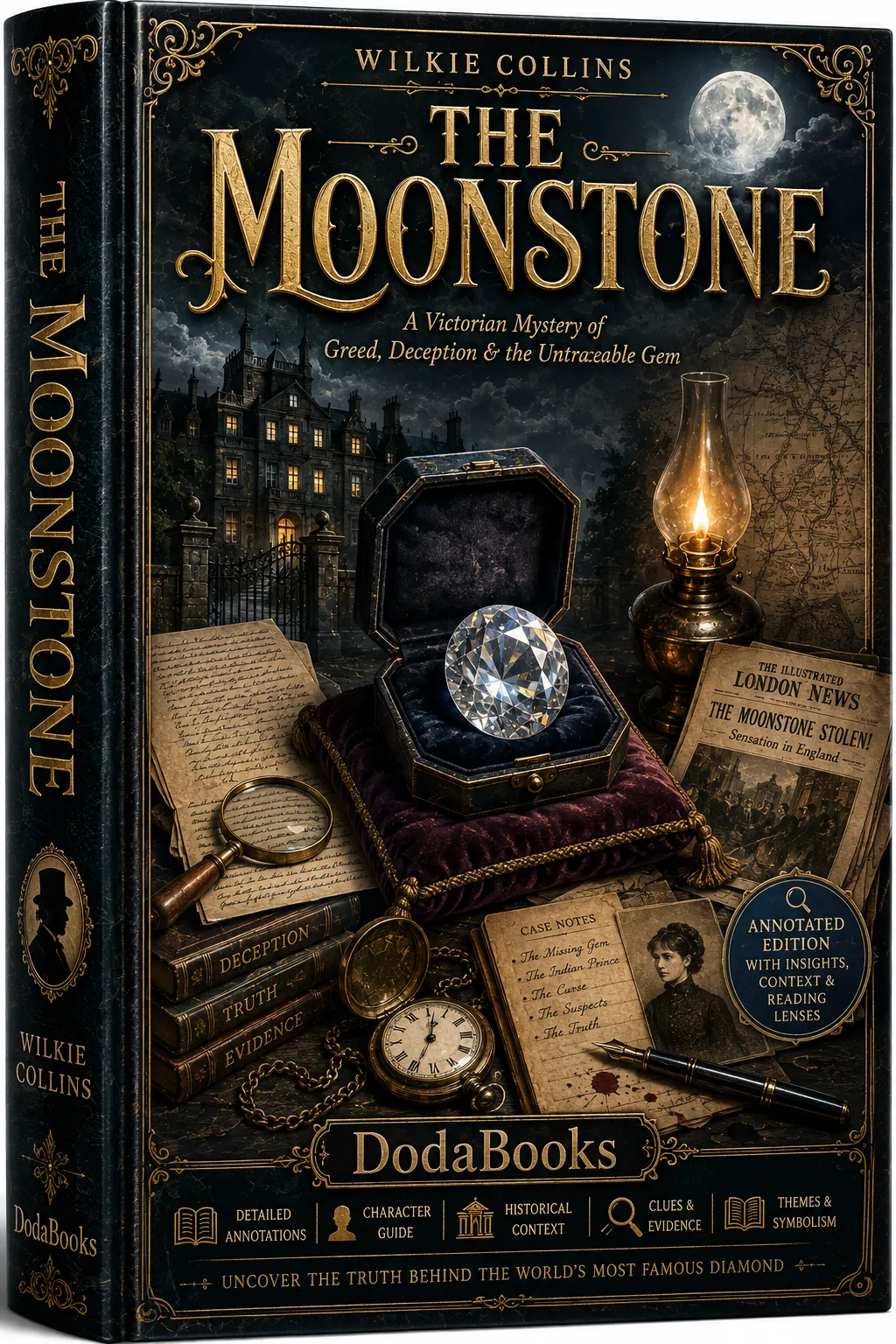
💎
The Moonstone
A great yellow diamond, stolen from an Indian temple, vanishes from an English country house the night it arrives. Every narrator suspects everyone else. The detective story's true birthplace — fully annotated.
| Author | Wilkie Collins |
| Published | 1868 |
| Genre | Detective fiction, sensation novel |
| Setting | Yorkshire country house and London, 1848 |
| Best For | Mystery fans, Victorian readers, students of the genre |
| Reading Time | 9–12 hours |
💎 The Story
In 1799, an English officer steals the sacred Moonstone — a huge yellow diamond — from the forehead of an Indian idol, and dies cursing his family with it. Sixty years later, the diamond is bequeathed to the beautiful Rachel Verinder on her birthday, and that very night it disappears from her bedroom.
The suspicion should fall on the three Indian jugglers seen near the house. Instead it falls everywhere: on Rachel, who refuses to explain the open door, on a sleeping-potion taken by a nervous servant, on a mysterious retiring officer, and on the eccentric Detective Sergeant Cuff, who quietly gets the whole thing wrong. Only a second investigation — conducted through fourteen different narrators, each with his own vanity, secrecy, and blindness — finally assembles the truth, which turns out to have been sitting in plain sight the whole time.
“I have a particular suspicion of the three jugglers — and a general suspicion of everything.”
🌀 Why It Invented the Genre
Before The Moonstone, crime fiction was mostly lock-and-key puzzles. Collins introduced almost everything we still expect from detective fiction: the country-house setting, the closed circle of suspects, the professional detective with quirky methods (Cuff and his roses), a murder weapon red herring of a drug, a reconstruction of the crime, and — most radically — an unreliable chorus of narrators, each writing their section with their own agenda.
Titled narrators aren’t just a framing device. They’re the engine of the mystery, because every witness misleads the reader by being human. An annotated edition earns its keep here, because most readers’ first experience is being quietly steered by Collins’s narrators — and the notes show both the steering and the truth.
🔍 The Annotated Layer, Clue by Clue
Annotation Cards
Visible, color-coded notes beside each narrative — read them as you go.
Clue Tracking
Every planted detail flagged — including the ones the narrators misread.
Opium & Science
The real Victorian opium culture and physiological psychology behind the plot.
Narrator Trust
What each narrator hides, misses, or spins — mapped as you encounter them.
Empire & Empire
India, colonial loot, and the shadow of empire under the diamond's shine.
Genre History
How Collins built the detective novel from suspense, sensation, and science.
📘 Annotated Insight — The Narrator You’re Meant to Misjudge
One of the book’s deepest tricks is that the most reliable-seeming narrator is quietly holding the reader back, and the reader is nudged to blame everyone else. Collins even hides the central clue in a narrator’s embarrassment rather than his secrecy. The annotations flag this in the moment — showing you that the mystery is built out of psychology as much as plot.
🕰️ A Novel About Empire, Reputation, and Drugs
The Moonstone is formally ingenious and quietly alarming all at once. The diamond’s curse is Empire’s debit being presented. The opium plot reflects Collins’s own painful dependence and his research into how memory and identity work. And the final section, told in part from a drugged Dr. Candy’s fragmented diary, is a masterpiece of wounded-narration — a century ahead of experimental fiction.
The annotated edition does what no lecture can: it puts the machinery in front of you, as you read.
🏛️ Historical & Cultural Context
The Moonstone did not appear out of nowhere; it was the convergence of several forces in mid-Victorian Britain. Collins published the novel serially in All the Year Round, the magazine edited by his close friend Charles Dickens, between January and August 1868.
Three contexts matter most. First, there was a genuine national scandal over the Koh-i-Noor diamond, displayed at the Great Exhibition of 1851 after having been taken from India — a real jewel seized through conquest that stirred uneasy questions about imperial plunder. Collins, who had served time among soldiers returning from India and had read widely about the subcontinent, folded these anxieties directly into his plot. The Moonstone diamond — religiously guarded by Indians tracking a stolen gem — hit very close to the realities of British colonial history.
Second, there was the era’s fascination with drugs and the workings of the mind. Collins himself was an opium addict, taking large daily doses of laudanum for chronic pain, and his novel draws on contemporary scientific interest in how drugs shape memory, identity, and behaviour. The second half of the story, in which a sleeper’s drugged actions become the hinge of the mystery, reflects cutting-edge debates about unconscious and involuntary action that prefigured modern psychology.
Third, the “sensation novel” was at its height. Writers like Mary Elizabeth Braddon — see our guide to Lady Audley’s Secret for the era’s other great scandal novel — were exploring crime, madness and bigamy in domestic settings. Collins took that raw energy and channelled it into something more methodical, inventing the police procedural before the term existed.
“So the Moonstone is a piece of the old Indian idol’s jewel — a thing sacred to the worship of the Hindus, who, it is said, have preserved it intact for centuries.”
🔍 The Story, in Detail
Because Collins trusts his narrators to be unreliable, a first reading can be disorienting — which is precisely the point. The novel opens with the famous “family document” that connects the diamond to the Verinder family, then hands the narrative over to Betteredge, the plump, loyal, opinionated house steward whose superstitions (he consults Robinson Crusoe by letting it fall open at random) are both comic and telling. It is Betteredge who describes the diamond’s arrival, the birthday party, and the night it vanishes.
Then the baton passes. Each of the fourteen narrators — Rachel’s cousin Franklin Blake among them, along with the evangelical clergyman and even the servants — contributes a piece. The key figure is Sergeant Cuff, the rose-loving detective with a surprisingly modern, almost weary professionalism, widely regarded as literature’s first real police detective. His theory of the case is wrong, of course — but his methods, his patience, and his eye for the tiny detail all anticipate the great detectives of the next century, from Holmes onward.
The crucial discovery, withheld for most of the book, is that the diamond was taken by the very narrator who appears most trustworthy: Franklin Blake himself, acting unknowingly while under the influence of the opium that the doctor, Candy, had dosed into his drink as an experiment. Blake genuinely does not remember taking it. This is the novel’s great twist — the criminal is also an innocent, and the “guilt” lies in the sleeping mind. From there the story pivots to London, to the sinister Godfrey Ablewhite, and eventually to India, where the diamond is restored to the idol it was stolen from.
🧭 What to Look For on a First Read
The Moonstone rewards a reader who pays attention to who is telling each section and why. Notice how each narrator believes themselves the most sensible person in the story — that confidence is exactly what Collins uses to steer you wrong. Watch Sergeant Cuff’s small offhand remarks; he is often right when he sounds most casual. And keep a mental note of the opium: the drug is not a garnish but the engine that makes the crime possible.
It also helps to know how the nineteenth-century reading experience worked. Serial readers followed the book over months, building suspense week to week, and Collins plays on that patience — compression that is its own pleasure if you read straight through. For readers who want to compare Collins’s methods with the more compact detective fiction that followed, our guide to The Sign of the Four shows Conan Doyle returning to the same formula of a stolen treasure, a vivid sidekick, and a brilliant investigator.
✨ Why It Still Matters
Why should a 150-year-old novel about a stolen diamond still matter today? Because The Moonstone is not merely a whodunit — it is a meditation on what we can and cannot know, about ourselves as much as about events. By making his criminal an unwitting one, Collins argues that guilt is not always conscious, that memory is fallible, and that the “truth” of any event depends on who is telling it. These are strikingly modern concerns, and they are why the novel keeps being rediscovered.
It also stands as a landmark of craft. T. S. Eliot’s famous verdict — “the first, the longest, and the best of modern English detective novels” — was not a passing comment but a serious judgement about Collins’s structural control. Almost every device we take for granted in crime fiction was invented or perfected here: the closed circle of suspects, the professional detective, the reconstruction of the crime, the solution delivered as a dramatic set-piece. To read The Moonstone is to see the genre being born, with all its machinery on display.
❓ Frequently Asked Questions
Is The Moonstone really the first detective novel?
It’s the consensus candidate — the first detective novel in English in the mature sense: a closed setting, a detective investigating, multiple suspects, and a formal reconstruction of the crime. T. S. Eliot called it the best of its kind, and later critics (Dorothy L. Sayers among them) agreed.
Do the Indian jugglers matter to the plot?
They’re a deliberate red herring and at the same time the story’s conscience. The diamond is a stolen Hindu relic, and its pursuers are its rightful guardians. The labeled edition spells out the colonial context that period readers took for granted.
Is the ending satisfying?
Exceptionally. The final third assembles the puzzle, then delivers the solution in a way that reworks the entire book — and resolves its deepest emotional mystery too.
How long is it?
It’s a big Victorian three-decker structure, around 500 pages in most editions — so 9–12 hours of reading at a normal pace. The chapter and card structure makes it easy to read in sessions.
Is it like Lady Audley's Secret?
Same era, same “sensation” energy — but where Braddon goes gothic-domestic, Collins goes systematic; he’s building the detective genre while keeping the thrills. Reading both annotated is a great way to compare the two masterpieces.
Who is Sergeant Cuff and why does he matter?
Sergeant Cuff is the retired police detective called in to investigate the theft — widely considered the first professional detective in English fiction. He loves roses, mistrusts everyone, and gets the initial case wrong before the deeper truth emerges. His patient, methodical approach set the template for every fictional detective who followed.
Is the opium a real explanation or a cheap trick?
Neither. The lavender-soaked opium is historically accurate — Collins himself was an opium addict — and it drives the novel’s deepest argument: that we can act without knowing, and that the self we think we control is partly shaped by forces outside awareness. The drug is not a plot cheat but the philosophical heart of the book.
Does the diamond's Indian origin really matter to the story?
Yes, and hugely. The Moonstone is a stolen Hindu relic, and its Indian pursuers are its rightful guardians. Collins wrote at a moment when Britain was uneasy about colonial plunder, and the ending — the diamond restored to its temple in India — is a quiet reckoning with empire. It is what lifts the novel from puzzle to tragedy.
📚 Related Articles
💎 Read the Book That Built Detective Fiction
Experience the first detective novel the way it was meant to be read:
- ✅ Complete 1868 text — all the narrators, all the clues
- 🗂️ Visible annotation cards — color-coded, passage-specific
- 🧫 Opium, science, and psychology — the real history behind the plot
- 🏛️ Empire and India context under the diamond’s glitter
- 🔒 DRM-free — read on any device
- 📥 Instant download — EPUB format