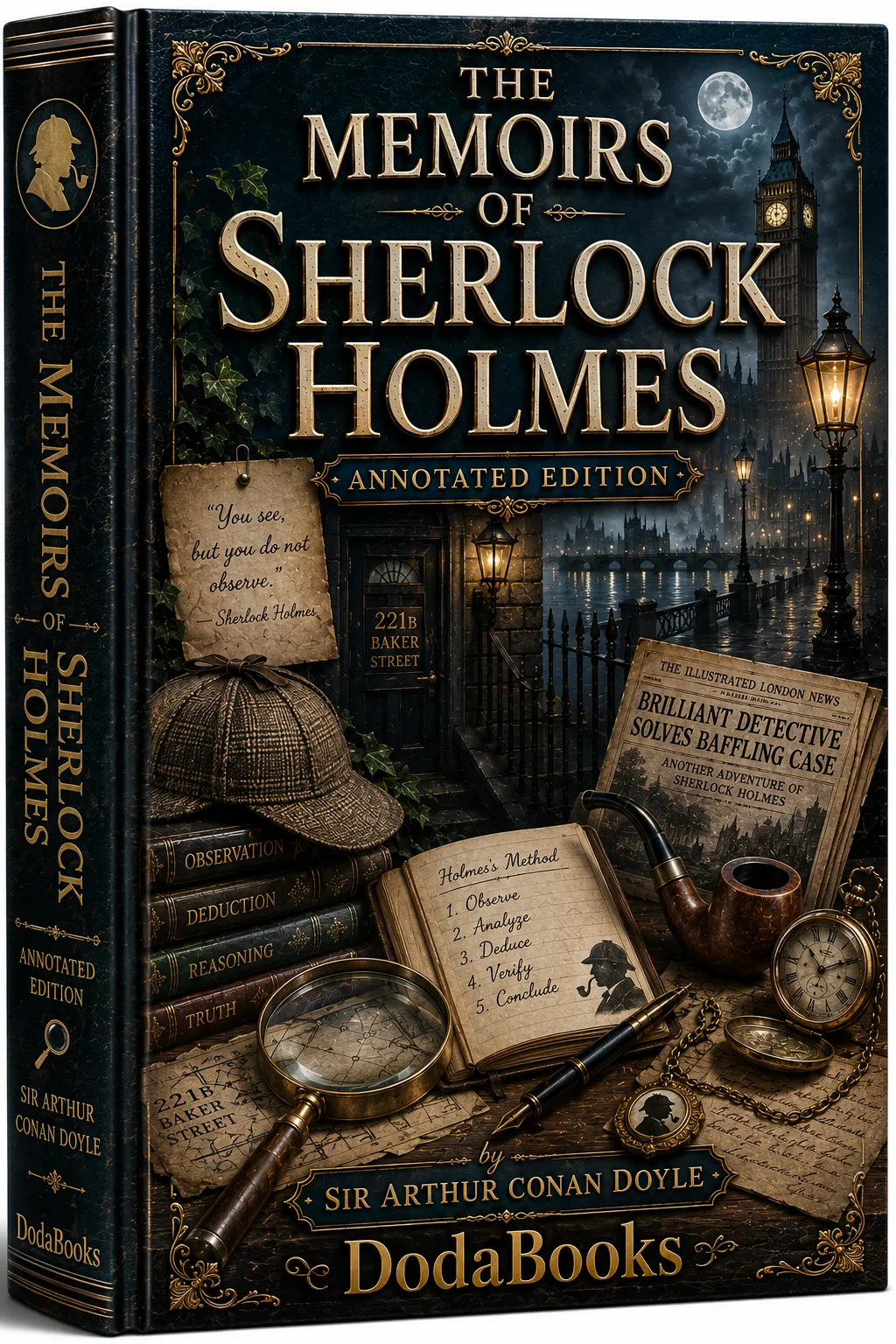
Arthur Conan Doyle’s The Memoirs of Sherlock Holmes is the collection that electrified and infuriated the world — eleven cases including “The Final Problem,” the story in which Holmes and Professor Moriarty fall together into the Reichenbach Falls. This guide covers the collection, the famous death, and the DodaBooks Annotated Edition.
🪨
The Memoirs of Sherlock Holmes
The naval treaty. The Greek interpreter. The man with the twisted lip. And, in "The Final Problem," the death of the world's most famous detective at the Reichenbach Falls. The collection that ended an era.
| Author | Arthur Conan Doyle |
| Published | 1894 (stories 1892–1893) |
| Genre | Detective short stories |
| Stories | 11 cases, ending with “The Final Problem” |
| Best For | Holmes fans, short-story readers, literary history |
| Reading Time | 6–8 hours |
🪨 The Collection
Published in 1894, The Memoirs collects the second season of Sherlock Holmes stories — and it is, by common consent, the collection that made the character’s fame explode, then brought him crashing down. Within its pages: the retired Navy man driven nearly mad by a treaty’s disappearance; a murderer who lives above a beggar’s disguise; the brilliant Greek interpreter Mycroft’s first appearance; a train-crash of a case with a hidden treasure; and “Gloria Scott,” the story where Arthur Conan Doyle finally told us how Holmes came to be a detective.
Then the ending. Conan Doyle was exhausted with Holmes, and in December 1893 he wrote “The Final Problem,” sending Holmes and his arch-enemy, Professor Moriarty, over the edge of the Reichenbach Falls in Switzerland, locked in a death-grip. The Edwardian public was devastated. They didn’t know (how could they?) that Conan Doyle would be forced to bring him back.
“I do not think that I have a word left to say at the end of the novel, except to wish you good-by.”
⚰️ The World Mourned a Fictional Man
When “The Final Problem” appeared, readers mourned in the streets. Men wore black armbands. The Strand lost tens of thousands of subscriptions. A London clerk was reported to have cried out on the Strand: “Good heavens, sir, do you know they’ve killed the man!” — using the present tense, as if Holmes had truly died of typhoid on the 3rd of May.
The story’s power depends on details the average reader skips: Conan Doyle chose the Reichenbach Falls for its real, documented history of deadly accidents, and he invented Moriarty single-handedly, making him a colossus strong enough to justify Holmes’s death. The annotated edition rebuilds both facts — the place and the legend — so that a century-old episode can still land with its original force.
🔍 The Annotated Layer, Case by Case
Passage-Specific Cards
Visible, color-coded annotations placed beside each story's key passages.
The Deductions
Holmes's reasoning unpacked line by line in the famous logical passages.
Victorian Society
Class, manners, household and legal life of the 1890s behind the cases.
The Crime World
Moriarty's web, Baker Street irregulars, and the underworld of gaslight London.
How the Canon Grew
First appearances — brother Mycroft, etc. — and developing continuity.
The Final Problem
The Reichenbach story's real context, in full, including its aftermath.
📘 Annotated Insight — The Death That Couldn’t Stick
Conan Doyle’s “The Final Problem” ends with Watson reading Holmes’s final message. But the collection’s last page famously hedges — “the most perfect reasoning and observing machinery that the world has seen” — and Victorian readers caught the hedge immediately. Within eight years the pressure was so intense that Conan Doyle wrote The Hound of the Baskervilles and then “The Empty House,” bringing Holmes back. The annotations trace the whole saga, including the famous hollow sculpture of the falls.
📜 Archivist of a Legend
The Memoirs set off the modern celebrity-fandom relationship: the outcry over a character’s death, the resurrection demanded by letters, the economics of serial fiction. The collection is the hinge of the entire Holmes canon — after it, the detective could never die for good, and the mythos became a staying world.
The Memoirs is where the legend palaces its heart. The annotated edition keeps both the brilliance and the catastrophe in view.
🗺️ The Stories, Case by Case
For all its legendary ending, The Memoirs is first a collection of superb short stories, and it rewards reading them as a run. The volume opens with “Silver Blaze,” the case of a racehorse and the famous “curious incident of the dog in the night-time” — the moment that has become shorthand for Holmes’s insistence that the absence of a clue is itself a clue. It closes with “The Final Problem,” and in between sit some of the character’s most fondly remembered adventures. “The Greek Interpreter” introduces Holmes’s elder brother Mycroft; “The Gloria Scott” flashes back to the young Holmes’s very first case, the one that set him on the road to detection; and “The Naval Treaty” is a taut political thriller in which a careless clerk and a stolen document put the fate of nations at risk.
There is real variety here. Some stories are near-perfect whodunits, others are more like psychological studies or disguised autobiographies. Read straight through, they show Doyle experimenting with the form he had invented — stretching the mystery, the confession, and the locked-room puzzle in ways that later detective writers would spend decades refining. If you want to compare stages of the character’s development, our guide to the earlier Adventures of Sherlock Holmes shows the first-season Holmes at his most brilliant, while The Sign of the Four gives you the novel Holme's growing fame was built on.
🏛️ Holmes in History: The 1890s Moment
To understand The Memoirs, it helps to understand the world it was born into. The stories were written across 1892 and 1893, near the height of the popularity of The Strand Magazine, where each case first appeared accompanied by Sidney Paget’s now-iconic illustrations. Paget’s drawings — the deerstalker hat, the Inverness cape, the pipe — fixed the image of Holmes in the public mind so completely that every later actor has been measured against them, even though Doyle never described the hat at all.
This was also a golden age of science in the popular imagination. The same years that gave readers Holmes’s deductions also gave them an expanding faith in observation, forensics, and the idea that careful reasoning could solve any puzzle. Holmes, with his “science of deduction,” was the hero of that faith — a reassuring figure in a rapidly industrialising London. The annotated edition sets each story in this context, showing how the cases reflect 1890s anxieties about empire, class, crime, and the city itself.
💀 Why the Death of Holmes Was So Shocking
We can easily forget, reading with the whole canon in hand, how unprecedented “The Final Problem” felt in 1893. Readers expected series characters to keep going; killing off a beloved hero was a genuine shock, and it was widely reported as almost a real death. The outcry is a fascinating piece of literary history in its own right — a reminder that serial fiction had already, more than a century ago, created the celebrity attachment we now take for granted.
Doyle’s own reasons were personal and practical. He felt the character was trapping him, taking time from the historical novels he wanted to write, and he saw an end as the cleanest escape. What he could not have predicted was how loudly the public would object, or how the death would bind Holmes even more tightly to the popular imagination — a resurrection-demanding love affair that the annotations trace all the way to “The Empty House.”
📖 How to Read The Memoirs Today
The good news for modern readers is that The Memoirs is short, episodic, and perfectly designed for dipping into. You do not need to read it straight through. Each case stands alone, so you can start with the most famous (“Silver Blaze”), read the flashback (“The Gloria Scott”) when you want backstory, and save the climactic “Final Problem” for a single focused sitting. Because the stories were written to be read in magazines, they reward small, contained reading sessions better than a novel does.
That said, there is pleasure in the full arc. Read as a collection, the book tells two stories at once: the growth of the world’s most famous detective and the mounting exhaustion of his author, right up to the point where Doyle decided to end it all. That tension — between invention and fatigue — is part of why The Memoirs feels so alive and so strange.
❓ Frequently Asked Questions
Is The Memoirs a good entry point to Holmes?
It’s among the strongest collections and includes “The Final Problem.” New readers may prefer to start with the earlier Adventures, but if you want the full saga including the death, this is indispensable.
Does "The Final Problem" really kill Holmes?
In-story, yes — Holmes and Moriarty both fall. The twist every reader eventually learns: Conan Doyle resurrected Holmes in 1903 in “The Adventure of the Empty House,” explaining the survival in a way the annotations dissect.
How many stories are in it?
Eleven, from “Silver Blaze” (the famous “curious incident of the dog in the night-time”) through “The Crooked Man,” “The Resident Patient,” “The Greek Interpreter,” and the closing “Final Problem.”
Why is Mycroft Holmes important?
“The Greek Interpreter” introduces Holmes’s elder brother — larger, lazier, and more brilliant — who forms the head of a private intelligence network. Later canon and countless adaptations make Mycroft one of the most beloved recurring characters.
Is this version different from The Case-Book?
Different era and mood. The Memoirs (1892–93) are energetic Victoriana; the Case-Book (1921–27) is darker and modern. Reading both gives you the full arc of Holmes.
Which story should I read first?
If you only read one, start with “Silver Blaze” — it contains the famous “curious incident of the dog in the night-time” and shows Holmes at his sharpest in a relatively light case. If you want the collection’s emotional arc, read the stories in order so the finale lands with full force.
Do I need to read the earlier novels first?
Not at all. Each story stands alone, and the collection gently reintroduces Holmes and Watson for new readers. That said, reading A Study in Scarlet and The Sign of the Four first adds richness to the recurring characters and makes “The Final Problem’s” impact even greater.
📚 Related Articles
🪨 Witness the Death That Shook a Nation — Annotated
Experience eleven classic cases plus the infamous ending, with full context:
- ✅ Complete 1894 text — all eleven stories
- 🗂️ Passage-specific annotation cards — visible, color-coded
- 🕵️ Deductions unpacked in every famous logical passage
- 🎩 Victorian context — the society behind the crimes
- 🔒 DRM-free — read on any device
- 📥 Instant download — EPUB format
For the pioneer who brought authentic laboratory science and forensic pathology into detective fiction, read our guide to Helen Vardon’s Confession Guide.
To follow the birth of pre-WWI secret service networks and Mediterranean code-breaking, explore William Le Queux’s spy classic in our The Dangerous Game Guide.