Arthur Conan Doyle’s The Hound of the Baskervilles (1902) is the most famous of all Sherlock Holmes adventures, a masterful blend of detective fiction, gothic horror, and atmospheric suspense. When Sir Charles Baskerville is found dead on the grounds of his Devonshire estate, the ancient curse of the Baskervilles — a phantom hound said to haunt the family — seems to have claimed another victim.
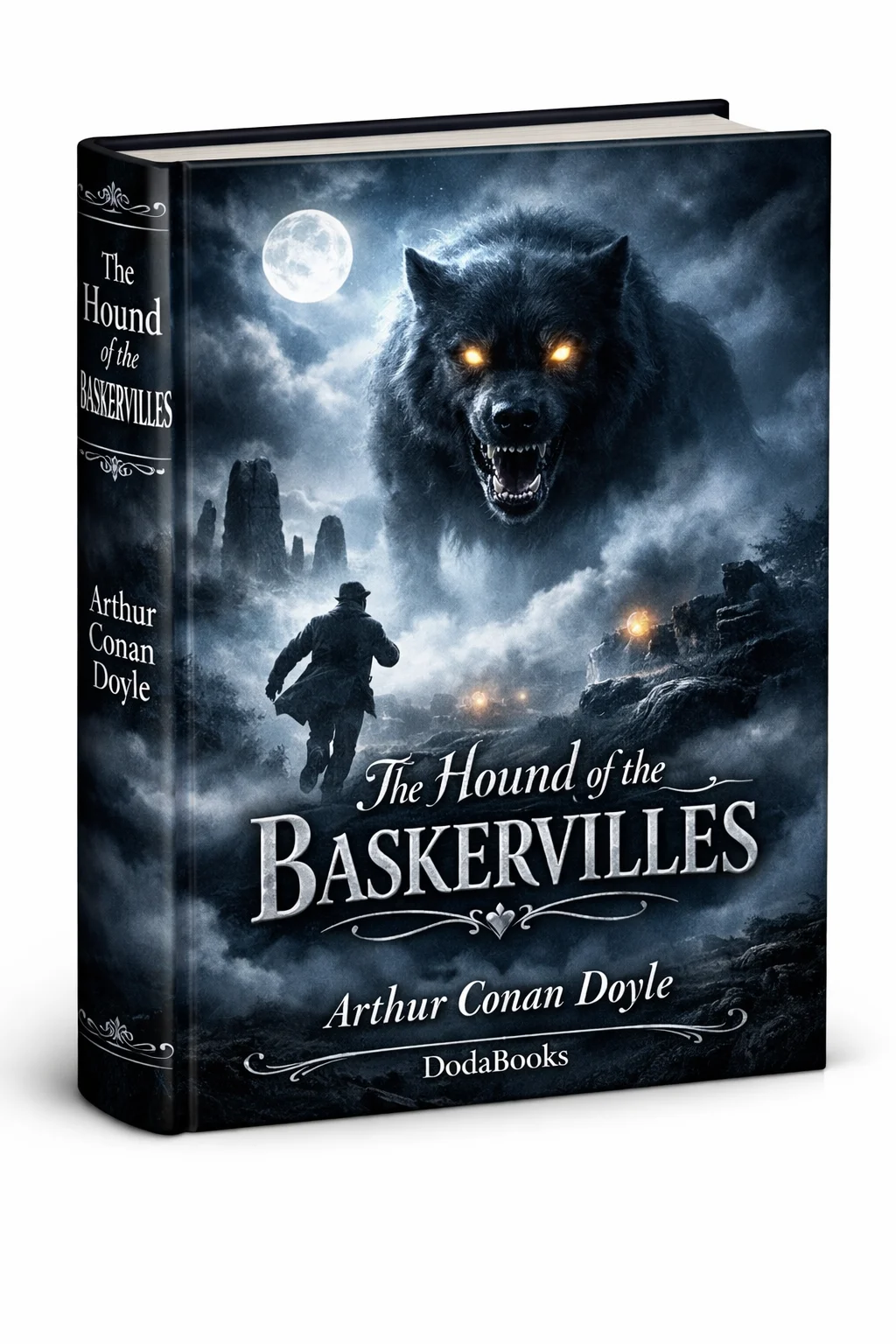
🐾
The Hound of the Baskervilles
Sherlock Holmes and Dr. Watson investigate a centuries-old legend of a demonic hound haunting the Baskerville family on the desolate moors of Dartmoor.
| Author | Arthur Conan Doyle |
| Published | 1902 |
| Genre | Mystery, gothic horror |
| Chapters | 15 |
| Setting | Baskerville Hall, Dartmoor, Devon |
| Series | Sherlock Holmes |
🐾 The Story
When Sir Charles Baskerville is found dead on the grounds of his Devonshire estate with a look of terror on his face, the ancient curse of the Baskervilles — a phantom hound said to haunt the family — seems to have claimed another victim.
Enter Sherlock Holmes and Dr. John Watson. With Holmes detained in London on another case, Watson is dispatched alone to Baskerville Hall to protect the young heir, Sir Henry Baskerville, who has just arrived from Canada. On the fog-shrouded moor, Watson encounters a desperate convict on the run, a beautiful woman with a secret, and the eerie howling that drifts across the desolate landscape at night. His reports to Holmes grow increasingly alarmed as the net tightens around Sir Henry.
The novel’s central tension is the clash between a rational detective’s worldview and a legend that defies explanation. Dr. Mortimer, the family physician, brings the case to Holmes carrying a manuscript that recounts the curse: how an ancestor, the cruel Hugo Baskerville, was hunted down by a great demonic hound after abducting a yeoman’s daughter and dragging her across the moor. According to the legend, the hound has haunted the family ever since, and Sir Charles’s death — his face frozen in horror, his footprints showing no sign of flight — seems to fit the curse to the letter.
As Watson settles into Baskerville Hall, the pieces multiply: the baronet’s hinted warnings against the moor, the strange and solitary figures who appear and vanish in the mist, and the tangled loyalties of everyone connected to the estate. Late in the novel, Holmes at last leaves London for the moor, and the story pivots from Watson’s journal-filled suspense to a headlong, rain-soaked confrontation in which deduction and superstition finally meet face to face. The solution — earned, plausible, and deeply satisfying — reasserts the power of reason over fear while never losing the chill of the supernatural atmosphere that precedes it.
🏛️ Historical & Cultural Context
The Hound of the Baskervilles arrived at a fascinating moment in the Sherlock Holmes saga. In 1893 Doyle had famously killed off Holmes at the Reichenbach Falls in “The Final Problem” — yet by 1901, public demand and financial incentive drew him back. The Hound of the Baskervilles, though set before Holmes’s “death” and resurrection, was the story that brought the detective back into the public eye, serialized in The Strand Magazine in 1901–1902 before appearing as a novel. It opened the door for the eventual return of the character to full-time service.
The book also synthesizes the two great traditions of Victorian popular fiction. The best-known of all the Holmes adventures, it is as much a gothic horror tale as a detective story — the cursed family, the desolate moor, the spectral hound, the ancestral sin demanding a terrible reckoning are the stock-in-trade of the gothic novel. Doyle’s great achievement was folding that supernatural machinery into a rational mystery and letting readers believe, for hundreds of pages, that the two might truly be in conflict. For another flourish of nineteenth-century gothic pressed into a story of detection and decline, our guide to Bram Stoker’s Dracula explores the same appetite for terror in elegant prose.
The Dartmoor setting is also deliberately real. Dartmoor’s famous granite tors, deep and dangerous mires, and the aptly named Grimpen Mire give the story a grounded physical reality that grounds its fantasy. Doyle’s Devon — rainy, windswept, and impossibly remote — is as much a character as any person in the book, and the setting’s authenticity is a large part of why the dread feels so convincing.
🕵️ Characters, Themes & What to Look For
The novel’s cast is small and perfectly balanced. Sherlock Holmes spends much of the book offstage, which makes his eventual entrance all the more dramatic — when he finally appears on the moor, he is at his most commanding and mysterious. Dr. Watson gets his finest hour here, working alone in the field for long stretches; his courage, decency, and occasional frustration make him the reader’s stand-in, and his first-person narration keeps the menace immediate. Sir Henry Baskerville is the likable, warm-hearted heir whose return from Canada reopens the old curse, and Dr. Mortimer supplies the legend and the scientific skepticism that frame the whole mystery. Around them gather the ambiguous figures of the moor — including Stapleton, the naturalist neighbor whose apparent helpfulness may conceal far more.
Look for the themes that make the novel resonate. Reason versus superstition is the heart of the book — the reader is invited at once to believe in the hound and to distrust it. Isolation and the landscape as menace colors every scene, as the moor becomes a symbol of the unknown that surrounds and threatens rational order. The sins of the past returning drives the plot, and Doyle keeps the question of ancestral guilt alive right up to the final chapter.
✨ Why It Still Matters Today
The Hound of the Baskervilles remains the ideal gateway into the Sherlock Holmes canon — with good reason. It needs no prior knowledge of the series, it showcases Holmes and Watson at their most appealing, and it delivers a genuinely gripping mystery on top of its gothic atmosphere. More than a century after its serialization, it is still regularly adapted for film, radio, and television, and its image of the phosphorescent hound looming out of the Dartmoor mist remains one of the most iconic in all of popular fiction.
If this is your first taste of Holmes, the rest of the canon awaits. The detective’s debut adventure, A Study in Scarlet, and the duo’s second novel, The Sign of the Four, both reward reading in sequence, while the late The Valley of Fear revisits the novel-length form with a thrillingly constructed second half. For shorter adventures, the collected stories in The Adventures of Sherlock Holmes are an excellent next step after the case of the Baskerville hound.
📖 About This Edition
Doyle weaves together a gripping mystery that pits rational deduction against supernatural terror, all set against the brooding backdrop of Dartmoor. This edition presents the complete 1902 text, carefully formatted for modern e-readers.
Zero Distractions
No ads, no license pages — just the complete text, clean and uninterrupted.
Smart Typography
Curly quotes, em-dashes, proper ellipsis — typeset with care for a premium reading experience.
Chapter Navigation
Full table of contents with navigation to each of the 15 chapters — easily jump between them.
Cleaned & Polished
All Gutenberg boilerplate stripped, consistent formatting throughout the text.
No DRM
You own your copy — read on any device, anytime, forever.
Instant Download
EPUB format included, delivered instantly after purchase.
❓ Frequently Asked Questions
Is this a standalone story?
Yes. While it features Sherlock Holmes and Dr. Watson, The Hound of the Baskervilles is a self-contained novel that requires no prior knowledge of the series.
Is the hound real or supernatural?
Without spoiling the story, Doyle masterfully keeps the question open until the final chapters. The novel’s brilliance lies in how it pits rational deduction against the terror of the unknown.
How long does it take to read?
At 197 pages across 15 chapters, most readers finish in 4-6 hours. It is the perfect length for a weekend read.
Is this the best Holmes story to start with?
Many readers consider it the ideal entry point to the Sherlock Holmes canon. It showcases Holmes at his finest, Watson in the field, and a genuinely gripping mystery from the first page to the last.
How scary is it?
It is atmospheric rather than graphic. The horror comes from mood — the fog, the moor, the howling in the night — and from the psychological dread of a supernatural claim, rather than from violence or gore. Sensitive readers may find it spooky, but it is far gentler than modern horror.
Where does it sit in the Sherlock Holmes series?
It is the first of the four Sherlock Holmes novels to be written in chronological order of publication but is set before the timeline of Holmes’s apparent death and return. It works perfectly on its own, though readers of the whole canon will spot references to events elsewhere in the series.
Why does the story take place in the countryside rather than London?
Doyle deliberately set most of the action on the remote Dartmoor moor to isolate the characters and build the gothic atmosphere that makes the mystery so chilling. London and Baker Street appear only at the edges, as a reminder of the rational world the moor threatens.
📚 Related Articles
🐾 Read the Greatest Holmes Adventure
Arthur Conan Doyle’s The Hound of the Baskervilles is the most famous of all Sherlock Holmes stories. The DodaBooks edition presents the complete 1902 text:
- ✅ Complete 15-chapter text — the full novel
- ✒️ Smart typography — curly quotes, em-dashes, proper ellipsis
- 📜 Full table of contents with chapter navigation
- 🔒 DRM-free — read on any device, anytime
- 📥 Instant download — EPUB format