Sir Philip Sidney’s Arcadia stands as one of the most ambitious and enchanting works of Elizabethan literature. Begun as a diversion for his sister Mary, Countess of Pembroke, it grew into a sprawling prose romance that weaves together tales of heroic princes, beautiful princesses, dangerous adventures, and pastoral idylls with extraordinary richness and invention.
🏹
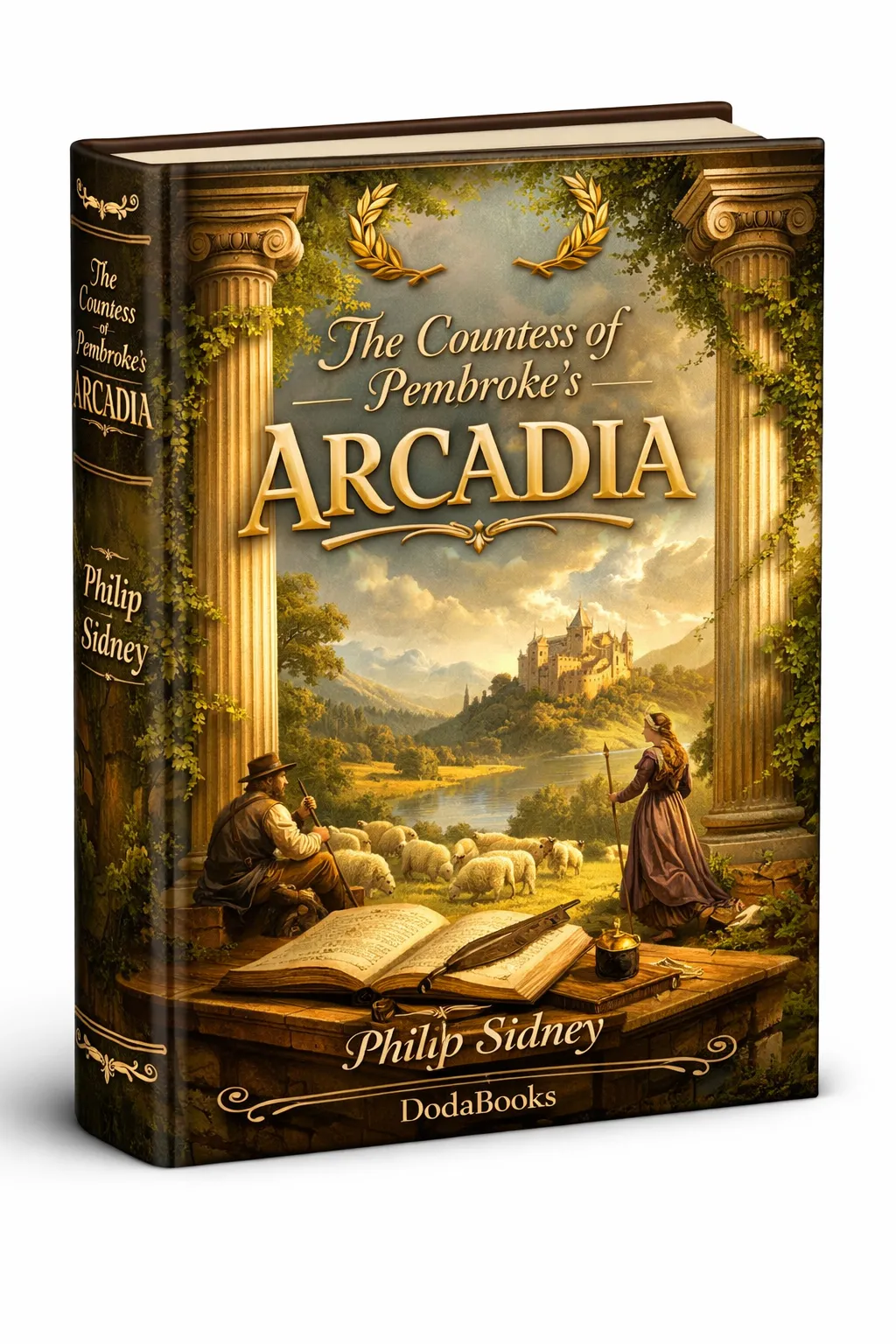
The Countess of Pembroke's Arcadia
A pastoral romance of chivalry, love, and adventure from the Elizabethan age's most celebrated poet-courtier.
| Author | Sir Philip Sidney |
| Published | 1590–1593 |
| Genre | Classic fiction, prose romance |
| Chapters | 11 books |
| Setting | Arcadia (ancient Greece) |
| Legacy | A landmark of English Renaissance literature |
🏹 The Story
The story follows two young princes, Pyrocles and Musidorus, who fall in love with the daughters of Duke Basilius of Arcadia. The duke, seeking to escape a troubling oracle, has retreated to a pastoral lodge with his wife and daughters, setting in motion a series of disguises, misunderstandings, battles, kidnappings, and trials of virtue. Sidney peoples his Arcadia with a memorable cast: the noble but misguided Basilius, the wise and courageous Pamela, the gentle Philoclea, the passionate Gynecia, and a host of shepherds, knights, and villains.
Beyond its thrilling narrative, the Arcadia is a meditation on love, honour, friendship, and the nature of rule. Sidney fills his pages with philosophical digressions, poetic eclogues, and rhetorical set-pieces that showcase his dazzling literary skill.
The tale itself is a double romance in a green world. When Duke Basilius, alarmed by an ominous oracle, retires from his palace to a rustic lodge with his queen Gynecia and his two daughters, Pamela and Philoclea, the arrival of two wandering princes sets the machinery turning. Pyrocles, to reach the gentle Philoclea, disguises himself as the Amazon warrior Zelmane; his cousin Musidorus, to win the proud Pamela, dresses as the shepherd Dorus. From then on nobody sees anyone clearly: the duke falls for the supposed Amazon, the queen falls for her with a far more dangerous passion, and the two princes must steer between farce and disaster inside a hall of mirrors.
In the later, heroic version of the story Sidney was revising when he died, the intimate comedy expands into something more epic. The princesses are carried off and imprisoned in a fortress by the wicked Cecropia and her son Amphialus; the green world fills with sieges, single combats, and tournaments; and the romance takes on a tragic gravity. The composite text presented here fuses the two designs, and the seams between private comedy and public heroism are part of its strange music.
Whatever form readers meet it in, the full Arcadian apparatus is on display: shepherds singing eclogues between the books, oracles and prophecies, long philosophical conversations, and the trial of the two princes before the judge Euarchus that brings the whole romance to its formal, pageant-like close.
📖 About This Edition
The work exists in two versions — the original “Old Arcadia” and an expanded, unfinished revision — and this edition presents the complete text of the 1593 composite, including the Sixth Book added by Richard Bellings in the seventeenth century. It has been carefully prepared from the 1907 George Routledge text edited by Ernest A. Baker, with clear chapter divisions and modern typography for comfortable reading.
Zero Distractions
No ads, no license pages — just the complete text, clean and uninterrupted.
Smart Typography
Curly quotes, em-dashes, proper ellipsis — typeset with care for a premium reading experience.
Book Navigation
Full table of contents with navigation to each of the 11 books — easily jump between them.
Cleaned & Polished
All Gutenberg boilerplate stripped, consistent formatting throughout the text.
No DRM
You own your copy — read on any device, anytime, forever.
Instant Download
EPUB format included, delivered instantly after purchase.
🏛️ Historical & Cultural Context
Philip Sidney (1554–1586) was the Elizabethan ideal made flesh: courtier, diplomat, soldier, and poet. He wrote the Arcadia in the early 1580s, largely to entertain his beloved sister Mary, Countess of Pembroke, at Wilton House, and he never intended it for print. The romance circulated in manuscript for years, copied by hand among an admiring circle, and reached the world at large only after his death.
Sidney’s death at only thirty-one, from a wound received at the battle of Zutphen, turned him into England’s great might-have-been, and the Arcadia, assembled from his papers and published in 1590 and 1593, became an instant landmark — the most admired extended prose fiction in English to that date, studied as a style manual, a moral mirror, and a delight. This edition follows the 1593 composite that combined the unfinished “New Arcadia” with the “Old Arcadia”’s conclusion, together with a Sixth Book later supplied by Richard Bellings.
The Arcadia did not spring from nowhere. Sidney grafted two Continental traditions onto English soil: the pastoral world of Jacopo Sannazaro’s own Arcadia and, decisively, the Greek romances recovered in the Renaissance, above all Heliodorus’s Aethiopica, with their shipwrecks, captivities, and astonishing reunions. Those same two traditions fed the French heroic romances of the seventeenth century and the pastoral and romantic modes of English poetry for two hundred years: when Shakespeare, Spenser, and their successors evoked endangered princesses and heroic virtue, they were writing in a register Sidney had tuned.
🔮 Characters, Themes & What to Look For
The two princesses give the romance its moral poles. Pamela, the elder and prouder, meets her imprisonment with philosophy and unshakeable courage; Philoclea, gentle and yielding, possesses a humility that becomes its own strength. The two princes model the friendship-and-honour bond Renaissance readers prized above romance itself, and Sidney is sly even about the ideal — the disguises stretch the notion of heroic identity so far that it nearly becomes parody. Around them circle Basilius’s foolishness, Gynecia’s doomed passion, and, in the heroic sections, Cecropia, one of the great literary villains of the age.
Three themes carry the intellectual load. Love is the proving ground of virtue: Sidney’s lovers must choose rightly under disguise, temptation, and threat. Friendship and honour are tried to the breaking point among princes and allies. And rule — what separates a good king from a tyrant — runs beneath the whole, surfacing in the trial scene and in the book’s meditations on government. Read deeply, the Arcadia is as much a political mirror for courts as it is a love story.
For first-time readers the romance asks a little patience and repays it generously. The syntax runs long and the rhetoric is ceremonial; give the style half an hour of attention and it turns from labour into luxury. Then look for the set-pieces — the eclogues between the books, the trial of the princes, the kidnapped princesses on their fortress walls — the moments when Sidney’s prose rises to spectacle.
✨ Why It Still Matters Today
Long dismissed by readers who took “romance” to mean nothing more than a love story, the Arcadia has been reclaimed in recent decades as a fountainhead of English prose fiction — the place where the modern novel’s deep well begins. Before Sidney, extended prose narrative in English ran a thin stream; after the Arcadia, a whole European tradition of imaginative prose fiction took shape, running down through the heroic romances and into the modern novel.
The right companions make the point. The chivalric romances of Chrétien de Troyes gathered in our guide to the Four Arthurian Romances show the older verse tradition the Arcadia absorbed; the story-tellers collected in the Thousand Nights and a Night share its appetite for nested tales and high adventure; and anyone who loves the poetic legend-making of a work like The Lady of the Lake will recognize the same longing — a beautiful landscape saturated with story. Sidney’s Arcadia is the shelf where all of them meet.
❓ Frequently Asked Questions
What is the Arcadia about?
It is a pastoral romance following two princes, Pyrocles and Musidorus, who fall in love with the daughters of Duke Basilius. Disguises, battles, kidnappings, and philosophical digressions drive the narrative forward in this sprawling Elizabethan masterpiece.
Is this the same as the "Old Arcadia"?
Sidney wrote two versions. The “Old Arcadia” is a simpler, shorter version. He later began a massive revision (the “New Arcadia”) that breaks off mid-sentence. This edition presents the 1593 composite that combines both.
How long does it take to read?
At over 1,000 pages, this is a substantial read — most readers finish in 20-30 hours. The book is divided into 11 parts with poetic eclogues between them, making it suitable for sustained reading over weeks.
Do I need to know Renaissance literature to enjoy it?
No. While the language takes some adjustment, Sidney’s storytelling is accessible and rewarding. The romance, adventure, and wit translate across centuries.
Why "the Countess of Pembroke" in the title?
Mary Sidney, Philip’s sister, was the romance’s dedicatee and midwife: it was written at her home and for her pleasure, circulated in manuscript among her literary circle, and was first brought to print in 1590 and 1593, after Sidney’s death, under her auspices. The title is at once a dedication and a compliment.
What is a "pastoral" romance?
A pastoral sets its story in an idealized countryside of shepherds, eclogues, and rustic simplicity. In the Arcadia, Sidney layers that shepherd world with princes in disguise, knightly adventure, and philosophical debate — the pastoral frame is partly a game, because real princes keep crashing the rustic party.
Should a first-time reader start with the Old Arcadia or the New Arcadia?
The 1593 composite presented here is the classic entry point: it gives Sidney’s expanded, heroic version and then completes the story in the manner of the Old Arcadia — which is how most English readers have met the book for over four centuries. Purists go back to the Old Arcadia afterward for its tighter, more symmetrical plot.
📚 Related Articles
🏹 Read the Elizabethan Masterpiece
Sir Philip Sidney’s Arcadia is one of the most ambitious and enchanting works of Elizabethan literature. The DodaBooks edition presents the complete 1593 composite text:
- ✅ Complete 11-book text — the full Arcadia including the Sixth Book
- ✒️ Smart typography — curly quotes, em-dashes, proper ellipsis
- 📜 Full table of contents with book navigation
- 🔒 DRM-free — read on any device, anytime
- 📥 Instant download — EPUB format