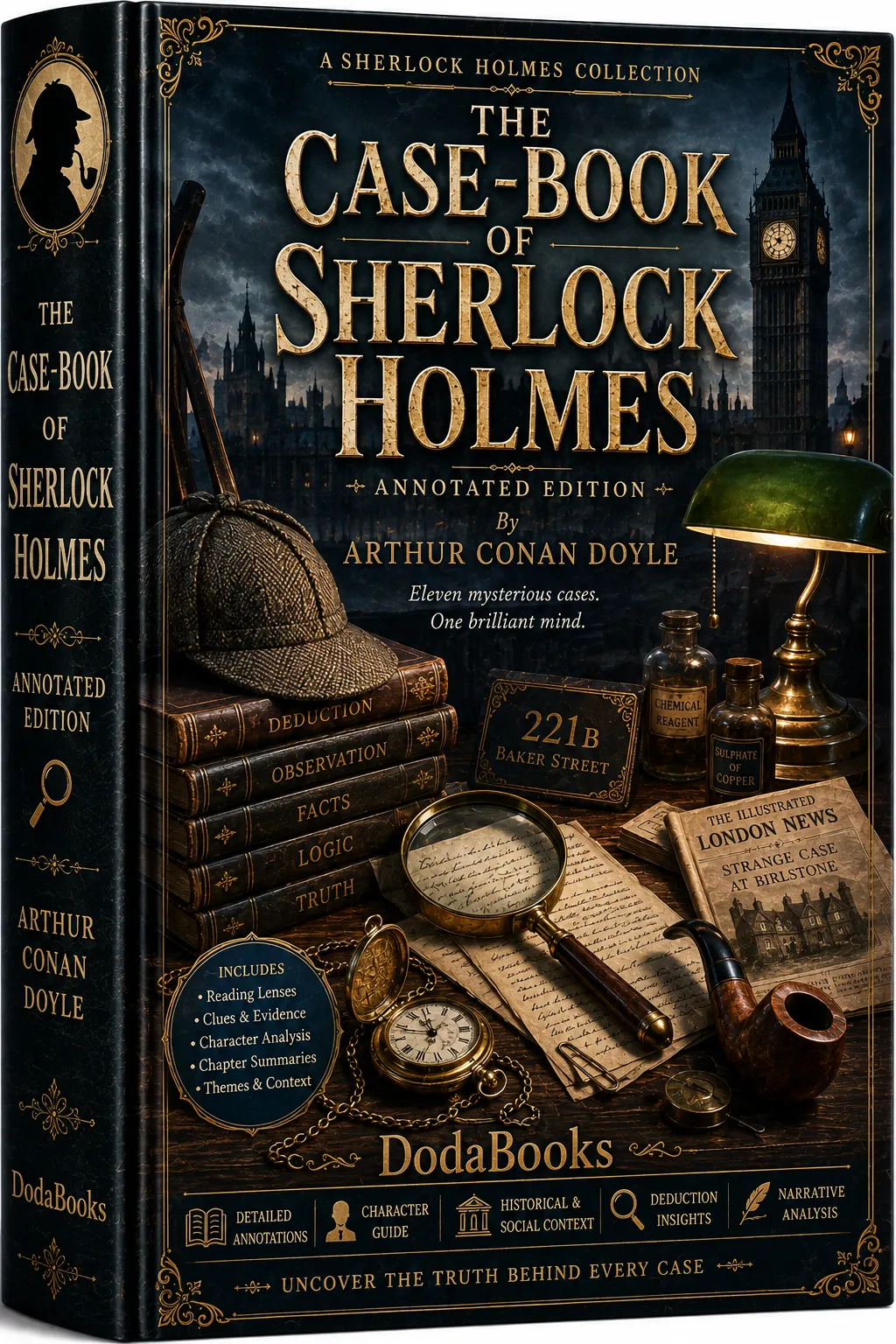
Arthur Conan Doyle’s The Case-Book of Sherlock Holmes is the twelfth and final Sherlock Holmes collection — twelve stories written at the end of the detective’s long reign, stranger, darker, and more modern than anything that came before. This guide unpacks the Case-Book’s unusual tone and how the DodaBooks Annotated Edition frames the final act of the world’s most famous detective.
⚫
The Case-Book of Sherlock Holmes
Twelve final cases from a grayer, more ambiguous Holmes — poisoners, maniac husbands, congenial monsters, and crimes with no tidy solution. The end of the canon, in full.
| Author | Arthur Conan Doyle |
| Published | 1927 (stories 1921–1927) |
| Genre | Detective short stories |
| Stories | 12 cases |
| Best For | Holmes completists, mystery readers, 1920s enthusiasts |
| Reading Time | 7–9 hours |
⚫ The Collection
Published two years before Conan Doyle’s death, The Case-Book collects the stories of his final decade as a crime writer — and it shows. These are not the confident Victorians of The Adventures. The world is modern, the crimes are messier, and Holmes himself is older, more authoritarian, and more unsettling. Several stories border on noir; others read almost like horror vignettes (one is famously inspired by the real-life Monster of Düsseldorf, Peter Kürten, whom a police commissioner asked Conan Doyle to examine).
The twelve cases include the lantern-jawed horror of “The Adventure of the Creeping Man,” the uncanny “The Adventure of the Sussex Vampire” (Holmes summoned to a case of a child bitten by a vampire — which is, of course, not vampires at all), the bizarre gnomes of “The Adventure of the Mazarin Stone,” and the genuinely grim “The Adventure of the Illustrious Client,” in which Holmes is beaten to a pulp for his trouble.
“There is nothing so unnatural as the commonplace.”
🕳️ A Darker Holmes
The difference from the earlier books is felt on almost every page. In The Case-Book, victims are often profoundly damaged by what has happened to them before a single clue is laid. Holmes’s deductions still dazzle, but he more often presides over moral ruin than neat resolution, and he will sometimes simply decide to keep a secret from the public — becoming, quietly, the judge the law cannot be.
That’s a genuinely modern move, and it’s why critics increasingly treat the Case-Book as essential rather than marginal. An annotated edition earns its keep here precisely because these stories assume you already know Holmes’s world — the edition’s context notes reconstruct what a 1920s reader would have brought to them.
🔍 The Annotated Layer, Tailored to the Twilight
Passage-Specific Cards
Visible, color-coded annotations beside every story in the collection.
1920s Context
Post-war society, celebrity, journalism, and the changing face of crime.
Moral Ambiguity
Why Holmes keeps secrets, spares criminals, and lets wrongs stand.
Gothic & Weird Color
The vampiric, ghastly, and uncanny underlayers of several tales.
Law & Justice
How far the law's machinery reaches — and where Holmes overrides it.
Canon Close
Continuity notes, retcons, and the final fate of 221B Baker Street.
📘 Annotated Insight — The Sussex Vampire Is Not About a Vampire
The title hook is bait. Beneath it lies one of the most painful domestic stories in the canon — a woman monstrously misread, a household ruined by jealousy. The annotations trace how Conan Doyle uses the supernatural title to hide a plain human tragedy, and how Holmes’s refusal to expose it becomes the point of the tale.
🏛️ A World Changed: Conan Doyle in the 1920s
To feel how far Holmes has travelled, it helps to remember where he began. In A Study in Scarlet, Doyle’s first Holmes story, the great detective was a young man with a science of deduction, dazzling Watson with the trick of reading a man’s history from his boots and his watch-chain. By the Adventures, he was the confident Victorian consulting detective, certain of his methods and his world. The Case-Book stories, written from 1921 to 1927, belong to a different England altogether — a country reshaped by the First World War, by mass journalism, by new scientific psychology, and by crime that no longer arrived neatly at Scotland Yard.
Doyle himself was different, too. He had tried to kill Holmes off in 1893 (the collection that first ended the legend, explored in our guide to The Memoirs of Sherlock Holmes), and spent decades writing historical novels and other experiments — yet the public kept demanding more Baker Street. When he finally returned to the detective in his last decade as a crime writer, he wrote a Holmes who had aged out of the old certainties. The Case-Book is full of cases that begin somewhere uncomfortable — a domestic tragedy, a scientific oddity, a horror story wearing the disguise of a crime — and it treats the 1920s world of celebrity, journalism, and psychology as just another set of clues.
🕰️ An Aging Holmes, A Quieter Farewell
One of the most striking things about the Case-Book, and the thing most readers miss on a first pass, is how deliberately it slows the great detective down. Holmes is no longer the restless younger man of the earlier canon. He has retired to a small farm on the Sussex Downs, between his beehives, and he solves these cases with the patience of a scholar rather than the swagger of a duelist. Two of the twelve stories — including “The Adventure of the Lion’s Mane” — are narrated by Holmes himself, and the shift in voice is the quiet point of the whole collection: the most famous narrator in crime fiction steps aside, and the detective tells his own story in a voice that is older, warier, and touched with melancholy.
This is the collection in which Holmes becomes, in the most literal sense, the last survivor of his own era. When he lets a wrong stand, or keeps a secret from the newspapers, he is behaving like a man who has seen enough of the century to distrust its certainties. Critics once treated the Case-Book as a curiosity; readers today increasingly see it as the most modern volume in the canon, and the essential companion to the confident stories of Holmes’s early years — those captured best in The Hound of the Baskervilles, where the detective still bestrides the moors like a force of nature.
🧭 How to Read the Case-Book
Begin with the earlier collections if you are new to Holmes — the Case-Book assumes you already know the Baker Street world and its rules, and it plays deliberately with your expectations of them. Once you have that foundation, read the twelve stories in order, and pay attention to the collection’s two experiments: crimes with no satisfying resolution, and mysteries that are barely crimes at all. “The Adventure of the Creeping Man” reads like a horror vignette dressed in detective clothes; “The Adventure of the Sussex Vampire” undresses its own Gothic premise on purpose; and “The Adventure of Shoscombe Old Place,” the final story Doyle ever wrote about Holmes, ends not with a flourish but with the word that hangs over the whole book — change.
📜 The Ending of an Era
Conan Doyle had tried to kill Holmes off in 1893; by 1927 he was instead letting him age out. The Case-Book’s final story, “The Adventure of Shoscombe Old Place,” ends not with a triumphant deduction but with a quiet, almost melancholy Holmes predicting “change and decay” — a farewell delivered without fanfare to the most famous fictional detective of the twentieth century.
For readers who want the full canon, the Case-Book is the true ending — and its context makes those final pages land.
❓ Frequently Asked Questions
Is the Case-Book different from the other Holmes collections?
Yes — noticeably. Written in the 1920s, the tone is darker and more modern: more psychological damage, more moral ambiguity, and a Holmes who behaves in ways the earlier books never imagined.
Which story is the most famous?
Ask ten readers and get ten answers, but the standouts include “The Problem of Thor Bridge,” “The Adventure of the Sussex Vampire,” and the genuinely gothic “The Adventure of the Creeping Man.” All are represented in the annotations.
Is it a good place to start Sherlock Holmes?
For newcomers, earlier collections are more accessible. But if you’re already a fan — or you love noir-adjacent mystery — this is where the canon becomes genuinely weird and wonderful.
Was the real serial killer really involved?
Peter Kürten, the “Monster of Düsseldorf,” was captured in 1929, and the German police asked Conan Doyle for his psychological insight. The Case-Book’s final story, “Shoscombe Old Place,” is loosely colored by the case. The annotations give you the full story.
How many stories should I expect?
Twelve complete short stories — several inspired by real Victorian-era crimes and sociological reports Doyle had kept for decades.
Who narrates the stories?
Watson narrates most of them, but two — “The Adventure of the Blanched Soldier” and “The Adventure of the Lion’s Mane” — are told by Holmes himself, writing from his retirement on the Sussex Downs. The change in voice is one of the collection’s quietest effects.
What is the final story in the Case-Book?
“The Adventure of Shoscombe Old Place,” the last Holmes story Conan Doyle ever wrote. It ends quietly, with Holmes reflecting on “change and decay” — a deliberate anti-climax after the theatrical endings of the earlier canon.
Did Conan Doyle write any other Holmes stories after 1927?
No — the Case-Book closes the canon. After it, Conan Doyle poured his energies into spiritualism and other causes, and Holmes passed entirely into the hands of his readers, filmmakers, and imitators.
📚 Related Articles
⚫ Read the True Ending of the Sherlock Holmes Canon
The Case-Book is the final word — read it with everything the earlier twenty years built:
- ✅ Complete 1927 text — all twelve stories
- 🗂️ Visit-able annotation cards — visible, color-coded, passage-specific
- 🎩 1920s context — journalism, psychology, and post-war society
- 🗡️ Moral ambiguity analyzed — Holmes as judge beyond the law
- 🔒 DRM-free — read on any device
- 📥 Instant download — EPUB format