H. P. Lovecraft’s The Call of Cthulhu is the 1928 story that created the Cthulhu Mythos and redefined supernatural horror — a tale told entirely through fragments: a dead sculptor’s relief, a sailor’s dying confession, a cult’s screaming ritual. This guide explains the story, its radical structure, and how the DodaBooks Annotated Edition cracks it open.
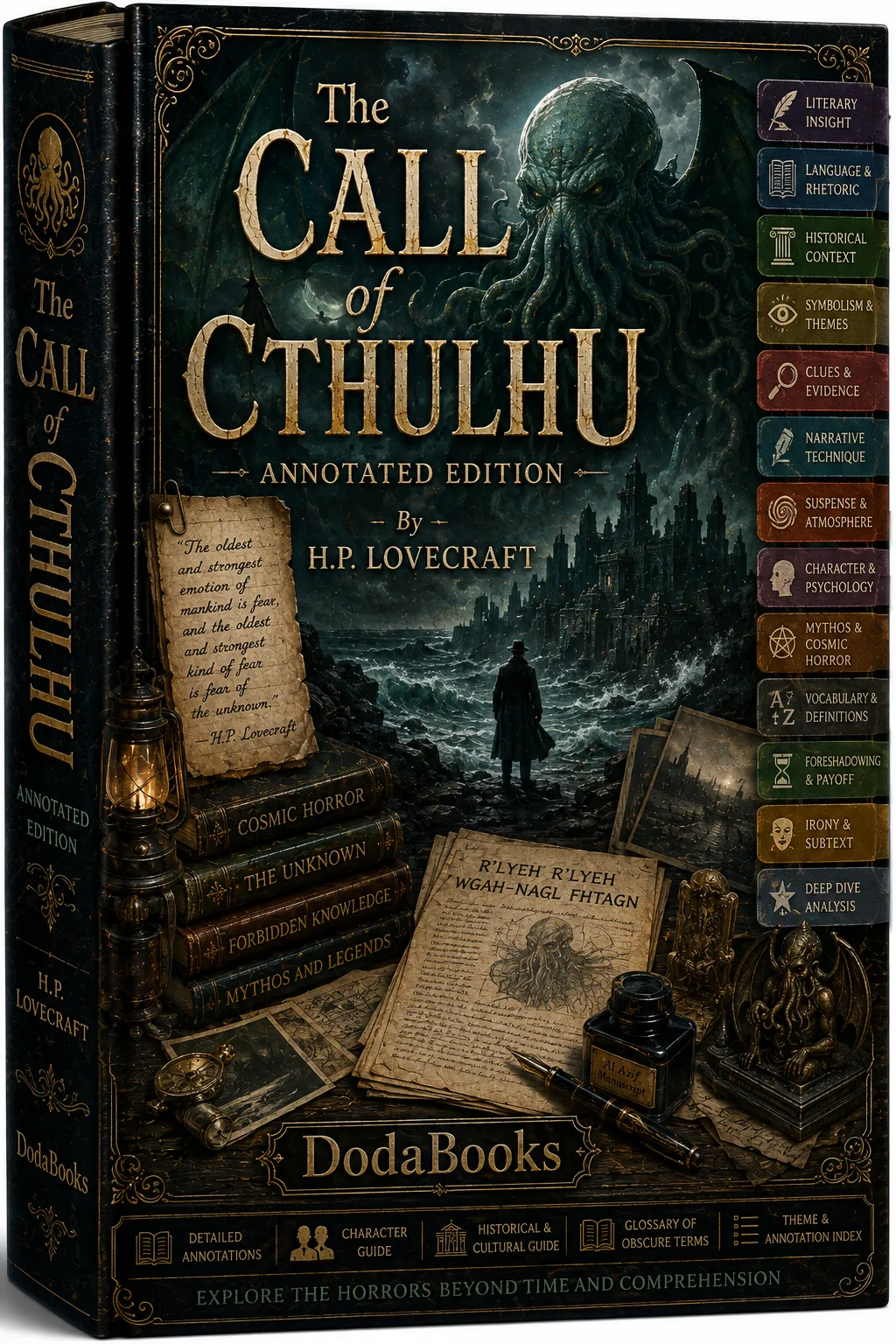
🐙
The Call of Cthulhu
When a professor dies, his nephew inherits a cardboard box full of madness: a bas-relief of a tentacled horror, newspaper clippings, a sculptor's visions, and a sailor's story. The most important horror story of the twentieth century.
| Author | H. P. Lovecraft |
| Published | 1928 |
| Genre | Cosmic horror, weird fiction |
| Setting | Providence, Louisiana, the South Pacific, the ocean floor |
| Best For | Horror fans, mythos readers, modern fantasy readers |
| Reading Time | 2–3 hours |
🐙 The Story
The story arrives in three fragments. First, the account of Francis Wayland Thurston, a man probing the papers of his late uncle, a professor of Semitic languages found dead in mysterious circumstances. The uncle’s effects include a bizarre bas-relief: a winged octopoid horror with a vaguely anthropoid outline — sculpted, terrifyingly, in his sleep by an artist who had been dreaming of it for weeks. The artist, Henry Wilcox, dies screaming within six months. Wilcox’s dreams connect him to “banner-less, colonnade-lined” cities beneath the sea and an immense, sleeping entity that calls to its worshippers.
Then, the sailor’s story: the crew of the Alert storms an island ritual — a howling, drumming mass of worshippers encircling a stone monolith and a blood-spattered idol — and the sailor’s dream of ceaseless screaming never ends. Finally, the report of two vessels: one that found an ancient, doorless, impossibly angled underwater city, and the shattering encounter with what rose from its depths.
“Ph’nglui mglw’nafh Cthulhu R’lyeh wgah’nagl fhtagn.” In his house at R’lyeh dead Cthulhu waits dreaming.
🧬 Why It Changed Horror
Before The Call of Cthulhu, horror villains were monsters with comprehensible motives: vampires sinned, ghosts revenged, werewolves hungered. Lovecraft’s horror was different — an entity of total cosmic indifference, beyond good and evil, whose waking would simply end the world as humanity knew it. The human race is not the story’s protagonist. It’s a rumor, a footnote, a dream.
That’s the thesis of the entire Cthulhu Mythos, and it’s why this 1928 story is the seed of everything from Alien to the modern cosmic-horror revival. The greatness of the piece is structural as much as thematic: Lovecraft tells the horror through documents and secondhand accounts, so every layer of distance adds to the dread rather than diluting it.
🏛️ Historical & Cultural Context
Lovecraft wrote The Call of Cthulhu in the autumn of 1926, alone in his small rented home in Providence, Rhode Island, and it was published in the February 1928 issue of Weird Tales — the pulp magazine that would become the unofficial home of his “cosmic horror.” By then Lovecraft was thirty-six and nearly all of his greatest work still lay ahead, but he had already perfected the strange literary instrument this story depends on: the framed narrative, where a narrator assembles documents that prove too much. It is the same architecture he had been building in earlier stories, and it would reach its fullest expression in the novellas that followed.
The story is rooted in its moment. The opening paragraph, one of the most famous in horror literature, sets the entire method to work:
“The most merciful thing in the world, I think, is the inability of the human mind to correlate all its contents.”
Lovecraft was fascinated by the archaeology and anthropology of his day — ancient religions, buried cities, the new science of comparative myth — and he wove those interests into a portrait of a cult sufficiently widespread and ancient to feel real. The famous couplet attributed to the fictional Necronomicon of Abdul Alhazred, which closes the story, captures the emotional payoff:
That is not dead which can eternal lie, And with strange aeons even death may die.
Read together, the framing paragraph and the closing couplet are the whole mythos in miniature: the human mind cannot bear what the world actually contains, and the things it cannot contain are not dead — only waiting.
💀 Why It Still Matters
A century on, The Call of Cthulhu remains the founding text of the modern horror renaissance. The creature named on its page has outgrown the page entirely — Cthulhu now appears in board games, heavy metal albums, video games, and ten thousand memes, while “cosmic horror” has become a genre label people apply to everything from movies to podcasts. But the original story deserves to be read on its own terms, and not just as a mascot: it is a tightly built machine for producing dread in the reader who has never heard of Cthulhu, the Necronomicon, or R’lyeh.
It matters, too, as a bridge between the nineteenth-century ghost story and the psychological horror that dominates today. Where earlier supernatural tales comforted readers with the promise that evil could be identified and defeated, The Call of Cthulhu offers no such comfort. It belongs to the same tradition you can trace through The House on the Borderland, whose cosmic scale Lovecraft openly admired, and the slow-burning dread of The King in Yellow, another tale in which a forbidden text is enough to unmake the reader. If you want to see how the ghost story’s tools were repurposed into something colder, start here and work outward through that lineage — the older supernatural strain still lives on in collections like Twenty-Five Ghost Stories, and the gothic extreme of the tradition runs all the way back to The Monk.
🧭 How to Read It
Because the story is assembled from testimony, the best approach is to read it the way Thurston does: as an investigation. On a first pass, resist the urge to skim the frame material — every narrator matters, because every narrator is slightly closer to the horror than the last. Track the three movements: the sculptor Henry Wilcox’s dreams and the bas-relief, Inspector Legrasse’s account of the Louisiana bayou ritual, and the sailor’s testament from the voyage of the Emma. Notice how each fragment is worse than the one before it.
On a second reading, watch the geometry. Lovecraft loads the story with architectural impossibilities — the “nightmare corpse-city” with its reckless angles and the stone idol that draws worshippers — and the annotations flag each one, because the broken geometry is the story’s real subject. Read the opening paragraph once more when you finish; its meaning has quietly changed.
🔍 The Annotated Edition, Fragment by Fragment
This is a story deliberately assembled from pieces — and a good annotation layer is exactly what makes the pieces snap into place.
Annotation Cards
Visible, color-coded notes sitting beside each fragment as you read.
Mythos Origins
Necronomicon, R'lyeh, and the entities Lovecraft builds around Cthulhu.
Real-World Roots
Lovecraft's sources: archaeology, Antarctic exploration, and pulp editors.
Fragments & Dread
How the documentary structure accumulates terror from restraint.
Place & the Map
Providence, the bayou ritual, and the deep-sea city pinned to reality.
Reading Lenses
Close-read guides, theme essays, and a full Annotation Index.
📘 Annotated Insight — The Horror of the Asterisk
Lovecraft’s showpiece sentence — the description of R’lyeh’s “nightmare corpse-city, reekling of… no right angles” — carefully discards measurement. Every angle is “wrong”; every direction flexes. The annotations show how Lovecraft deliberately breaks the reader’s sense of Euclidean space, so that the geometry itself becomes the first sign that humanity’s categories don’t apply to what waits below.
📜 Inheriting the Mythos
The story seeded an entire shared universe: the Necronomicon, R’lyeh, Cthulhu’s herculean dreamer family, the Old Ones. Lovecraft’s correspondents and successors built on it, and a century later “Cthulhu” runs through games, metal lyrics, and daily meme-dom. But the original remains the most disciplined, most perfectly built piece — the mythos at the moment it was born, before anyone had written the sequels.
Understanding The Call of Cthulhu is understanding a century of horror. The annotations get you there in one sitting.
❓ Frequently Asked Questions
Is it a novel or a short story?
A novella — roughly 60 pages, readable in one evening. It’s the perfect length for its fragment-of-fragments structure.
Do I need to read anything else first?
No. It’s the origin point: the Necronomicon, R’lyeh, and the central entities of the mythos all debut here. Everything else is geographic expansion.
Is the prose very hard?
Lovecraft’s style is archaically ornate — that’s part of the effect. The annotations translate the difficult sentences, flag the archaisms, and make clear what would otherwise be swept past.
Why is the story told through documents?
Distance is the engine of the horror. By delivering the dread through clippings, confessions, and memoirs, Lovecraft makes the reader feel the information is true, and makes the closer glimpses more isolating. The card notes explain this strategy as it operates.
Is this the most famous Mythos story?
Alongside At the Mountains of Madness and The Shadow over Innsmouth, yes — and it’s the most culturally influential, the one that birthed the name and the shape that everyone recognizes.
What is R'lyeh?
R’lyeh is the sunken city where Cthulhu lies dreaming — a place of impossible geometry that Lovecraft describes as a “nightmare corpse-city” whose angles are somehow wrong. It debuts in this story and became one of the most famous locations in the mythos.
Is Cthulhu based on a real myth?
No — Lovecraft invented the deity, the cult, and the Necronomicon out of whole cloth, drawing loosely on his reading in archaeology and comparative religion. That invented mythology is one reason the story works: it feels ancient and recorded, as if the documents really existed.
Where should I go after this story?
The natural next reads are At the Mountains of Madness and The Shadow over Innsmouth, both of which expand the mythos Lovecraft built here. In this library, The King in Yellow and The House on the Borderland extend the same cosmic-horror tradition.
📚 Related Articles
🐙 Enter the Mythos With Every Fragment Decoded
Read the story that birthed cosmic horror with support anywhere you need it:
- ✅ Complete 1928 text — the full novella, uncut
- 🗂️ Passage-specific annotation cards — visible, color-coded
- 🌑 Mythos and Necronomicon explained as they appear
- 🧠 Structural analysis — how fragments build dread
- 🔒 DRM-free — read on any device
- 📥 Instant download — EPUB format