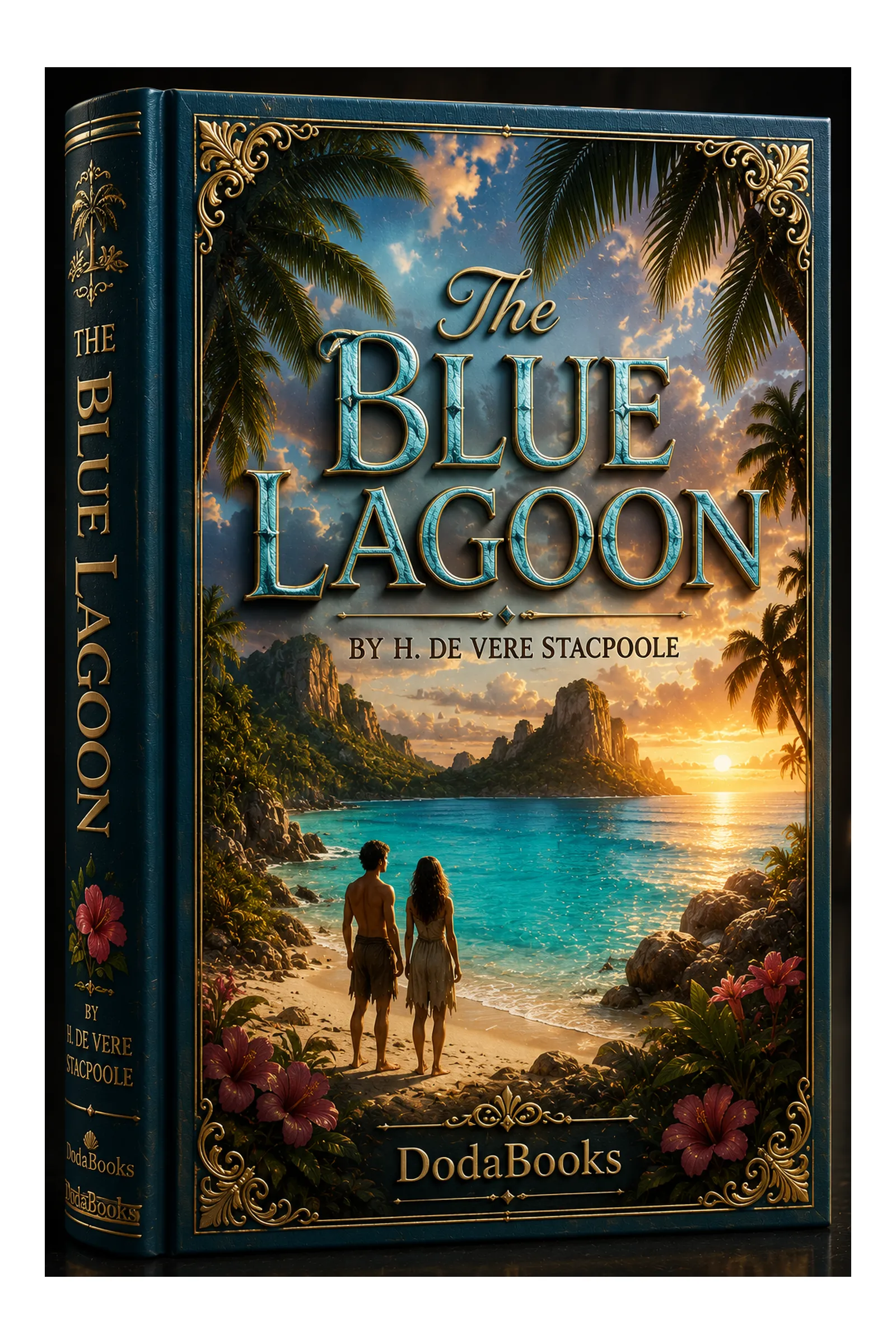
H. De Vere Stacpoole’s The Blue Lagoon is a hauntingly beautiful romance of innocence and survival. When two young cousins, Dick and Emmeline Lestrange, are shipwrecked on a remote South Pacific island with their sailor uncle, they must learn to fend for themselves in a tropical paradise.
🌴
The Blue Lagoon
A shipwreck, a deserted island, and two children who grow up alone discover love in its purest form.
| Author | H. De Vere Stacpoole |
| Published | 1908 |
| Genre | Romance, island fiction |
| Chapters | 52 |
| Setting | A deserted South Pacific island |
| Legacy | Adapted into multiple films |
🌴 The Story
The Blue Lagoon opens with a double calamity: after a devastating fire at sea, the Northumberland — the ship carrying young cousins Dick Lestrange and Emmeline Lestrange — goes down, leaving the two children and the sailor Paddy Button (called “Paddy” throughout) stranded on a remote, uninhabited South Pacific island. Wrecked on what seems an earthly paradise, the tiny party must learn to build shelter, forage for food, and make sense of a world that offers both abundance and danger in equal measure.
As years pass, Dick and Emmeline grow from childhood into adolescence and adulthood, untouched by the conventions of civilization. They discover the wonders of the island — its azure lagoon, its lush forests, its strange and beautiful creatures — and gradually discover each other. Stacpoole portrays their awakening love with extraordinary delicacy, free of judgment and full of wonder.
The novel weaves together breathtaking descriptions of island life with the psychological drama of two souls navigating the mysteries of nature, maturity, and love without any guide but instinct. From the comedy of their attempts to teach themselves to read, to the terror of a cyclone, to the poignant mystery of their final fate, The Blue Lagoon holds the reader in a spell that has lasted for over a century.
As the pair mature, the novel becomes a quiet meditation on what human beings are when every social script is stripped away. With no priest, no teacher, no family to tell them what to feel, Dick and Emmeline must negotiate the most intimate questions of their lives alone. Stacpoole does not moralize; he observes with the same unhurried wonder he brings to the island’s birds and tides. The result is one of the most unusual love stories in English literature — one in which tenderness grows out of total isolation rather than against it.
🏛️ Historical & Cultural Context
When Stacpoole published The Blue Lagoon in 1908, the South Pacific cast a powerful spell on the European imagination. Decades of exploration, colonial trade, and writers such as Robert Louis Stevenson — who had settled in Samoa and whose Treasure Island and essays celebrated the region’s beauty — had made the islands a byword for escape, exoticism, and the imagined innocence of “natural” life. Stacpoole’s novel taps directly into that fascination, offering a paradise that is both gorgeously real and frankly idealized.
The book also arrives at the tail end of a long tradition of Robinsonade fiction — stories of castaways and survival that stretch from Daniel Defoe’s Robinson Crusoe through Jules Verne and R. M. Ballantyne’s The Coral Island. Where those earlier tales often celebrate resourcefulness, empire, and the triumph of civilization, The Blue Lagoon pointedly turns inward. Its castaways do not conquer the island or plant the flag of a nation; they simply live, love, and drift toward an ambiguous fate. That quiet refusal of imperial adventure makes the novel feel startlingly modern for its time.
Stacpoole himself was a man of restless and varied background — a ship’s doctor who traveled widely before turning to writing, and whose medical training lends his descriptions of the body and its changes an unusual exactness. He went on to write prolifically, but it is The Blue Lagoon that secured his literary reputation, and the trilogy it began established the island and its characters as a lasting landmark of popular romance.
🎭 Characters, Themes & What to Look For
The heart of the novel is its two protagonists. Dick Lestrange begins as a boy of resourceful practicality, the sort who does rather than wonders, and whose steady nerve anchors the little colony through its worst crises. Emmeline Lestrange is more contemplative — attuned to beauty, prone to reverie, and the more spiritually restless of the two. Their complementary natures make their slow fall in love feel as natural as tide and moon, and they are the entire emotional engine of the book. The third member of the party, Paddy Button, provides warmth, loyalty, and a vital link to the world they have lost, even as age and accident threaten his frailty.
As you read, watch for the themes that give the book its staying power. Innocence and education runs throughout: the children’s comic, touching attempts to reconstruct reading and language from memory show how much of “civilization” is absorbed habit rather than knowledge. The natural world as both garden and threat recurs in every chapter — the lagoon’s beauty is matched by the cyclone’s fury and the sea’s indifference. And most delicately, the awakening of love without a template — Stacpoole’s central risk — asks the reader to imagine what tenderness looks like when nobody has told you its shape.
✨ Why It Still Matters Today
More than a century on, The Blue Lagoon remains a genuinely singular reading experience. In an age of constant connection, its portrait of two people raised entirely outside society keeps its power to unsettle and enchant — a thought experiment about the human animal that feels as fresh as the day it was written. The book also rewards a second reading: knowing how the story ends, the early chapters gain a haunting new resonance, and Stacpoole’s delicate hints become visible pointers rather than passing color.
If you enjoy the way The Blue Lagoon blends romance, isolation, and a vivid geographical setting, you’ll want to wander into the related island-and-escape stories in our collection — the sunlit transformation of The Blue Castle or the seaside reinvention of the four women in The Enchanted April. For another romance built on distance, travel, and self-discovery, A Room with a View is a natural pairing.
📖 About This Edition
This edition has been carefully formatted from the original 1908 text, preserving the three-book structure with all original chapter divisions.
Zero Distractions
No ads, no license pages — just the complete text, clean and uninterrupted.
Smart Typography
Curly quotes, em-dashes, proper ellipsis — typeset with care for a premium reading experience.
Chapter Navigation
Full table of contents with navigation to each of the 52 chapters — easily jump between them.
Cleaned & Polished
All Gutenberg boilerplate stripped, consistent formatting throughout the text.
No DRM
You own your copy — read on any device, anytime, forever.
Instant Download
EPUB format included, delivered instantly after purchase.
❓ Frequently Asked Questions
Is this the book the films are based on?
Yes. The novel was adapted into a 1923 silent film, a 1949 remake, and a 1980 film starring Brooke Shields. The 1980 version is the most widely known, though it differs significantly from the book.
Is this a children's book?
Not exactly. While it features child protagonists, the novel deals with awakening sexuality and adult themes in a delicate but unmistakable way. It is better suited to mature readers.
How long does it take to read?
At 216 pages across 52 short chapters, most readers finish in 5-7 hours. The short chapters and vivid descriptions make it a fast, immersive read.
Are there sequels?
Yes. Stacpoole wrote two sequels: The Garden of God (1923) and The Gates of Morning (1925), forming a trilogy about the island and its inhabitants.
Is the ending a happy one?
Readers have debated this for over a century. The ending is deliberately ambiguous — bittersweet and open to interpretation rather than either triumph or tragedy. It is the book’s most discussed passage and a large part of why the story lingers in the memory.
Why is it considered a romance rather than an adventure story?
Although the setup — a shipwreck and survival on a desert island — sounds like adventure, Stacpoole’s focus is firmly on the inner lives of his characters and the growth of their love. The action matters less than the emotional journey, which is what places the book in the romance tradition.
Should children read it?
Despite the child protagonists, the novel is written for adults. It addresses awakening sexuality and mature themes in a delicate but unmistakable way, so it is best saved for older teens and grown readers rather than young children.
📚 Related Articles
🌴 Read the Island Romance
H. De Vere Stacpoole’s The Blue Lagoon is a hauntingly beautiful romance of innocence and survival. The DodaBooks edition presents the complete 1908 text:
- ✅ Complete 52-chapter text — the full three-book novel
- ✒️ Smart typography — curly quotes, em-dashes, proper ellipsis
- 📜 Full table of contents with chapter navigation
- 🔒 DRM-free — read on any device, anytime
- 📥 Instant download — EPUB format