The CIA World Factbook is the United States government’s premier reference work on the nations of the world. The 2006 edition provides up-to-date information on 271 countries, dependencies, and other entities, organized for quick reference and easy comparison.
🌍
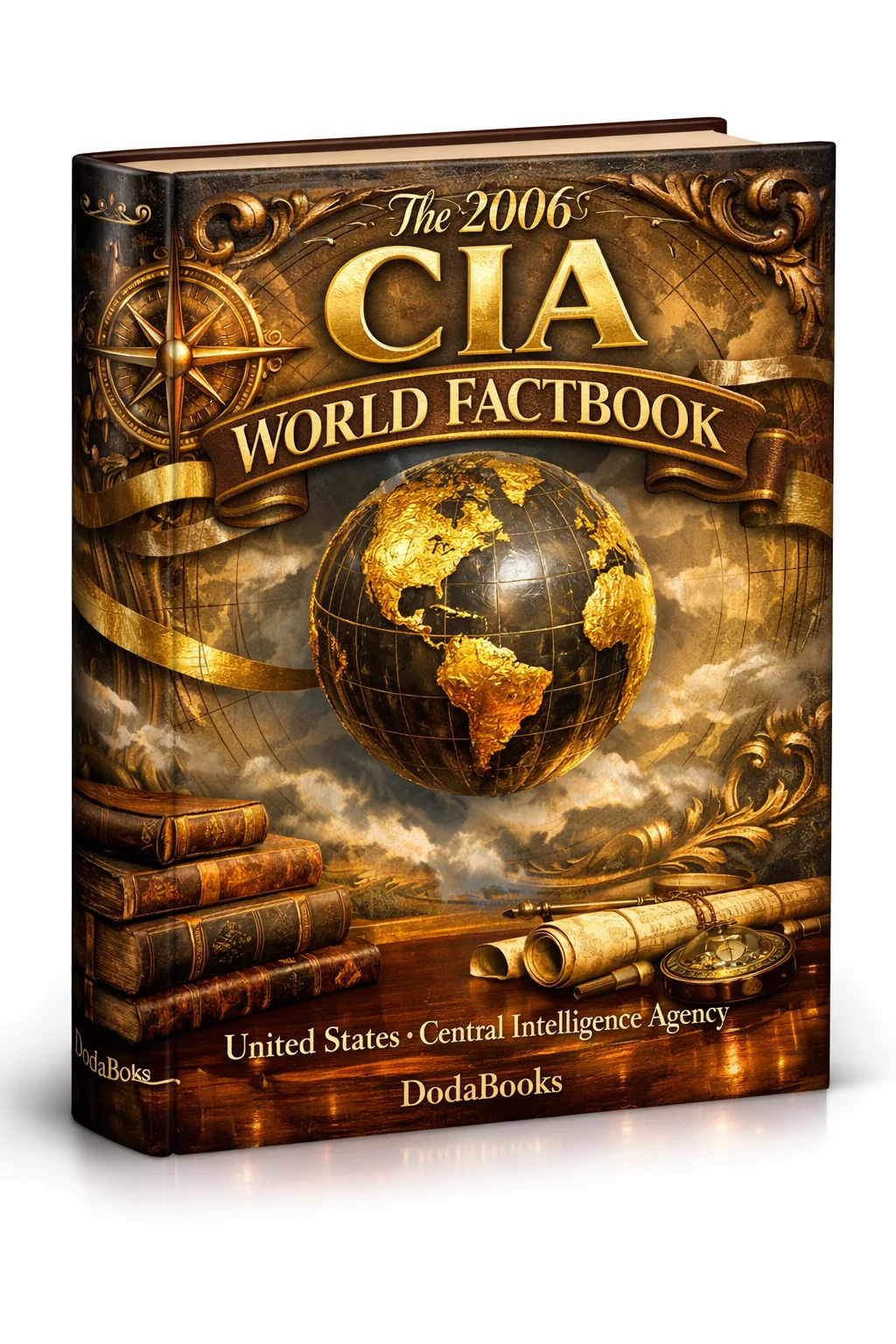
The 2006 CIA World Factbook
The complete 2006 edition of the CIA World Factbook, offering detailed country-by-country data on geography, demographics, government, economy, and military affairs.
| Author | United States. Central Intelligence Agency |
| Published | 2006 |
| Genre | Reference, world affairs |
| Chapters | 262 country entries |
| Pages | 824 |
| Coverage | 271 countries and dependencies |
🌍 About the Factbook
Each country entry is organized into categories including geography (area, climate, terrain, natural resources), people (population, ethnic groups, languages, religions), government (capital, administrative divisions, legal system, political parties), economy (GDP, inflation, unemployment, exports, imports), communications (telephones, radio, television, internet), transportation (airports, railways, roadways, waterways), military (expenditure, branches, service age), and transnational issues (disputes, refugees, trafficking).
In addition to the country entries, the Factbook includes detailed field listings that allow direct comparison across countries, rank orders for key statistics such as area and GDP, appendixes covering international organizations and selected economic indicators, and a comprehensive set of notes and definitions explaining every term used in the entries.
The Factbook is designed as a reference tool rather than a narrative — you dip into it, you don’t read it straight through. Its real power lies in the ability to move between the three ways it structures the world’s information. Want a single nation’s full profile? Look it up alphabetically. Want to compare population or GDP across every country? Jump to the field listings or rank orders. Want to understand a term like “GDP per capita” or “official exchange rate”? The notes and definitions chapter has you covered. That layered design is what has made it the default starting point for students, journalists, and analysts for decades.
Because each entry follows the same rigid template, the Factbook also rewards casual browsing in a way few reference books do. Flip to a small island nation or a newly independent state and you instantly get a compact portrait — its physical geography, its people, its form of government, how it earns its living, and the disputes that occupy its foreign policy. In a few sentences per category, a country’s character begins to emerge.
🏛️ Historical & Cultural Context: The World in 2006
This 2006 edition is a fascinating time capsule of geopolitics. It is the first edition to recognize Montenegro and Serbia as separate states after the June 2006 secession referendum ended the State Union of Serbia and Montenegro — a genuine milestone in the post-Yugoslav realignment of the Balkans. The same year saw the partition of Sudan and the creation of East Timor already established, advancements in global communication, and a world still adjusting to the post-9/11 reordering of security priorities.
The mid-2000s were also a transition point in how people accessed information. The Factbook had long been published as a bound volume and, from the mid-1990s, posted free on the CIA’s website — but 2006 still sat squarely in the pre-smartphone era, when a printed reference or a desktop browser remained the normal route to this kind of data. Holding a printed copy of the 2006 edition offers a rare chance to experience that moment as contemporaries did, before the world’s statistics migrated to apps and live feeds.
Reading the 2006 volume against today, you also notice how much has shifted in a single generation. Countries have appeared and disappeared; populations have grown; economic rankings have reshuffled. What makes this edition valuable as a historical artifact is precisely that it records the world as it actually was in a specific year — not as historians later reconstructed it, but as a contemporary analyst would have seen it then.
📖 How to Use the 2006 Factbook
The Factbook rewards a simple approach: start with a country you’re curious about, read its entry end to end, and let one detail lead you to another. Follow a mention of a disputed territory to that territory’s own entry, or chase a statistic you don’t recognize into the definitions chapter. Because the entries are short and consistently structured, a full profile can be absorbed in a few minutes — making it ideal for quick reference, geography projects, or settling an argument about whether one nation is bigger, richer, or more populous than another.
If you’re a student or hobbyist, a powerful exercise is to pick a dozen countries across different continents and read their entries side by side, using the field listings to compare them directly. The patterns that emerge — in population density, economics, natural resources, and politics — are exactly the kind of global literacy the Factbook was built to encourage. For teachers, the consistent categories make it a ready-made source for research assignments on virtually any country in the world.
✨ Why a Printed Edition Still Matters Today
A book, by its nature, is a fixed record — and for a reference work, that is exactly its virtue. The online Factbook is constantly updated and relentlessly current, but it can never show you what the world looked like on a particular date. This 2006 edition preserves a precise snapshot that has quietly become history, and there is genuine pleasure in reading it as a document of its moment rather than as live data.
If reference works and the record of a specific era appeal to you, our collection has related volumes worth pairing with it — the painstakingly distilled portraits of nineteenth-century lives in Modern English Biography, Vol. 2, the founding-era documents explored in our Declaration of Independence study guide, and the firsthand American story of The Autobiography of Benjamin Franklin. Each offers its own kind of window onto the past through reference and primary text.
📖 About This Edition
This 2006 edition captures a fascinating moment in geopolitics — featuring updated country information as of December 2006, including the recognition of Montenegro and Serbia as independent states following the 2006 secession referendum, expanded capital entries with geographic coordinates and time zone information, a new entry on human trafficking, and a new appendix on weights and measures.
Zero Distractions
No ads, no license pages — just the complete text, clean and uninterrupted.
Smart Typography
Curly quotes, em-dashes, proper ellipsis — typeset with care for a premium reading experience.
Full Navigation
Complete table of contents with navigation to all 262 country entries.
Cleaned & Polished
All boilerplate stripped, consistent formatting throughout the text.
No DRM
You own your copy — read on any device, anytime, forever.
Instant Download
EPUB format included, delivered instantly after purchase.
❓ Frequently Asked Questions
Is this the same as the online CIA Factbook?
The CIA publishes the Factbook online and in print. This 2006 edition represents a specific snapshot of the data as of December 2006, including entries no longer available in current editions.
How is the data organized?
Country entries are alphabetical, each with standardized categories for easy comparison. The book also includes field listings that aggregate data across all countries and rank orders for key statistics.
Who uses the Factbook?
Researchers, students, journalists, government officials, and anyone needing quick, reliable information about any country in the world. It is one of the most widely used reference works in existence.
How many pages is it?
At 824 pages covering 262 chapters (country entries), this is a substantial reference volume designed for browsing and consultation rather than cover-to-cover reading.
Is the data accurate and reliable?
The Factbook is compiled by the CIA from multiple U.S. government sources and other available intelligence, and it is widely regarded as one of the most reliable freely published reference works of its kind. Like any snapshot, however, it reflects the state of knowledge available in 2006, so some figures will have changed since.
Is the Factbook still published today?
Yes. The CIA continues to publish and update the World Factbook, largely online, with periodic print editions. The 2006 volume is of special interest now because it preserves entries and details — such as the era before certain countries changed — that later editions no longer contain.
What makes the 2006 edition historically notable?
It is the first edition to recognize Montenegro and Serbia as independent states following the 2006 secession referendum, and it captures a distinct moment in world affairs that later, updated editions have moved past. For anyone interested in history, that makes it a valuable primary document of its time.
📚 Related Articles
🌍 Read the Premier World Reference
The CIA World Factbook is the US government’s premier reference work on the nations of the world. The DodaBooks edition presents the complete 2006 text:
- ✅ Complete 262-country coverage — every entry from the 2006 edition
- ✒️ Smart typography — curly quotes, em-dashes, proper ellipsis
- 📜 Full table of contents with country navigation
- 🔒 DRM-free — read on any device, anytime
- 📥 Instant download — EPUB format