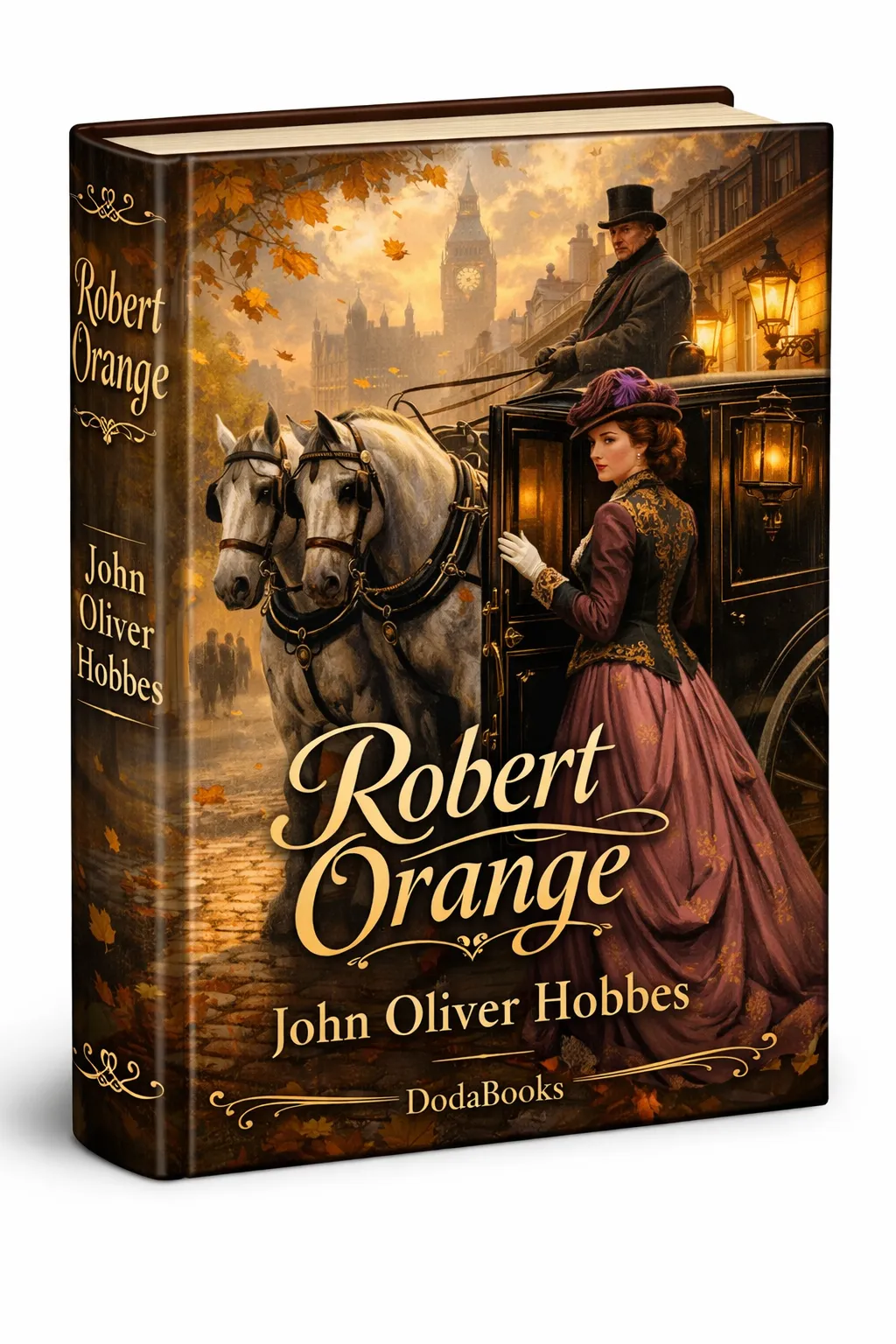
John Oliver Hobbes’s Robert Orange is a continuation of the author’s earlier novel The School for Saints, following the extraordinary career of Robert Orange, M.P. First published in 1900, this Edwardian novel of ideas weaves together politics, religion, and romance with wit and psychological insight.
🎭
Robert Orange
A young parliamentarian torn between love, friendship, and a mysterious calling must navigate the treacherous waters of Victorian high society.
| Author | John Oliver Hobbes |
| Published | 1900 |
| Genre | Classic fiction, political novel |
| Chapters | 30 |
| Setting | London, Westminster, country houses |
| Also known as | Pearl Mary Teresa Richards |
🎭 The Story
Robert Orange is a man of many parts: a rising young Member of Parliament, a descendant of a noble but troubled family, and a soul in search of something beyond the glitter of London society. He moves between the drawing rooms of St. James’s, the corridors of power at Westminster, and the quiet retreats of country houses, pursued by the affections of two remarkable women: the brilliant and enigmatic Mrs. Parflete and the steadfast Sara de Treverell.
The novel unfolds through a series of vividly drawn scenes and letters: a stormy afternoon in St. James’s Square, a tense game of political brinkmanship, a clandestine meeting at Almouth House, and a devastating confrontation that changes everything. Around Orange revolve a cast of unforgettable characters: Lord Beauclerk, his worldly confidant; Lord Wight, his political patron; Agnes Carillon, a woman of hidden depths; and Brigit, whose loyalties are tested to the breaking point.
For readers arriving without The School for Saints, Robert Orange supplies its own bearings. Its hero enters already in flight: an M.P. with a noble but troubled inheritance, already entangled with the Parflete household, already half-aware that his ambitions point somewhere his social set would not predict. Hobbes tells the story in scenes that pivot on a single glance, in letters that carry whole chapters of plot, and in set-pieces — stormy afternoons, card tables, doorways held too long — arranged with the economy of a playwright, which is apt, since in her other life she was one of the leading dramatists in London.
The book’s emotional geometry is set by its two women. Mrs. Parflete is brilliant, worldly, and married, and she wants something from Orange he may not be free to give. Sara de Treverell is steadfast and clear — the love that asks him to be whole rather than successful. Between their two claims, and between the claims of ambition and of conscience, Orange must discover what his own life is actually for; that question is the engine that runs the whole machine.
📖 About This Edition
Hobbes writes with a sharp eye for social comedy and a deep sympathy for spiritual struggle. Robert Orange is a novel about vocation and the cost of following one’s conscience in a world that rewards compromise. It stands as one of the finest works of a writer whom Oscar Wilde called “the most brilliant woman in England.” This edition presents the complete 1900 text, carefully formatted for modern e-readers.
Zero Distractions
No ads, no license pages — just the complete text, clean and uninterrupted.
Smart Typography
Curly quotes, em-dashes, proper ellipsis — typeset with care for a premium reading experience.
Chapter Navigation
Full table of contents with navigation to each of the 30 chapters — easily jump between them.
Cleaned & Polished
All Gutenberg boilerplate stripped, consistent formatting throughout the text.
No DRM
You own your copy — read on any device, anytime, forever.
Instant Download
EPUB format included, delivered instantly after purchase.
🏛️ Historical & Cultural Context
Robert Orange appeared in 1900, on the hinge between the Victorian and Edwardian decades, and it carries the anxieties of that moment. The drawing-room world it describes — the London season, the country-house weekend, the masculine clubland of Westminster — was exact and current for its first readers. Yet Hobbes charges that décor with questions her own literary circle was asking: What is a vocation? Can a public man keep his conscience? Does faith survive the company of the worldly?
The late-Victorian novel had been decisively invaded by the novel of ideas. George Eliot had shown that fiction could carry philosophy and social theory without losing its human warmth; Henry James had sharpened its psychological precision; and the fin-de-siècle society novels and plays layered wit and scandal on top of both. Hobbes — born Pearl Mary Teresa Richards in Boston, and later remade in London — belonged squarely to that world. Her admirers included Oscar Wilde, who called her “the most brilliant woman in England,” and Henry James.
The political furniture is period-true as well. Turn-of-century Britain ran on party machinery, land questions, and reform debate, and novels with parliamentary heroes had a long pedigree — Benjamin Disraeli’s political novels of the 1840s treated Westminster as romance and moral theater at once. But Hobbes is not writing a policy novel. Parliament is a stage for character, and its real function in the book is to let a good man measure what his compromises will cost him.
🔮 Characters, Themes & What to Look For
Robert Orange is the oldest of literary figures: the man of many parts looking for the one thing that will hold them together. His two suitors map the novel’s moral field with unusual clarity. Mrs. Parflete represents the world as seduction — everything glittering, everything conditional. Sara de Treverell represents the world as covenant — the love that wants him steady and complete. In the supporting cast, Lord Beauclerk is the confidant who reflects Robert’s choices back at him, and Lord Wight is the patron who tempts them; Agnes Carillon and Brigit carry the cost of his decisions into other lives.
The themes run through every novel of ideas worth the name: vocation against ambition, conscience against compromise, and the difference between two species of love. Hobbes is at her sharpest showing how the social machine converts moral questions into social ones — how a man’s soul, once it walks into St. James’s, becomes talk. On the surface her prose is witty, aphoristic, and allusive; underneath it is scrupulous about motive.
Look for a few things while reading: the letters, which carry real narrative weight; the recurring motif of secrecy and public performance; and the dialogue, where most of the book’s best work is done in what is left unsaid.
✨ Why It Still Matters Today
Hobbes’s reputation faded with the century — she died young, at barely thirty-eight, in 1906 — even as Wilde and James were being canonized. The recent rediscovery of fin-de-siècle women novelists has brought her back, and Robert Orange is the jewel of that revival: a novel that is both a pure period pleasure and a genuinely modern investigation of how people reconcile their public roles with their private selves.
Anyone who has watched a promising public figure being slowly flattened by the machinery of success will recognize the subject at once; the men and women of Westminster have merely changed their clothes. Read it beside the career-and-conscience novels of its age — George Eliot’s Middlemarch, Oscar Wilde’s The Picture of Dorian Gray — and Robert Orange holds its own. For a dose of the same wit applied to an earlier age’s marriage market, its natural shelf-companion is Jane Austen’s Sense and Sensibility.
❓ Frequently Asked Questions
Is this a sequel?
Yes, it continues the story begun in The School for Saints (1897). While it helps to have read the first novel, Robert Orange stands on its own with enough context for new readers.
Who was John Oliver Hobbes?
A pen name for Pearl Mary Teresa Richards (1867–1906), an American-born British novelist and playwright. She was celebrated for her wit and psychological depth, and counted Oscar Wilde and Henry James among her admirers.
Is this a political novel?
In part. Parliament and political ambition form the backdrop, but the novel is really about vocation, conscience, and the competing claims of love, friendship, and faith. It is a novel of ideas disguised as a society romance.
How long does it take to read?
At 340 pages across 30 chapters, most readers finish in 8-11 hours. The chapters are short and the dialogue-driven narrative moves quickly.
Is Robert Orange based on a real person?
No reliable key exists, and that is probably the right caution — Hobbes was recording a social world she knew intimately, and her characters live. What is well documented is how much of herself went into the novel’s concerns: a brilliant American self-made in London and a convert deep in the Catholic intellectual life of the capital, she knew exactly what she was writing about.
Who will enjoy Robert Orange?
Readers who like novels of ideas, drawing-room comedy with real stakes, vocation stories, and late-Victorian political romance. If Middlemarch moves you but you want something shorter and wittier, this is the natural next step; its very restrained length makes it an approachable taste of the period.
Why is Hobbes not as famous as her admirers?
A combination of causes: she died at thirty-eight with much of her promise unfulfilled, she worked across genres — novels, plays, essays — so no single work anchored her reputation, and her social and religious subject matter went out of fashion as the century turned. The same reasons make her rediscovery so rewarding now.
📚 Related Articles
🎭 Read the Victorian Classic
John Oliver Hobbes’s Robert Orange weaves politics, religion, and romance with wit and psychological insight. The DodaBooks edition presents the complete 1900 text:
- ✅ Complete 30-chapter text — every word of the 1900 classic
- ✒️ Smart typography — curly quotes, em-dashes, proper ellipsis
- 📜 Full table of contents with chapter navigation
- 🔒 DRM-free — read on any device, anytime
- 📥 Instant download — EPUB format