Frederick Douglass’s Narrative of the Life of Frederick Douglass, an American Slave (1845) is the most famous and influential slave narrative ever written. Published seven years after his escape from bondage, it recounts Douglass’s early life on Maryland’s Eastern Shore, his brutal treatment under several masters, his secret pursuit of literacy, and his ultimate flight to freedom in the North.
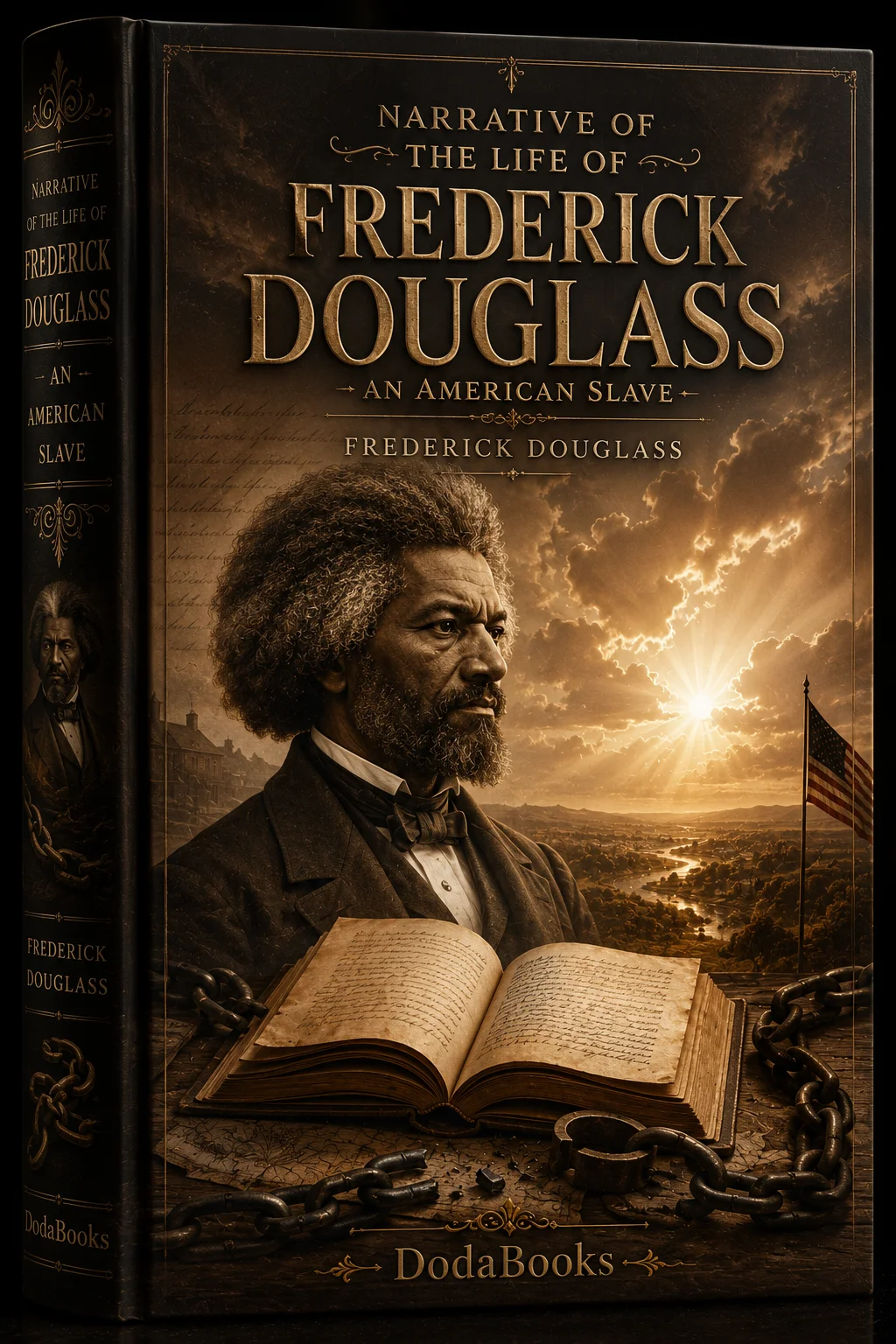
📜
Narrative of the Life of Frederick Douglass
A former slave's gripping account of his journey from bondage to freedom, and his transformation into one of America's most powerful voices for abolition.
| Author | Frederick Douglass |
| Published | 1845 |
| Genre | History, autobiography |
| Chapters | 15 |
| Setting | Maryland, Baltimore, New York |
| Legacy | The most influential slave narrative ever written |
📜 The Story
The narrative is both a powerful personal testament and a devastating indictment of American slavery. Douglass describes with unflinching clarity the physical cruelty, psychological degradation, and moral corruption inherent in the institution — from the starvation of slave children to the systematic destruction of family bonds. His account of being sent to the notorious slave-breaker Edward Covey, and his eventual triumph over Covey in a physical confrontation that restored his spirit, is one of the most celebrated passages in American autobiography.
Beyond the story of his enslavement, Douglass chronicles his intellectual awakening — learning to read and write against his masters’ wishes, teaching fellow slaves in secret Sabbath schools, and ultimately plotting his escape to New York.
Born into slavery on Maryland’s Eastern Shore around 1818, Douglass opens his memoir with a childhood deliberately kept dark and unbounded: separated from his mother in infancy, denied any reliable knowledge even of his own birthday, and forced early on to know the floggings, the hired-out labor, and the scattering of families that the institution ran on. The opening chapters catalogue what slavery did to bodies and to family bonds, and Douglass is careful to report that the master’s economic interest, not cruelty for its own sake, explained most of it.
His crossing with the Aulds of Baltimore supplies the book’s famous turning point. His new mistress, Sophia Auld, began teaching him the alphabet until her husband stopped her, saying it was both unlawful and unsafe to teach a slave to read — words, Douglass writes, that made the lesson permanent, because they revealed to him that literacy was the very thing the institution feared. He finished the job himself, trading bread to the poor white boys of the neighborhood for lessons and devouring The Columbian Orator, a school anthology whose dialogues on liberty, he says, gave him the language in which to name his own wrongs.
The middle chapters darken toward the pivot of the story: hired out to Edward Covey, the notorious “slave-breaker,” Douglass is whipped week after week until his spirit breaks. The famous Sunday fight in the barnyard — “You have seen how a man was made a slave; you shall see how a slave was made a man” — restores what Covey broke and marks the hinge of the whole memoir. From there the narrative moves through a failed escape plot, the jail cell, and the successful journey north; the account deliberately keeps the route vague, so that the free Black men and women who helped him would not be endangered.
📖 About This Edition
This edition includes the original preface by William Lloyd Garrison and a letter from Wendell Phillips, which together provide contemporary context for Douglass’s extraordinary achievement. It presents the complete 1845 text, carefully formatted for modern e-readers.
Zero Distractions
No ads, no license pages — just the complete text, clean and uninterrupted.
Smart Typography
Curly quotes, em-dashes, proper ellipsis — typeset with care for a premium reading experience.
Chapter Navigation
Full table of contents with navigation to each of the 15 chapters — easily jump between them.
Cleaned & Polished
All Gutenberg boilerplate stripped, consistent formatting throughout the text.
No DRM
You own your copy — read on any device, anytime, forever.
Instant Download
EPUB format included, delivered instantly after purchase.
🏛️ Historical & Cultural Context
Published in 1845 by the Massachusetts Anti-Slavery Society, the Narrative appeared at a moment when the American abolition movement was gathering moral force. William Lloyd Garrison’s The Liberator had been printing since 1831; free Black activists were establishing newspapers, schools, and lecture circuits; and slavery was being forced onto Northern doorsteps through conventions, petitions, and the testimony of fugitives. Douglass, already a celebrated orator, had watched skeptical white audiences refuse to believe such eloquence had ever come from slavery — and that skepticism is a large part of why the book exists: written testimony could be inspected page by page.
Garrison’s preface and the supporting letter from Wendell Phillips, both preserved in this edition, functioned as vouchers for a man the law treated as suspect. Publishing a detailed account of his enslavement was genuinely dangerous, because it handed authorities and former masters a paper trail back to him. The Narrative appeared four years before the brutal Fugitive Slave Law of 1850 — and yet even so Douglass judged it prudent to spend the following years lecturing in Britain and Ireland, where friends eventually helped purchase his freedom.
Literarily, the Narrative heads a tradition that would run from Harriet Jacobs’s Incidents in the Life of a Slave Girl through Solomon Northup’s Twelve Years a Slave, but it does more than document: it argues. Douglass bends the resources of the sermon, the oration, and the sentimental fiction of his own age toward a single claim — that slavery corrupted everyone it touched, enslaved and enslaver alike — and he makes that argument with a rhetorical sophistication that astonished his contemporaries.
🔮 Characters, Themes & What to Look For
Although it is a memoir, the Narrative has the shape and tension of a novel, and its people are drawn with novelistic force. Sophia Auld enacts the corruption theme in a single arc: a kind mistress who, poisoned by her husband’s doctrines, hardens into an enforcer. Edward Covey personifies the religiosity that Douglass found more revolting than the violence itself. And Douglass himself is the narrator-hero — the “I” who sorts through watches, trades bread for reading lessons, and looks out at the white sails on the Chesapeake and aches to be aboard them.
Three themes carry the book. The first is literacy as liberation: Douglass calls reading “the pathway from slavery to freedom,” and he is careful to show that his masters’ cruelty was as intellectual as it was physical. The second is the decadence of the institution itself, documented through the households in which the enslaved were treated as so much human stock in the master’s economy. The third and deepest is identity: the memoir is a fugitive’s document about naming oneself — about reclaiming a birthday, an ancestry, and, tellingly, a name (“Douglass” he chose, he records flatly, partly to make recapture harder).
For new readers, a few things are worth looking for: the recurring imagery of ships and water as figures of freedom; the reappearances of The Columbian Orator as a touchstone of awakening; and the deliberate silence about the escape route, which scholars now read as part of the book’s craft rather than a gap in it.
✨ Why It Still Matters Today
The Narrative remains one of the most assigned autobiographies in American schools and one of the most teachable books in the canon, and for good reason: it turns the abstraction “slavery” into a single face, voice, and family. It is also the indispensable counterpart to the great self-made-man narratives of the era. Read against Benjamin Franklin’s Autobiography — the founding American account of rising by industry and virtue — Douglass’s memoir becomes the powerful rejoinder: the story of a man who had to become himself first. Alongside the Confessions of St. Augustine, it shows the autobiography form being used at full moral force, confession doing the work of accusation.
It stays news because its questions remain open: How does a society silence testimony in order to protect its institutions? What does freedom cost, and who gets to define it? That Douglass answered those questions in prose good enough to survive two centuries is the enduring wonder of the book — and why every new reader finds it still burning.
❓ Frequently Asked Questions
Is this the only autobiography Douglass wrote?
No. Douglass wrote three autobiographies: this Narrative (1845), My Bondage and My Freedom (1855), and Life and Times of Frederick Douglass (1881, revised 1892). The 1845 Narrative is the shortest and most widely read.
Why did Douglass write it?
To prove his identity as a former slave and to advance the abolitionist cause. Many doubted that such an eloquent speaker could have been born in bondage, and the Narrative provided irrefutable evidence.
How long does it take to read?
At 134 pages across 15 short chapters, most readers finish in 3-5 hours. It is a powerful, accessible read that can be completed in a single sitting.
Is this suitable for students?
Absolutely. It is one of the most frequently assigned texts in American schools and universities, essential reading for understanding the history of slavery and the abolitionist movement.
Why does the Narrative withhold details of the escape?
Deliberately. Douglass names no helpers and describes no route, because publishing the mechanics of escape would have endangered the free Black men and women who aided him and closed the doors behind him. He records the method only obliquely — steering by the North Star — and scholars now read that silence as part of the book’s political seriousness rather than a gap.
What happened to Douglass after the book was published?
He sailed for a lecture tour of Britain and Ireland, where supporters raised the money to purchase his freedom, and returned in 1847 to found his own abolitionist newspaper, The North Star, in Rochester, New York. He went on to advise presidents, help recruit Black soldiers during the Civil War, and become the most visible Black leader of his century.
Was Anna Murray important to the story?
Very. Anna Murray, a free Black woman whom Douglass met in Baltimore, supported his plans for escape and joined him in New York after his flight; they married there in 1838. The Narrative barely names her, but historians have reconstructed how much of the successful escape quietly depended on her courage and her savings.
📚 Related Articles
📜 Read the American Classic
Frederick Douglass’s Narrative is the most famous slave narrative ever written — a powerful personal testament and a devastating indictment of American slavery. The DodaBooks edition presents the complete 1845 text:
- ✅ Complete 15-chapter text — the full narrative with Garrison’s preface and Phillips’s letter
- ✒️ Smart typography — curly quotes, em-dashes, proper ellipsis
- 📜 Full table of contents with chapter navigation
- 🔒 DRM-free — read on any device, anytime
- 📥 Instant download — EPUB format