King Arthur and the Knights of the Round Table brings the enduring legends of Camelot to life for modern readers. Based on Sir Thomas Malory’s Le Morte d’Arthur, this edition presents the full sweep of Arthurian romance in clear, accessible prose.
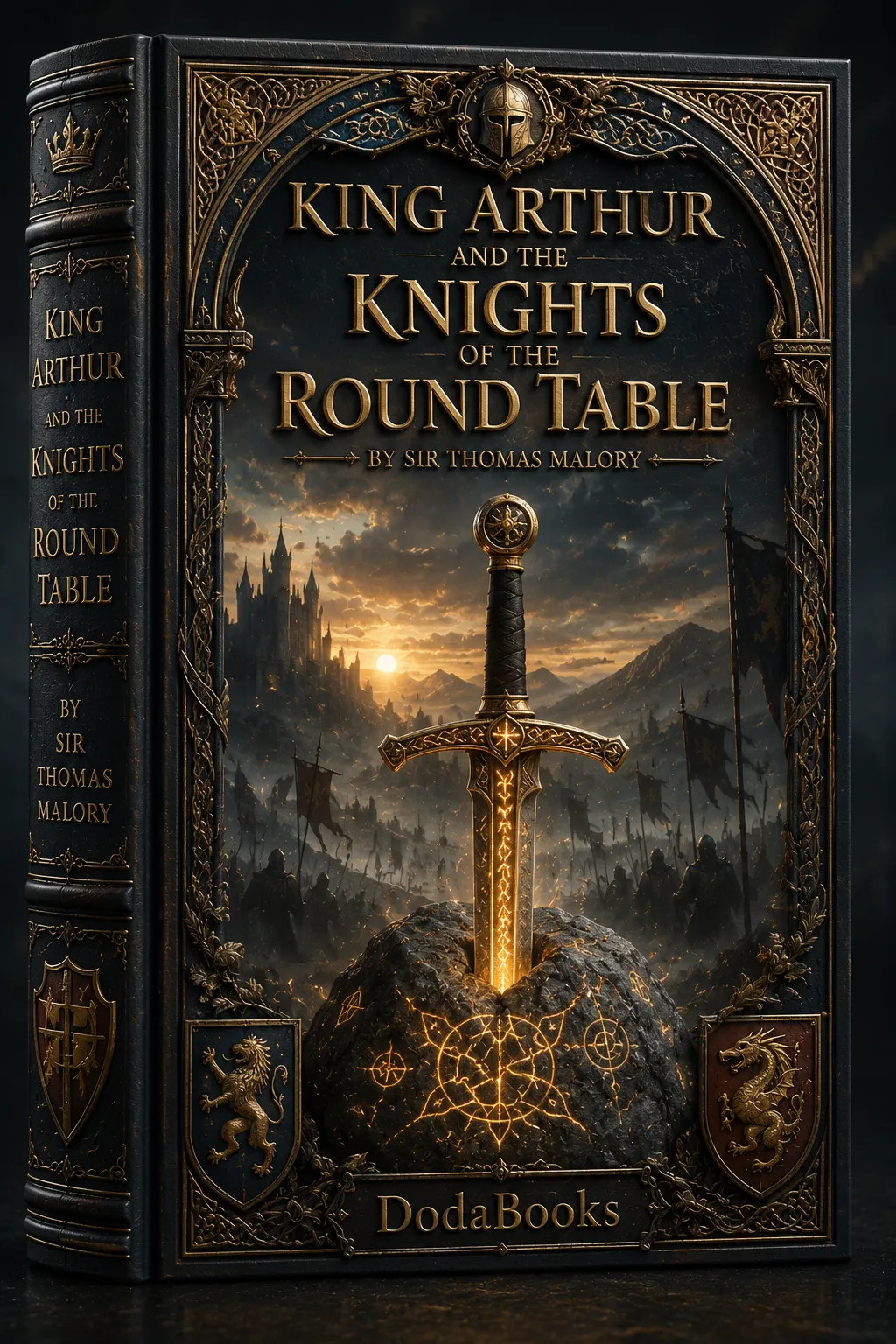
🏰
King Arthur and the Knights of the Round Table
A timeless retelling of the Arthurian legends — from Merlin's prophecies and the sword Excalibur to the quest for the Holy Grail and the passing of Camelot.
| Author | Rupert S. Holland |
| Published | 1919 |
| Genre | Classic fiction, Arthurian legend |
| Chapters | 15 |
| Setting | Camelot, Britain |
| Source | Adapted from Malory’s Le Morte d’Arthur |
🏰 The Story
The story begins with Merlin foretelling Arthur’s birth and the young king’s miraculous drawing of the sword Excalibur from the stone. From there unfold the adventures of the Round Table — the founding of Camelot, the love of Arthur and Guinevere, the exploits of Sir Lancelot, the quest of Sir Galahad for the Holy Grail, and the tragic downfall of Arthur’s kingdom.
Along the way we meet Sir Balin who strikes the Dolorous Stroke, Sir Beaumains who proves himself the equal of any knight, Sir Tristram whose love for Isolde rivals Lancelot’s, and Sir Gawain whose loyalty to Arthur endures to the very end. Each knight’s tale weaves into the larger tapestry of Camelot’s rise and fall.
As the cycle moves forward, Holland’s adaptation traces the deep arc that gives the legends their tragic grandeur. The early chapters glow with the optimism of a new court — magic, promise, and the dream of a just reign. But the seeds of ruin are planted early: in the adulterous love of Lancelot and Guinevere, in the jealousies and old grudges that the Round Table cannot quite dissolve, and in Arthur’s own failure to see the betrayal gathering around him. The middle of the book is a parade of brilliant quests and strange adventures, but its rhythm is always pulling toward the final act, where Camelot’s brightness is extinguished in civil war and Mordred’s treachery at the battle of Camlann.
Holland’s version keeps the sweep of this tragedy intact while smoothing the archaic language of his sources. Knights still sword-fight and enchantresses still scheme, but the prose moves at a pace a modern reader can match, and every episode — however fantastical — carries the moral weight that gives Arthurian stories their enduring seriousness about loyalty, honor, love, and the limits of both.
🏛️ Historical & Cultural Context
The Arthurian legends are among the oldest and most deeply layered stories in European literature. The figure of Arthur appears in Britain’s earliest chronicles as a war leader of the late fifth and early sixth centuries — the era after the Romans departed and Saxon invasions threatened — and from those shadowy origins, centuries of storytellers shaped him into the ideal Christian king. The name and the romance tradition took on a life of their own across Brittany, Wales, France, and England.
The version of the legend that dominates the modern imagination took shape in the Middle Ages, above all through Chretien de Troyes, whose twelfth-century verse romances introduced Lancelot, the love triangle with Guinevere, and knightly codes of courtly love. It was Chretien who made Arthur’s court the stage for both its greatest glory and its deepest wound, and his influence runs throughout every later retelling. If you want to meet the earlier, French branch of the legend in its own voice, our guide to Chretien’s Four Arthurian Romances is an ideal companion.
In 1485 Thomas Malory’s Le Morte d’Arthur gathered the scattered tales into a single monumental English narrative — the source that Rupert S. Holland’s 1919 adaptation draws on directly. Malory, writing at the end of the Wars of the Roses, infused the stories with a melancholy sense of a fading chivalric age, and it is that tragic cast, more than the magic and adventure, that gives Le Morte d’Arthur its power. Holland’s retelling preserves that spirit for twentieth- and twenty-first-century readers who might otherwise struggle with Malory’s fifteenth-century English.
⚔️ Characters, Themes & What to Look For
The legends are crowded with characters, so it helps to keep an eye on the handful that carry the plot. Arthur is the king and the embodiment of a doomed ideal — brave, just, generous, and ultimately unable to prevent the chaos around him. Merlin is the mysterious wizard-prophet who sets the whole story in motion, sees the future, and can do little to change it. Guinevere and Lancelot form the romantic-ethical core, their forbidden love the crack that eventually splits the court apart. Galahad achieves the perfection Arthur’s world cannot sustain, attaining the Holy Grail where others fail. And Mordred, Arthur’s ruinous son, is the shadow that the bright court casts unavoidably forward.
Watch as you read for the themes that give the material its weight. Honor, loyalty, and betrayal pervade every episode — knights swear oaths they cannot keep, and the story repeatedly asks what a promise is worth. The quest as moral trial structures much of the action, since the adventures are rarely about brute strength alone and usually about worthiness and faith. And running beneath everything is the fall from paradise — the sense that even the most golden age contains the seed of its own destruction.
✨ Why It Still Matters Today
The Arthurian legends endure because they are about the questions that do not go out of date: what makes a good leader, whether love can coexist with duty, whether perfection is attainable or only approachable, and why great things sometimes fall. Holland’s 1919 retelling makes this ancient material genuinely approachable, letting a modern reader feel Camelot’s glory and grief without paging through fifteen centuries of linguistic change.
For more of the world these legends come from, our collection offers natural next stops. The chivalric romances of Chretien de Troyes in Four Arthurian Romances show the French side of the story, while The Lady of the Lake — Sir Walter Scott’s sweeping narrative poem — carries the same sense of honor and love into a Highland setting that the modern Arthurian tradition always loved.
📖 About This Edition
Rupert S. Holland’s adaptation preserves the grandeur and tragedy of Malory’s original while making the stories approachable for contemporary audiences. This edition presents the complete 1919 text, carefully formatted for modern e-readers.
Zero Distractions
No ads, no license pages — just the complete text, clean and uninterrupted.
Smart Typography
Curly quotes, em-dashes, proper ellipsis — typeset with care for a premium reading experience.
Chapter Navigation
Full table of contents with navigation to each of the 15 chapters — easily jump between them.
Cleaned & Polished
All Gutenberg boilerplate stripped, consistent formatting throughout the text.
No DRM
You own your copy — read on any device, anytime, forever.
Instant Download
EPUB format included, delivered instantly after purchase.
❓ Frequently Asked Questions
Is this the same as Malory's Le Morte d'Arthur?
Holland’s adaptation is based on Malory but written in modern, accessible prose. It covers the same stories — the founding of Camelot, the adventures of the knights, the Grail quest, and Arthur’s fall — but is easier for contemporary readers to follow.
Which knights are featured?
The book follows the key figures of the Round Table: Arthur, Merlin, Guinevere, Lancelot, Galahad, Gawain, Tristram, Balin, and Beaumains, among others. Each chapter focuses on a different knight’s adventure while advancing the larger story of Camelot.
How long does it take to read?
At 342 pages across 15 chapters, most readers finish in 7-10 hours. Each chapter is a self-contained adventure, making it easy to pick up and put down.
Was King Arthur a real person?
The short answer is that we don’t know. Arthur appears in early chronicles as a fifth- or sixth-century British war leader, but the magical king of Camelot is the invention of centuries of storytellers. Most historians treat the historical Arthur as possible but unproven, and the legendary Arthur as a literary creation.
Is this a good place to start with the Arthurian legends?
Yes. For most modern readers, Holland’s retelling is an ideal entry point — it covers the full sweep of the story in clear, accessible prose without the difficulty of Malory’s original 1485 Middle English. You can read Malory later if you fall in love with the material.
Is it suitable for younger readers?
Generally yes, though it is not written specifically for children. The stories contain violence, betrayal, and the tragedy of Camelot’s fall, but Holland’s version handles these maturely rather than graphically, making it suitable for teenagers and above.
📚 Related Articles
🏰 Read the Arthurian Legends
From Merlin’s prophecies to the quest for the Holy Grail and the passing of Camelot — Holland’s adaptation preserves the grandeur and tragedy of Malory’s original in clear, accessible prose. The DodaBooks edition presents the complete 1919 text:
- ✅ Complete 15-chapter text — the full Arthurian cycle
- ✒️ Smart typography — curly quotes, em-dashes, proper ellipsis
- 📜 Full table of contents with chapter navigation
- 🔒 DRM-free — read on any device, anytime
- 📥 Instant download — EPUB format