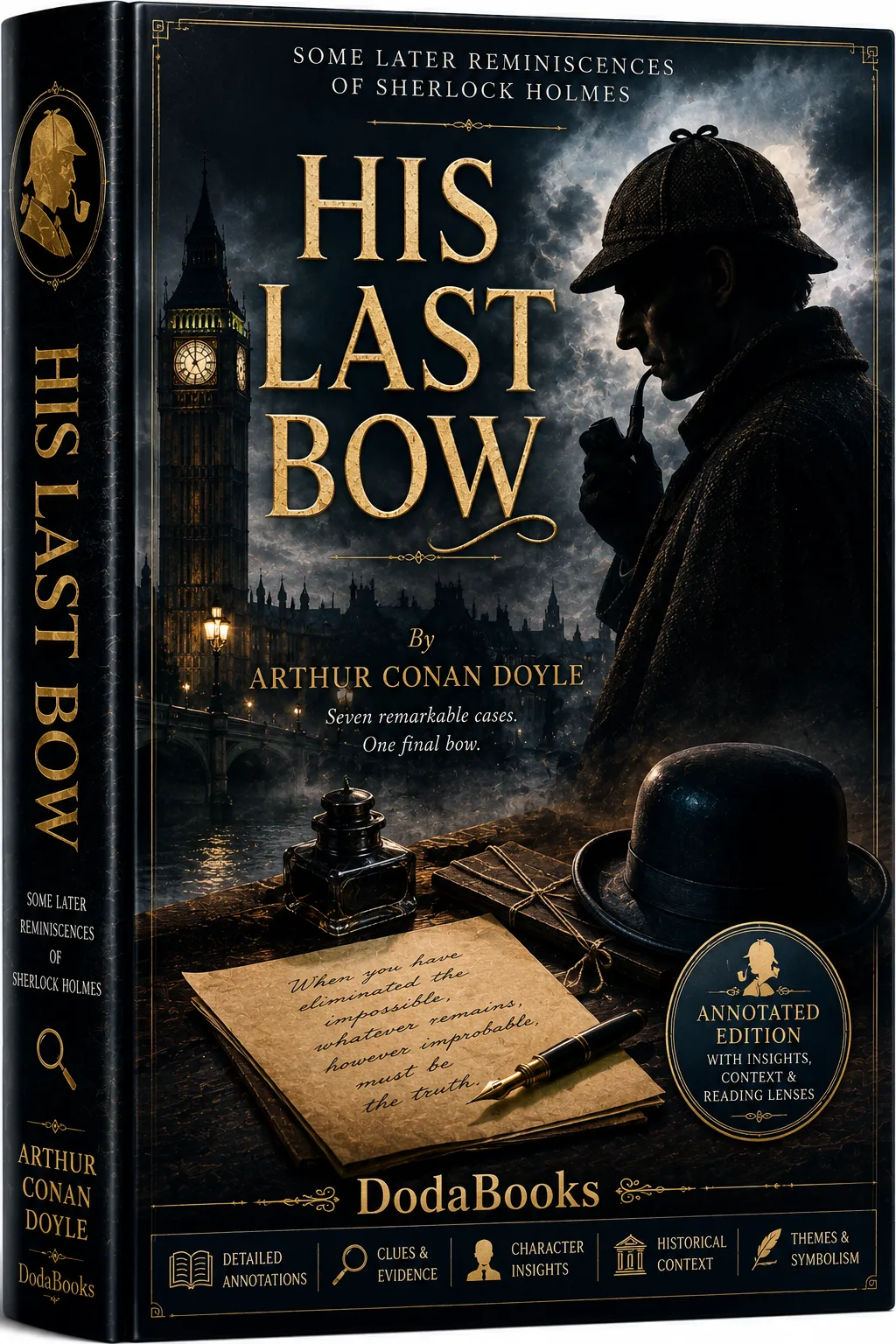
Arthur Conan Doyle’s His Last Bow is the 1917 collection that marks Sherlock Holmes’s final curtain — seven stories from the turn of the century, plus a title tale set in the trenches of the First World War. This guide covers the stories, their place in the canon, and how the DodaBooks Annotated Edition layers context onto every case.
🏛️
His Last Bow
International plotters, dying detectives, and a final mission on the eve of the Great War. The last collection in the Sherlock Holmes canon — annotated story by story.
| Author | Arthur Conan Doyle |
| Published | 1917 (stories 1908–1917) |
| Genre | Detective short stories |
| Stories | 8 cases, including the title tale |
| Best For | Short form readers, Holmes completists, WWI history fans |
| Reading Time | 6–8 hours |
🏛️ The Collection
His Last Bow assembles the final Sherlock Holmes cases published before the Great War, ending with the title story that takes the detective beyond pure crime fiction. It’s a collection of endings — old Europe, old certainties, and a way of detecting crimes that the trenches are about to render almost quaint.
The seven shorter cases range across the international and the domestic: a Yorkshire manor house where a foreign conspiracy hides behind a ruined building; a cardboard box that arrives by post containing two severed ears; a murder clue buried in London’s Underground; a detective who pretends to be dying in order to catch a killer red-handed. Then comes the finale: “His Last Bow,” in which an aging, retired Holmes is called back for one last act — foiling a German spy ring on the eve of war.
“There’s an east wind coming all the same, such a wind as never blew on England yet.”
⚔️ The Final Story: Context Makes It Sing
“His Last Bow” is unlike anything else in the canon. Set in 1914, it shows Holmes working as “Altamont, an Irish-American spy” in a German agent’s household, unpicking an espionage network whose code is hidden in the very structure of the tale. The title’s double meaning — a literal bow from the theater, and the falcon’s bow of a hawk — is Conan Doyle closing the story of the greatest character he ever created, with his country at war.
The story is best read with its history in view, and that’s exactly what an annotated edition provides: the real German espionage fears, the code-breaking culture of 1914, and the reason Conan Doyle has Holmes speak of “an east wind.” Readers who only know the stories miss half of this one’s freight.
🔍 The Annotated Edition, Case by Case
Each story in the DodaBooks edition carries its own set of visible, color-coded annotation cards rather than buried footnotes.
Per-Story Annotations
Notes tailored to each tale — no generic padding, no hidden sections.
Deduction Explained
Holmes's reasoning unpacked line by line in the famous logic passages.
Edwardian Society
Class, domestic life, and respectable crime behind the 1908–1914 settings.
International Politics
The real conspiracies of the pre-war years that fuel several plots.
Media & Crime
Newspapers, sensation, and women's lives as the stories' darker layers.
Canon Connections
How the collection retcons, confirms, and closes threads from earlier tales.
📘 Annotated Insight — The Dying Detective’s Con Game
In “The Adventure of the Dying Detective,” Holmes fakes a tropical disease so convincingly that Watson is deceived to the point of panic. It’s easy to read as a fairy tale of cleverness. The annotated edition points to what’s actually going on: Holmes has become the criminal he pretends to expose, using Watson’s love as a prop. The subversion — the greatest detective as con artist — is one of Conan Doyle’s most quietly radical strokes.
🕰️ Why the Collection Matters
His Last Bow holds a special place precisely because it is a twilight book. Chronologically it covers 1890 to 1914; historically it spans the gap between the murder mysteries of the Victorians and the mass death of the first industrial war. The domestic crimes of the earlier tales feel nearly innocent next to the title story’s calm calculation of a world coming apart.
The edition’s historical annotations make “His Last Bow” land the way Conan Doyle intended — as a detective, a goodbye, and a prophecy, all at once.
🕵️ The Seven Cases at a Glance
Because the collection ranges widely, it helps to know what each case brings. “The Adventure of Wisteria Lodge” opens with a Yorkshire mystery that begins as a domestic horror and spirals into an international conspiracy — a churchman killed in his own house, a note in a strange hand, and a trail leading to a shadowy foreign power. “The Adventure of the Bruce-Partington Plans” is the political jewel of the set: a young clerk found dead on the Underground with seven secret submarine plans sewn into his coat, a case that pulls Holmes into the world of official secrets and double agents in Edwardian London.
The middle tales dial down the scale but not the inventiveness. “The Adventure of the Cardboard Box” is one of Doyle’s darkest domestic tales — an old lady receives a box by post containing two severed ears, leading to a tangle of jealousy and adultery. “The Adventure of the Red Circle” turns on a cipher scratched in a newspaper margin and a lodger who never shows their face; “The Adventure of the Dying Detective” sees Holmes feign a fatal disease to trap a murderer; and “The Disappearance of Lady Frances Carfax” is a brisk pursuit of a missing noblewoman whose rescue turns on an oversized coffin.
🏛️ Historical & Cultural Context
Read in sequence, these stories chart the slow darkening of the Edwardian world. The first cases are satires of respectable crime — adulterers and confidence men — while the later ones lean heavily on the espionage panics that gripped Britain before 1914. That trajectory is genuinely historical: anxiety about German spies, naval supremacy, and secret diplomacy intensified through the naval arms race, and Doyle fed those fears directly into his fiction.
The collection’s placement in the canon matters too. Published in 1917, His Last Bow is the penultimate volume of the Sherlock Holmes short stories — the last before The Case-Book of Sherlock Holmes, and one Doyle intended as the detective’s farewell. The domestic cases preserve the old Holmes of gaslit Baker Street; the title story nods to the new century. It’s a book caught between two worlds: where The Adventures of Sherlock Holmes opens the Victorian series with confident logic, His Last Bow closes it with a detective who has aged into something closer to a wartime strategist.
🎭 Why It Still Matters
Placed against the rest of the canon, His Last Bow matters precisely because it shows the series refusing to end where it began. By the time these stories appeared, Holmes was no longer a young man of pure deduction but a fixture of a fast-changing nation. Doyle shows what happens when the world outgrows the crimes that made a detective famous — and the answer is that Holmes adapts, trading petty criminals for foreign agents.
The anthology is also an ideal way to sample Doyle’s range. Each story is complete in itself, perfect for commuters and busy readers, yet together they display nearly every trick in the Holmes repertoire: disguise, deduction, escape, and the slow war of nerves. For newcomers it is a rewarding later stop; for completists, the satisfying penultimate chapter before The Case-Book of Sherlock Holmes. Fans of earlier collections will also want to compare it to The Memoirs of Sherlock Holmes, where the world is still small enough for Holmes to master it.
✍️ Reading Tips for a Faster, Deeper Read
Because the book is a collection, the best way in is to read each story in a single sitting and let the endings hit. On a first pass, don’t chase every historical reference — let the plot carry you. On a reread, slow down in the two long political cases, “Wisteria Lodge” and “The Bruce-Partington Plans,” where espionage and naval rivalry transform simple thrillers into something richer.
To track the arc of the whole series, treat this collection as the final movement of the Holmes cycle. Reading it beside The Hound of the Baskervilles shows how far the detective travelled from sunlit Baker Street to the gathering storm of 1914.
✨ About This Edition
The DodaBooks Annotated Edition presents all eight stories in the clean, distraction-free format the rest of the series shares, with visible, color-coded annotation cards built into the reading flow. Deduction passages, Edwardian social detail, and pre-war political context appear beside the text as you read.
❓ Frequently Asked Questions
Do I need to read Sherlock Holmes in order first?
No. The short stories in this collection stand alone well, and the edition’s canon-connection notes fill in any callbacks. If you’re a newcomer, this is a fine place to start; if you’re a completist, this completes the arc.
What does the title actually mean?
A “last bow” is the final curtain call of an actor — Conan Doyle originally intended to retire Holmes here. The title also plays on word “bow,” and the final story is set in 1914, giving the phrase a bittersweet historical weight.
Is the WWI story really about spies?
Yes. “His Last Bow” is Conan Doyle’s spy tale — Holmes goes undercover in an Irish-American disguise to break up a German espionage ring days before war is declared. It’s the only canonical story to leave the purely royal-and-criminal world behind.
Is this a good first Sherlock Holmes book?
For short-story readers, yes. It spans the full range of Doyle’s Holmes tricks — deduction, disguise, confession, and international intrigue — without needing the novel-length immersion of the earlier books.
How many stories are in the collection?
Eight: seven Holmes mystery short stories plus the title tale. Each is a complete short read, which makes the book ideal for commutes and study pauses.
What is "The Bruce-Partington Plans" about?
It’s the political centrepiece of the collection. A young clerk is found dead on the Underground with seven secret submarine plans hidden in his coat, and Holmes must recover them before they reach a foreign power — one of the clearest glimpses of espionage anxiety in the canon.
Is Holmes actually retired in "His Last Bow"?
In the title story, yes — he has retired to the Sussex Downs to keep bees before being recalled for one final espionage mission on the eve of the First World War, working undercover as the Irish-American “Altamont” inside a German agent’s household.
Should I read it after the other Sherlock collections?
For the richest experience, yes. It works standalone as a sampler, but its themes of ending and war land hardest if you’ve followed Holmes through the earlier collections and novels.
📚 Related Articles
🏛️ Close Out the Canon with the Full Annotated Reading Layer
Experience every story in His Last Bow with context where you need it:
- ✅ Complete 1917 text — all eight stories
- 🗂️ Per-story annotation cards — visible, color-coded, passage-specific
- 🕵️ Deduction breakdowns for Holmes’s logic in every case
- 🎩 Edwardian and WWI historical context throughout
- 🔒 DRM-free — read on any device
- 📥 Instant download — EPUB format