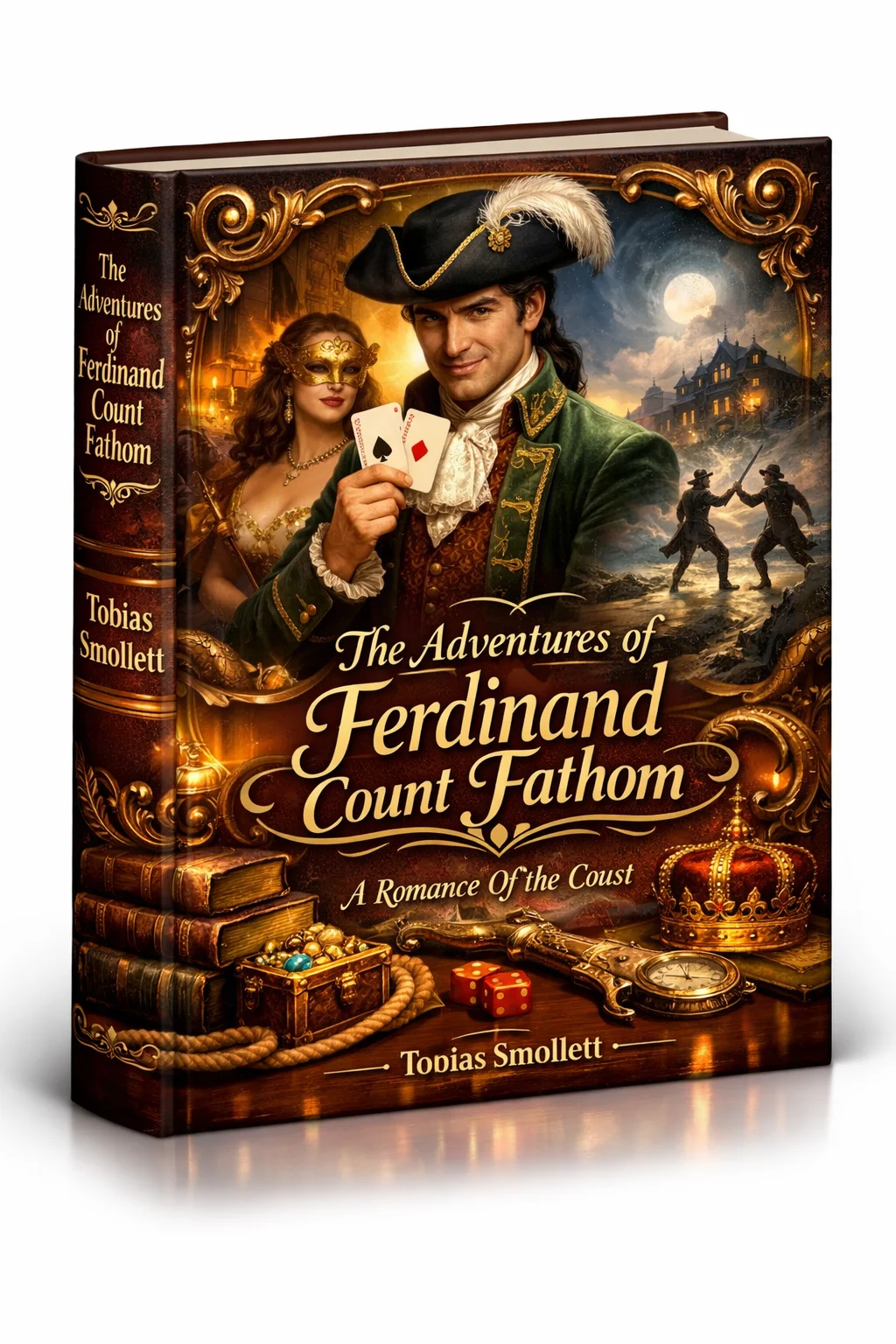
Tobias Smollett’s The Adventures of Ferdinand Count Fathom (1753) follows the exploits of its titular antihero, a man of obscure birth who rises through society on a tide of deception, seduction, and outright villainy.
🎭
Ferdinand Count Fathom
A cunning rogue navigates 18th-century Europe with wit, charm, and utter moral depravity in Smollett's darkest satire.
| Author | Tobias Smollett |
| Published | 1753 |
| Genre | Picaresque, satire, Gothic novel |
| Chapters | 71 |
| Setting | England, France, and the European continent |
| Protagonist | Ferdinand Count Fathom |
🎭 The Story
Born to a camp-following mother in the midst of a military campaign, Fathom is gifted with extraordinary charm, intelligence, and physical grace — all of which he deploys in the service of his boundless ambition. From the drawing rooms of London to the gambling dens of Paris, from the beds of trusting heiresses to the cells of foreign debtors’ prisons, Fathom leaves a trail of ruined lives behind him.
Yet Smollett, writing with the savage wit that made him one of the great novelists of the eighteenth century, never lets us forget that his hero’s crimes are a mirror held up to the corrupt society that enables them. Widely regarded as a precursor to the Gothic novel, Ferdinand Count Fathom contains scenes of genuine terror and suspense that anticipate the work of Ann Radcliffe and Matthew Lewis. It remains Smollett’s most controversial and morally complex work — a “rogue’s gallery” portrait painted with unforgettable vividness.
Fathom’s origins are exactly as obscure as his manners are polished. Orphaned almost at once after his birth in the chaos of that military campaign, he is raised on the charity of others and reveals early the talents that will carry him through polite society: a handsome face, a ready tongue, quick wits, and a complete indifference to anyone else’s welfare. Education and the patronage of the credulous launch him into the fashionable world, where he graduates by degrees from petty swindles to schemes of real viciousness.
Where Smollett’s earlier heroes Roderick Random and Peregrine Pickle had been rogues with recoverable hearts, Fathom is a study in something colder. Smollett’s preface makes the design explicit: to display the operations of knavery so that honest readers might detect it in the world. The novel accordingly parades a line of victims — gamblers, heiresses, fortune-hunters, respectable clergymen — and the satire cuts two ways, because most of Fathom’s marks lose their money through their own greed or vanity.
The book’s strangest and most influential stretch is its Gothic core. Midway through his European wanderings Fathom is plunged into a nightmare sequence — the flight through the forest of M. de la Mark, the remote castle, the breathless presence of what appears to be the supernatural — scenes of stage-managed dread that directly anticipate Ann Radcliffe and Matthew Lewis. The sudden gear-shift from comic satire to genuine terror is why scholars keep returning to Fathom as the hinge between the picaresque and the Gothic.
📖 About This Edition
This edition presents the complete 1753 text in one volume, carefully formatted for modern e-readers.
Zero Distractions
No ads, no license pages — just the complete text across all 71 chapters, clean and uninterrupted.
Smart Typography
Curly quotes, em-dashes, proper ellipsis — typeset with care for a premium reading experience.
Chapter Navigation
Full table of contents with navigation to each of the 71 chapters.
Cleaned & Polished
All Gutenberg boilerplate stripped, consistent formatting throughout the text.
No DRM
You own your copy — read on any device, anytime, forever.
Instant Download
EPUB format included, delivered instantly after purchase.
🏛️ Historical & Cultural Context
Fathom appeared in 1753, in the first great flowering of the English novel. Mid-eighteenth-century London was a city of abrupt upward mobility and spectacular fraud — fortunes were made and lost on credit, cargo, gambling, and marriage — and the novelists of the 1740s and 1750s were busy anatomizing that society, each with his own instrument. Smollett brought a Scottish surgeon’s unromantic eye to the table; he had served as a naval surgeon’s mate and seen at close range how the world actually collected its debts, fought its duels, and paid for its pleasures.
The book grows directly out of the picaresque tradition. From the sixteenth-century Spanish Lazarillo de Tormes to Lesage’s Gil Blas — a novel Smollett himself translated — the genre sent an unprincipled wanderer through a chain of episodes, holding a mirror up to the venality of the world. Fathom differs in one crucial respect: Smollett takes the genre’s opportunist and makes him genuinely monstrous, a portrait of villainy drawn without applause, and then pushes the tone beyond comedy into the genuinely frightening.
Fathom also marks a stage in Smollett’s own career. It was his third novel, written after Roderick Random and Peregrine Pickle, and its first readers registered the ferocity at once — the book reads like a self-correction of the cheerful roguery his earlier heroes had been allowed. Contemporary taste was struck by the Gothic undertow, and the Gothicists of the century that followed, above all the Ann Radcliffe of The Mysteries of Udolpho, owed a real debt to the atmosphere Fathom helped create.
🔮 Characters, Themes & What to Look For
Fathom himself is the centerpiece — English fiction’s first great portrait of the charming sociopath. The novel’s slyest trick is that he never stops being likable: magnetic, eloquent, resourceful right up to the instant he ruins you. Around him Smollett arranges a choral cast of swindled innocents and deserving dupes, and among them stands the gentle Monimia — the one character who reaches Fathom’s conscience, and therefore the measure of how far he has wandered from virtue.
The themes are the wreckage of a world without honor. Appearance against reality does most of the work: every successful scheme depends on a disguise, a borrowed pedigree, or an invented alliance. Beneath the surface runs a pointed social critique, because Fathom’s victims are rarely innocent — Smollett the physician diagnoses the eighteenth-century money economy as the patient, and his cure, an ending in which the rogue’s luck finally runs out, is his species of poetic justice.
New readers should expect an episodic structure rather than a tightly wound modern novel; the book rewards dipping in and out. Look for the inset tales and digressions, the bursts of physical comedy, the sudden darkness of the terror set-pieces, and the narrator’s Olympian asides — and keep an eye on the moral ledger Smollett keeps in plain sight: every account, in the end, is settled.
✨ Why It Still Matters Today
Two and a half centuries on, Fathom remains startlingly current because the confidence man is a permanent figure of human society, and Smollett’s clinical pleasure in tracing exactly how a con works feels thoroughly modern. The book also matters to anyone tracing the bloodline of the antihero — the seductive scoundrel who compels fascination without ever earning forgiveness. If the glamorous criminals of later fiction have a grandfather in English prose, it is Ferdinand Fathom.
It is also, unexpectedly, a root of the Gothic. Already in 1753 Smollett had worked out how to make prose genuinely frightening — a thread that runs forward to The Monk and the Radcliffe school, and sideways toward the lighter-hearted criminal romances of a figure like Arsène Lupin, who stole Fathom’s charm and left behind his cruelty. If you also enjoy the eighteenth century’s passion-tragedies of love and ruin — a novel like Manon Lescaut — Fathom belongs on the same shelf.
❓ Frequently Asked Questions
Is Ferdinand Count Fathom Smollett's best novel?
That depends on taste. Humphry Clinker is generally considered his masterpiece, but Ferdinand Count Fathom is his most daring and original work — a deeply unsettling portrait of pure villainy that has no easy parallel in eighteenth-century fiction.
What makes this a Gothic novel?
Several scenes — particularly those set in the remote castle and the forest of M. de la Mark — contain the atmospheric terror, suspense, and supernatural suggestion that would define the Gothic genre a decade later. Scholars often cite Fathom as a key precursor to works like The Mysteries of Udolpho.
How long does it take to read?
At 554 pages across 71 chapters, most readers finish in 12-18 hours. The episodic structure makes it easy to read in short sessions.
Is Fathom based on a real person?
Yes and no. Smollett drew on the stories of several notorious criminals and confidence men of his era, but Fathom is a composite figure — an archetype of the charming sociopath that has influenced literary villains ever since.
Does Fathom ever get what he deserves?
Yes — and the justice is part of the book’s design. Smollett, a moral satirist at heart, corners his rogue in the closing chapters: Fathom is stripped of his gains, lands in prison, and is afterwards reformed, exiting the novel subdued and penitent rather than triumphant. The abruptness of the turn is itself a Smollett trademark.
Where should a new reader start with Smollett?
Most people begin with Humphry Clinker — warm, funny, and generally considered his masterpiece — or with Roderick Random. Ferdinand Count Fathom is best saved for readers who have tasted the picaresque and want Smollett’s darkest, most experimental side. It is fully self-contained; you do not need the earlier novels first.
Is much of the novel set outside England?
Yes. Fathom moves through France, Germany, and the European continent generally, and Smollett uses the travel — inns, frontiers, consulates, foreign courts — to keep the hero one step ahead of his creditors and his victims. The restless, episodic structure of the picaresque is part of the point.
📚 Related Articles
🎭 Read the Picaresque Satire
Tobias Smollett’s Ferdinand Count Fathom is his most daring and morally complex work — a rogue’s gallery painted with unforgettable vividness. The DodaBooks edition presents the complete 1753 text:
- ✅ Complete 71-chapter text — the full novel
- ✒️ Smart typography — curly quotes, em-dashes, proper ellipsis
- 📜 Full table of contents with chapter navigation
- 🔒 DRM-free — read on any device, anytime
- 📥 Instant download — EPUB format