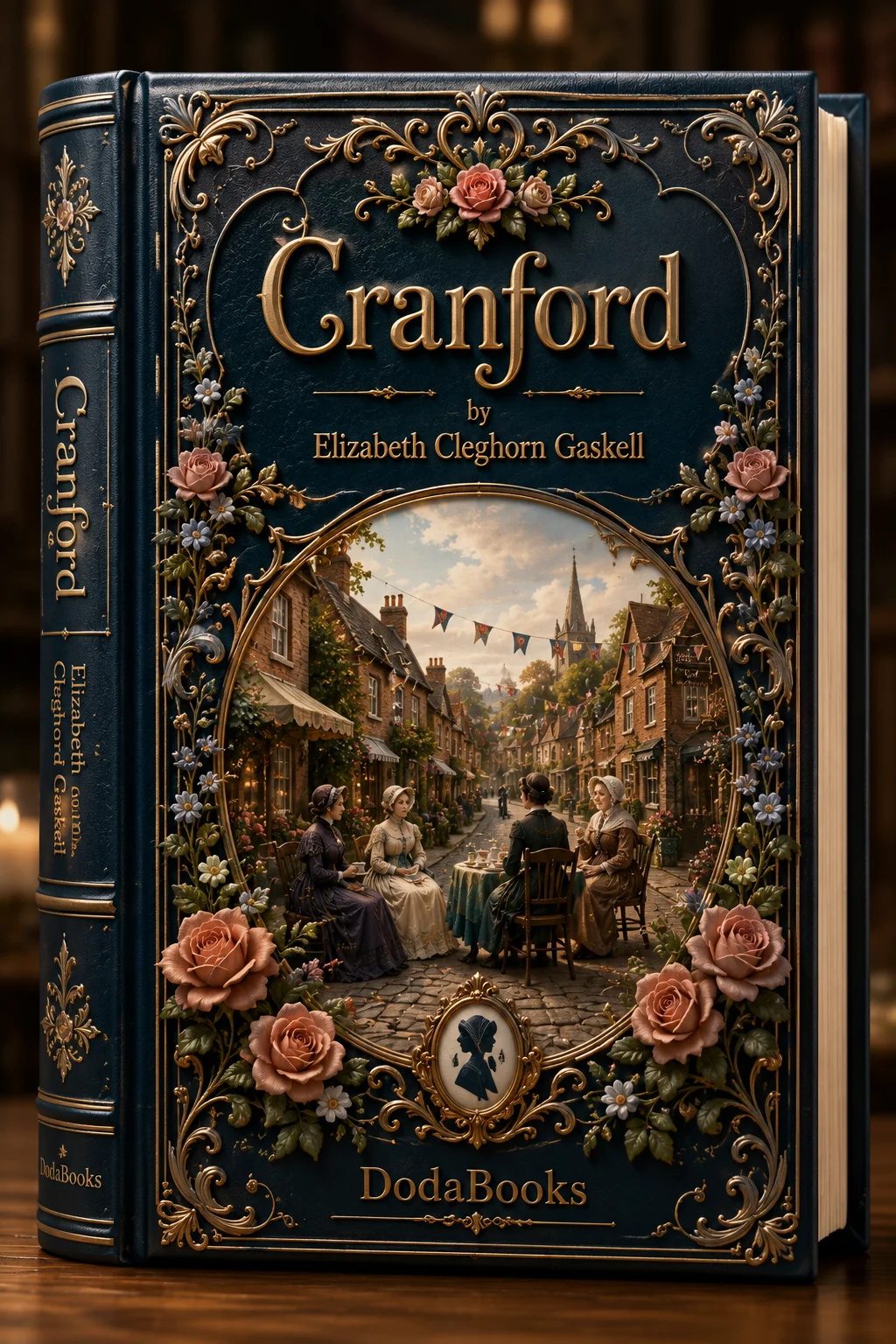
Elizabeth Gaskell’s Cranford (1853) is a series of interconnected sketches of life in a small English country town dominated by its female residents — women of “gentle” upbringing navigating the narrow straits of genteel poverty with dignity, humor, and an unshakable commitment to propriety.
🏡
Cranford
Gaskell's affectionate chronicle of the widows and spinsters of Cranford — a village where tea parties, gossip, and quiet courage rule the day.
| Author | Elizabeth Cleghorn Gaskell |
| Published | 1853 |
| Genre | Classic fiction, Victorian novel |
| Chapters | 16 |
| Setting | Cranford, an English country town |
| Narrator | Mary Smith |
🏡 The Story
Cranford is not a novel in the conventional sense — it has no single driving plot, no mounting crisis resolved in a final chapter. Instead, it unfolds as a series of linked sketches, narrated by the gentle, observant Mary Smith, who visits the little town of Cranford and reports on the lives of its dominant female residents. In Cranford, the “Amazonian” society of widows and unmarried women rules, and the presence of a man is treated almost as a breach of decorum. “If a married couple come to settle in the town,” Mary notes, “somehow the gentleman disappears.”
The central figure of this world is Miss Matty Jenkyns, the kind, timid, and generous-hearted younger daughter of the late rector. Alongside her formidable older sister Miss Deborah, and her circle of friends — the gossipy Miss Pole, the aristocratic Lady Glenmire, and the dutiful Miss Jessie Brown — Matty navigates the small crises of village life: the arrival of new neighbors, a disputed bank note, the arrival of the railway, and the constant, careful management of “elegant economy.” This is the heart of the book’s gentle comedy: a group of proud women, reduced by circumstance to genteel poverty, who keep up appearances through a hundred tiny stratagems — saving a pound of candles by skimping on sugar, and treating every indulgence as a crisis to be met with quiet ingenuity.
Beneath the surface, however, Cranford is a book about real suffering and real courage. Miss Matty’s kindness is tested over and over again: by the death of loved ones, by the financial ruin that follows the failure of a bank, by the emotional blow of a lost love from her youth. Gaskell’s genius is that she never lets the comedy harden into satire. Her affection for her characters is genuine, and the reader comes to care deeply about these women and their small, dignified struggles to hold their world together.
By the end, Cranford has traced a quiet arc of friendship, loyalty, and resilience. The community closes ranks around Miss Matty when her fortunes collapse, proving that the bonds of village life are the book’s real subject — and its real treasure. It is one of the warmest, wittiest portraits of English village life ever written, and it rewards rereading precisely because so much of its charm lives in the details and the tone.
🏛️ Historical & Cultural Context
Cranford was written during the high noon of the Victorian era and published in 1853, having first appeared as a series of sketches in Charles Dickens’s magazine Household Words. The 1850s were a turning point in British history: the railways were knitting the country together, industrial towns were booming, and the old agricultural England that Cranford represents was slowly being left behind. Part of the book’s melancholy and its charm is that it captures a way of life that was already fading — a world of small market towns, landed gentry, and provincial propriety.
Gaskell based Cranford on the Cheshire town of Knutsford, where she was raised after her mother’s death. She drew her characters and incidents from the people she had known there as a girl, giving the book an affectionate authenticity that no amount of research could manufacture. This is why the social world of Cranford feels so specific and so true: Gaskell was not inventing a quaint village, but lovingly reconstructing the community that shaped her.
The book also participates in a distinctly female literary tradition. Unlike the grand social canvases of male contemporaries, Cranford is deliberately small and domestic, and it takes the lives of unmarried and widowed women seriously at a time when such lives were often dismissed. Gaskell treats her spinsters with humor but also with profound respect, insisting that their concerns — friendship, kindness, memory, and dignity — are matters of genuine importance. In this sense, Cranford is quietly radical: a celebration of a world of women, narrated by a woman, at the very center of the Victorian canon.
🎭 Characters, Themes & What to Look For
Miss Matty Jenkyns is the soul of the book — tender-hearted, anxious, affectionate, and sustained by a deep well of quiet strength that emerges only when she is tested. Her friendship with Mary Smith, the narrator, is the emotional anchor of the story. Watch how Matty combines a childlike vulnerability with a real capacity for generosity and courage, and how Gaskell gradually reveals the depth beneath her gentle exterior.
Miss Deborah Jenkyns, Matty’s sister (who is alive for the early chapters), is the voice of Cranford’s fierce commitment to propriety — a stickler for etiquette, literature, and the old ways. Around them swirls a memorable cast: the gossipy Miss Pole, the aristocratic Lady Glenmire, whose decision to marry a doctor scandalizes the town, and the spirited Miss Jessie Brown. Each character embodies some facet of village society, and Gaskell uses their interactions to say more about human nature than many longer novels manage.
The central themes are friendship, the dignity of poverty, the value of kindness, and the quiet heroism of ordinary women. Gaskell is especially interested in how communities care for their own — how the informal networks of friendship and neighborliness can provide support that no institution can match. As you read, look for the small, telling details through which Gaskell reveals character: what people save for, what they splurge on, how they treat a visitor, and how they respond when a friend is in trouble.
💡 Why It Still Matters Today
Cranford endures because it is genuinely, quietly moving in a way very few “gentle” books achieve. Its humor is warm rather than cruel, its sadness is real but never bleak, and its celebration of friendship and resilience speaks as strongly now as it did in 1853. In an age of grand gestures and loud opinions, the book’s quiet insistence that kindness and loyalty are the real substance of a good life feels almost radical.
Its portrayal of women supporting one another also resonates powerfully today, as do its reflections on how communities respond to change — the arrival of the railway, the shifting of fortunes. Readers who love the neighboring women-authored classics of the era will find Cranford fits naturally alongside Jane Austen’s Sense and Sensibility, with its careful attention to the lives and choices of women, and Pride and Prejudice, the great English novel of village society and marriage. For the wider world of nineteenth-century provincial life, George Eliot’s Middlemarch offers a grander canvas of the same small-town world.
🎀 How the Annotated Edition Helps
Because Cranford is a collection of interconnected episodes rather than a single plot, the DodaBooks edition’s clear chapter navigation across all 16 chapters is especially valuable — you can easily return to a favorite sketch, revisit a particular incident, or jump between storylines. The careful typography keeps the era’s prose readable, and the clean, distraction-free layout lets Gaskell’s warm voice come through without interruption. Whether you are new to Cranford or returning to it, the edition is designed for the kind of relaxed, sentence-by-sentence savoring this book rewards.
📖 About This Edition
This edition presents the complete 1853 text, carefully formatted for modern e-readers.
Zero Distractions
No ads, no license pages — just the complete text, clean and uninterrupted.
Smart Typography
Curly quotes, em-dashes, proper ellipsis — typeset with care for a premium reading experience.
Chapter Navigation
Full table of contents with navigation to each of the 16 chapters.
Cleaned & Polished
All Gutenberg boilerplate stripped, consistent formatting throughout the text.
No DRM
You own your copy — read on any device, anytime, forever.
Instant Download
EPUB format included, delivered instantly after purchase.
❓ Frequently Asked Questions
Is Cranford a novel or a short story collection?
It was originally published as a series of sketches in Household Words magazine and later collected into a book. While it reads as a novel, each chapter is a self-contained episode.
Was Cranford based on a real place?
Yes. Gaskell based Cranford on the Cheshire town of Knutsford, where she grew up. Many of the characters and incidents were inspired by people and stories from her childhood.
How long does it take to read?
At 253 pages across 16 chapters, most readers finish in 5-8 hours. Gaskell’s warm, witty prose makes for an easy and delightful read.
Are there TV adaptations?
Yes. The BBC produced a beloved adaptation in 2007 starring Judi Dench as Miss Matty and Eileen Atkins as Miss Deborah. It introduced a new generation to Gaskell’s charming world.
Who is the main character of Cranford?
The emotional center of the book is Miss Matty Jenkyns, the gentle and kind-hearted younger sister of the late rector. Her friendship with the narrator, Mary Smith, anchors the story, and it is around Matty’s life, her setbacks, and her friendships that the sketches cohere.
Is there any romance in Cranford?
Yes, but it is quieter than in a conventional romance. There is Captain Brown and Miss Jessie, the scandalous marriage of Lady Glenmire to a doctor, and a tender, poignant thread concerning Miss Matty’s own youthful lost love. Romance in Cranford is subtle and bittersweet rather than dramatic.
Does Cranford have a happy ending?
It ends warmly and hopefully rather than with a dramatic climax. Miss Matty’s fortunes are restored in a modest way, her circle of friends rallies around her, and the book closes on a note of quiet contentment and loyalty that is deeply satisfying even without a conventional marriage or triumph.
Why is it called "elegant economy"?
This is the phrase Gaskell uses for the careful, genteel thrift practiced by Cranford’s ladies, who have fallen on harder times but refuse to appear so. It captures their dignified skimping — saving candles, turning dresses, and forgoing small luxuries — while maintaining every appearance of propriety. It is both a gentle joke and a mark of their resilience.
📚 Related Articles
🏡 Read the Victorian Village Classic
Elizabeth Gaskell’s Cranford is one of the warmest, wittiest portraits of English village life ever written. The DodaBooks edition presents the complete 1853 text:
- ✅ Complete 16-chapter text — the full novel
- ✒️ Smart typography — curly quotes, em-dashes, proper ellipsis
- 📜 Full table of contents with chapter navigation
- 🔒 DRM-free — read on any device, anytime
- 📥 Instant download — EPUB format