Benjamin Franklin’s Autobiography is one of the most celebrated and widely read life stories ever written. Begun in 1771 during a visit to England and completed in fragments over two decades, it remains the finest account of the self-made man in American literature.
🖋️
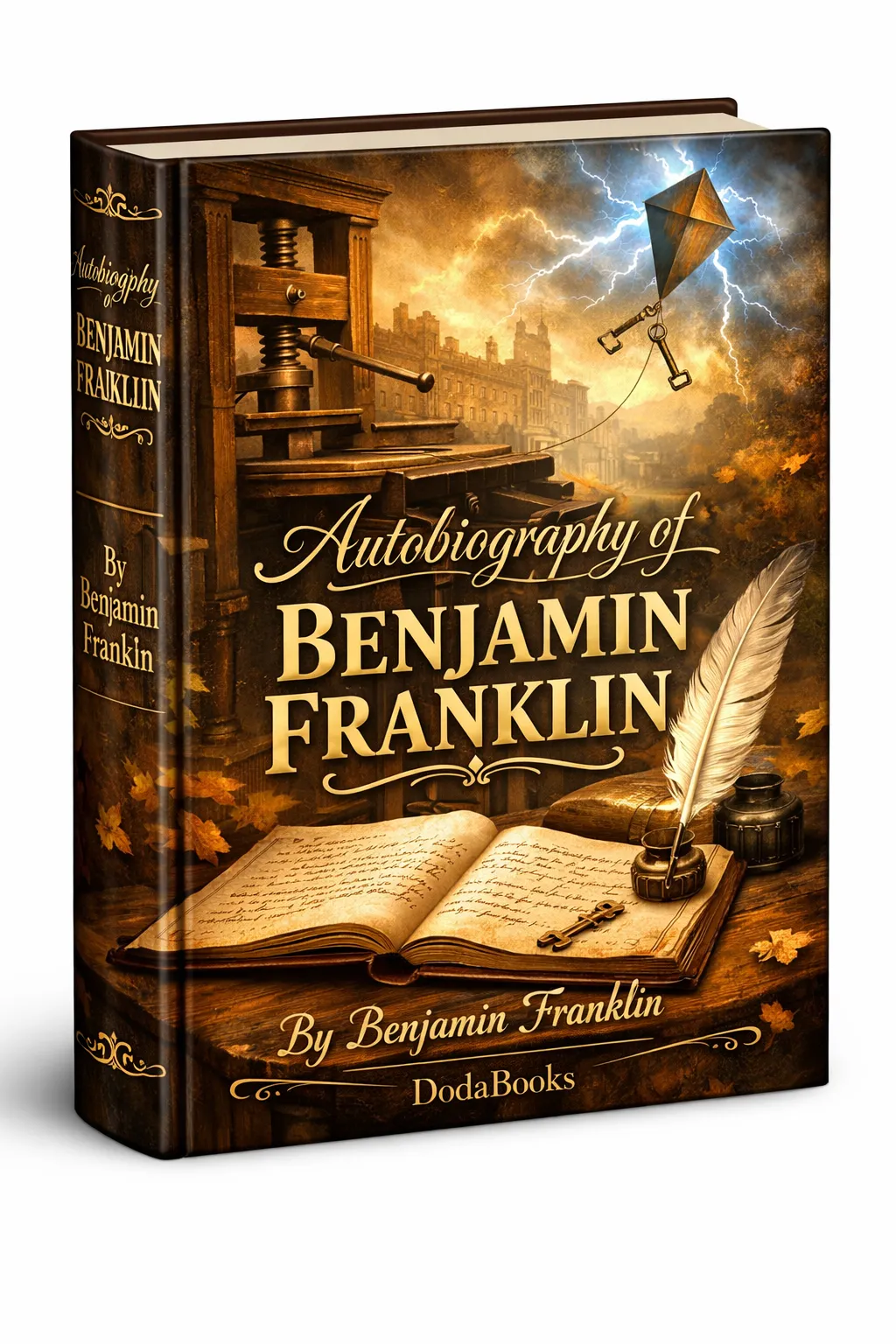
Autobiography of Benjamin Franklin
The remarkable life story of one of America's greatest founding fathers, told in his own timeless words.
| Author | Benjamin Franklin |
| Published | 1771–1790 (written) |
| Genre | History, biography |
| Chapters | 19 |
| Setting | Colonial America, England, France |
| Legacy | One of the most celebrated autobiographies ever written |
🖋️ The Story
Franklin begins with his humble origins in Boston, the son of a tallow-chandler, and traces his extraordinary rise through industry, curiosity, and an unshakeable belief in self-improvement. He recounts his apprenticeship as a printer, his daring escape to Philadelphia, his establishment of the Pennsylvania Gazette and Poor Richard’s Almanac, and his experiments with electricity that brought him international fame.
Beyond the personal story, the Autobiography offers Franklin’s reflections on morality, politics, and the art of living well. His famous plan for attaining moral perfection, his thirteen virtues, and his practical maxims have inspired readers for generations. The narrative follows his growing involvement in public affairs: the Albany Plan of Union, his defense of the Pennsylvania frontier, his diplomatic missions to England, and the scientific pursuits that made him a Fellow of the Royal Society.
The opening pages give the American myth its sacred text. Boston, 1706: youngest son in a family of seventeen, apprenticed to his brother James’s printing shop. When the brothers fall out — over a series of witty letters to James’s newspaper signed “Silence Dogood” — the seventeen-year-old runs away to Philadelphia in 1723, arriving with almost nothing and famously buying three great puffy rolls on the street. No single image has done more to define the self-made man.
What follows is less a memoir than a deliberate curriculum. In calm accounting prose Franklin narrates the founding of his Junto discussion club, the subscription Library Company, the Pennsylvania Gazette, and Poor Richard’s Almanack, with its harvest of maxims about industry and thrift. Then the tradesman turns civic builder: the fire company, street lamps, the academy that became the University of Pennsylvania, the militia, the hospital. Each enterprise is recorded with the satisfaction of a bookkeeper whose columns balance.
The most famous detour comes in Part Two, written in Paris in 1784: the “bold and arduous Project of arriving at moral Perfection,” the thirteen virtues and their weekly scorecard, the scheme of fixing one virtue at a time in a thirteen-week cycle. Franklin confesses, with characteristic honesty, that Order defeated him all his life and that he grew proud of his humility. It is the ancestor of every modern habit-tracking app — and its self-deprecation is where its charm lives.
The closing parts carry Franklin into science and diplomacy — the experiments with electricity, the lightning rod, the Albany Plan, the post office — and the whole book, addressed to his son William, breaks off abruptly in 1790, mid-sentence, in the last year of his life. It stops precisely where the American Revolution would have begun, and Franklin never lived to tell that part.
📖 About This Edition
Franklin wrote with a clarity and honesty that make the Autobiography as fresh today as when it was first published. It is at once a historical document of the first importance and a deeply personal portrait of a man who shaped the modern world. This edition presents the complete text, including the famous fourth part written during the final year of Franklin’s life, carefully formatted for modern e-readers.
Zero Distractions
No ads, no license pages — just the complete text, clean and uninterrupted.
Smart Typography
Curly quotes, em-dashes, proper ellipsis — typeset with care for a premium reading experience.
Chapter Navigation
Full table of contents with navigation to each of the 19 chapters — easily jump between them.
Cleaned & Polished
All Gutenberg boilerplate stripped, consistent formatting throughout the text.
No DRM
You own your copy — read on any device, anytime, forever.
Instant Download
EPUB format included, delivered instantly after purchase.
🏛️ Historical & Cultural Context
The Autobiography is the Enlightenment’s great self-portrait, written across three decades and three countries. Franklin began it in 1771 in an English country house, resumed it in Paris in 1784 during his celebrated diplomatic triumph as America’s minister to France, and completed the bulk of it in Philadelphia under the infant republic in 1788 and 1790. Each context left its grain in the prose: the early pages are nostalgic, the Paris pages programmatic, the Philadelphia pages the careful summing-up of a man taking stock of a completed world.
The project itself was bracingly novel for its time. The idea that a life could be improved by plan — by schedule, score-sheets, and civic association — belonged to the culture of Locke and Newton that Franklin absorbed and translated into the language of a working printer. His Junto, clubs, almanacs, electrical investigations, and famous virtues form one continuous instrument of self- and social betterment, and the Autobiography is its operating manual.
The book is as notable for what it conceals as for what it tells. Franklin barely mentions his wife Deborah Read; he confesses his “errata” with a smile that can read as vanity itself; and the man who had done as much as anyone to prepare the ground of American independence leaves the Revolution out of the story entirely. Historians read the memoir as a performance as carefully as they read it as a source. Paired with the document it surrounds by implication — the Declaration analyzed in our teaching guide — it completes a portrait of the temperament behind 1776.
🔮 Characters, Themes & What to Look For
The protagonist is a persona as much as a man: Franklin the narrator, rational, modest, amused, occasionally proud of nothing so much as his humility. In the early chapters he is nearly a rogue — the runaway entering Philadelphia with a roll under each arm, the young printer arriving in London with almost nothing and a head full of schemes. His brother James wears a sharp edge that shows what print culture could exact, and William — the son to whom the book is addressed, later a Loyalist governor estranged from his father — haunts the margins from the very first lines.
Three themes structure the book. Industry and thrift are preached in Poor Richard and then practiced in the memoir’s own showing. Self-improvement is made methodical — the thirteen virtues, the weekly schedule, the error-correcting “errata” — arguably the most influential self-help system ever printed. And usefulness is framed as the social contract: again and again Franklin turns a private gain into a civic improvement, until ambition and community service merge and become indistinguishable.
For new readers, look for three things: the deadpan humor of the narrator (“so convenient a thing it is to be a reasonable creature, since it enables one to find or make a reason for everything one has a mind to do”), the recurring accounting imagery — Franklin the bookkeeper of souls — and, in the margins, the quiet precision of a man who believes that progress can be measured.
✨ Why It Still Matters Today
No text did more to define what the English-speaking world means by a self-made man, and no American book is more often quoted by biographers, executives, and commencement speakers reaching for a model of the good life. But the Autobiography is best read as half of a dialogue. Paired with Frederick Douglass’s Narrative, Franklin becomes the story of what a society that granted a man liberty and literacy could build — and Douglass becomes the story of everything that same society kept locked away behind the presumptions of race. Read together, the two books frame the American argument about freedom, work, and self-creation.
And it belongs, too, to the deep history of autobiography as a form — the same radical self-examination practiced in the Confessions of St. Augustine and continued, in our own century, in every memoir worth the shelf space. For casual readers the Autobiography offers simple, durable pleasures: clarity, humor, contradiction, and the shock of recognition across three centuries.
❓ Frequently Asked Questions
Is this the complete autobiography?
Yes. The book covers all four parts of Franklin’s autobiography, from his birth in 1706 through his diplomatic missions in the 1760s. The final part was written in the last year of his life and ends mid-sentence — a poignant reminder of the story left untold.
What are Franklin's thirteen virtues?
Temperance, Silence, Order, Resolution, Frugality, Industry, Sincerity, Justice, Moderation, Cleanliness, Tranquility, Chastity, and Humility. Franklin’s method for cultivating them — focusing on one per week in a 13-week cycle — is one of the first self-improvement systems in Western literature.
How long does it take to read?
At 264 pages across 19 chapters, most readers finish in 6-9 hours. Franklin’s clear, direct prose makes it a surprisingly fast read for an 18th-century work.
What makes this different from other editions?
This edition strips away all Gutenberg boilerplate and presents Franklin’s text in a clean, distraction-free format with smart typography and chapter navigation. You get the complete text without the usual public domain clutter.
How much of Franklin's life does the book actually cover?
The four parts written between 1771 and 1790 carry the story from his birth in 1706 through the late 1750s and into the early 1760s. The Revolution, the Declaration, and the French mission all came later, and the manuscript breaks off before Franklin ever reached them.
Was Franklin really as virtuous as he claims?
No — and he never quite claims to be. The charm of the book is that he admits his own failures, including Order, the virtue that defeated him all his life, and the humility he says he only grew proud of. Treat it as a self-portrait with certain blemishes gently rearranged — exactly how Franklin the inventor understood the process.
Is the "self-made man" story really true?
With important qualifications. Franklin rose on genuine talent and industry, but he had help — family connections in the printing trade, patrons, and the largely uncredited labor of his wife. The myth he helped create is real, but so is the fine print, which is why the book rewards skeptical reading.
📚 Related Articles
For the greatest biographical portrait of Enlightenment wit and intellectual conversation, read our Boswell’s Life of Samuel Johnson Guide.
🖋️ Read the American Classic
Benjamin Franklin’s Autobiography is the finest account of the self-made man in American literature. The DodaBooks edition presents the complete text, including the famous fourth part:
- ✅ Complete 19-chapter text — all four parts of Franklin’s autobiography
- ✒️ Smart typography — curly quotes, em-dashes, proper ellipsis
- 📜 Full table of contents with chapter navigation
- 🔒 DRM-free — read on any device, anytime
- 📥 Instant download — EPUB format
To study the ultimate psychology of speculation, risk, and Wall Street tape reading, read our companion to Reminiscences of a Stock Operator Guide.